Clear Sky Science · en
Enhancement of fiber content and cannabinoids of hemp using arbuscular mycorrhizal fungi and endophytic fungi
Why soil helpers matter for a familiar plant
Hemp is best known for its strong, versatile fibers and for the plant chemicals that make cannabis famous. This study explores how tiny partners living in the soil and inside hemp roots can boost both fiber quality and useful cannabinoids, while reducing the need for synthetic fertilizer. For farmers, industry, and environmentally minded readers, it points toward cleaner ways to grow a high-demand crop for textiles, building materials, and other products.
Hemp as a useful and demanding crop
Hemp, a close relative of marijuana, produces tall stems packed with long, tough fibers. These fibers are used in textiles, paper, construction materials, and bio-based plastics. Hemp also makes cannabinoids such as cannabidiol (CBD) and tetrahydrocannabinol (THC), although industrial hemp varieties usually contain much less of these than marijuana. Like many crops, hemp production often relies on synthetic fertilizers to reach high yields, but heavy use of these inputs can damage soil life and water quality over time. The authors therefore looked for biological helpers that could sustain strong growth and fiber quality with fewer chemical inputs.
Friendly fungi above and below ground
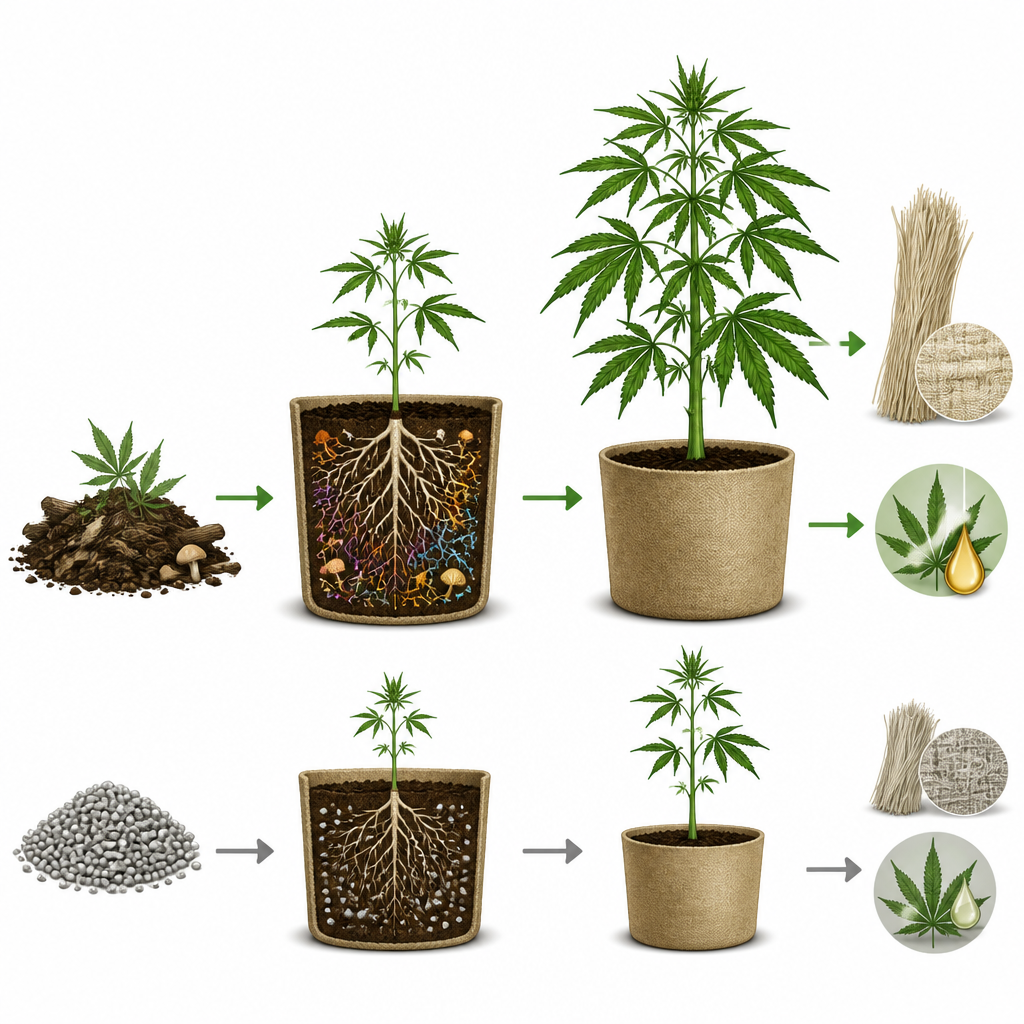
The team focused on two groups of fungi that naturally partner with plants. Arbuscular mycorrhizal fungi live around and inside roots, extending thin filaments through the soil that help plants capture nutrients such as phosphorus, nitrogen, and potassium. Endophytic fungi live quietly within plant tissues without causing visible disease, and some strains can make plant hormones, release nutrients from soil minerals, and improve stress tolerance. The researchers selected two mycorrhizal species and two endophytic species isolated from hemp and other hosts, first confirming that the endophytes did not cause disease symptoms on hemp leaves.
Putting soil partners to the test
In a greenhouse pot experiment lasting 90 days, hemp cuttings of a fiber-focused variety (RPF3) were grown under six conditions. Plants either received no added microbes and no fertilizer, synthetic fertilizer alone, or inoculation with one of the four fungi without synthetic fertilizer. The scientists measured plant height, leaf area, stem and bast-fiber dry weight, root traits, and leaf nutrient levels. They also analyzed fiber composition, focusing on cellulose and related components that determine strength, and used chemical analysis to measure CBD and THC in leaves and shoots. Root samples were checked under the microscope to confirm that the fungi had colonized the plants.
Growth, fiber, and cannabinoids on biological support
Plants treated with any of the beneficial fungi grew better than unfertilized controls, showing taller stems, larger leaves, and more biomass. Synthetic fertilizer still gave the largest overall plants, but one endophytic fungus, Macrophomina phaseolina, nearly matched that performance without chemical inputs. Root systems were generally similar across treatments, although one mycorrhizal species increased root length and surface area. Importantly for industry, plants with fungal partners had fiber contents equal to or higher than fertilized plants, with one mycorrhizal species, Rhizophagus aggregatus, giving the highest levels of cellulose-rich fractions linked to strong, high-quality fibers.
Natural partners and plant chemistry
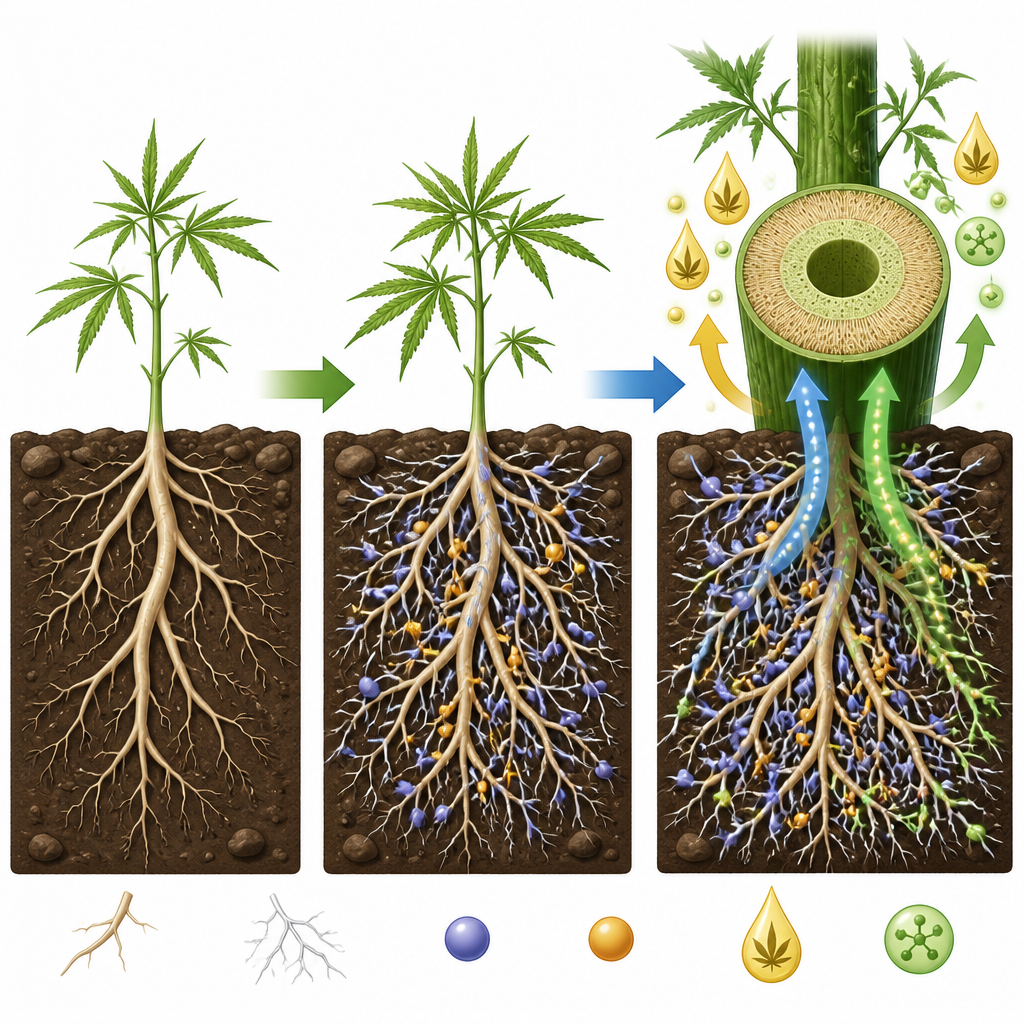
The fungal partners also influenced hemp chemistry. All plants produced both CBD and THC at low levels typical for fiber hemp, but inoculated plants had higher concentrations than unfertilized controls. In particular, R. aggregatus and the endophyte Lasiodiplodia theobromae led to the strongest increases in CBD and THC per gram of plant material. Because fertilizer made plants much larger, fertilized controls still had the greatest total cannabinoid amounts per plant, even though their concentrations were only moderate. The authors suggest that better nutrition and subtle activation of plant defense pathways by the fungi may drive these changes in plant chemistry.
What this means for future hemp fields
For non-specialists, the key message is that carefully chosen soil and endophytic fungi can help hemp grow well, build stronger fibers, and adjust its cannabinoid levels, even in the absence of synthetic fertilizer. These biological partners did not harm hemp under the test conditions and in some cases rivaled fertilizer in boosting growth. While more field work is needed to confirm safety and performance outside the greenhouse, the results point toward more sustainable hemp cultivation that relies on living helpers in the soil rather than only on chemical inputs.
Citation: Seemakram, W., Paluka, J., Khota, W. et al. Enhancement of fiber content and cannabinoids of hemp using arbuscular mycorrhizal fungi and endophytic fungi. Sci Rep 16, 15829 (2026). https://doi.org/10.1038/s41598-026-46869-0
Keywords: hemp cultivation, beneficial fungi, mycorrhiza, fiber quality, cannabinoids