Clear Sky Science · en
A hybrid analytical–optimization framework for sidelobe suppression and beamwidth control in linear antenna arrays
Sharper Signals for a Crowded Airwaves
From 5G networks and weather radar to medical scanners that peer inside the body, many modern systems rely on antenna arrays to send and receive focused beams of radio waves. The sharper these beams are, and the less stray energy they throw off to the sides, the better these systems can see, communicate, and resist interference. This paper introduces a new way to design such arrays that produces very clean, narrow beams while keeping the required computations and hardware demands manageable.
Why Antennas Need “Good Neighbors”
An antenna array is simply a set of many small antennas lined up and driven together so they act like one larger, more precise instrument. Ideally, you want a strong central beam pointing at your target and very weak “sidelobes” off to the sides, which otherwise can pick up or cause interference. The catch is that pushing sidelobes down usually makes the main beam fatter, hurting resolution. Classic design tricks adjust how strongly each element is driven, using patterns called windows or tapers, to juggle this trade-off. But these approaches often demand awkward, highly uneven drive levels and still rely heavily on trial-and-error numerical optimization.
Borrowing a Trick from Digital Communications
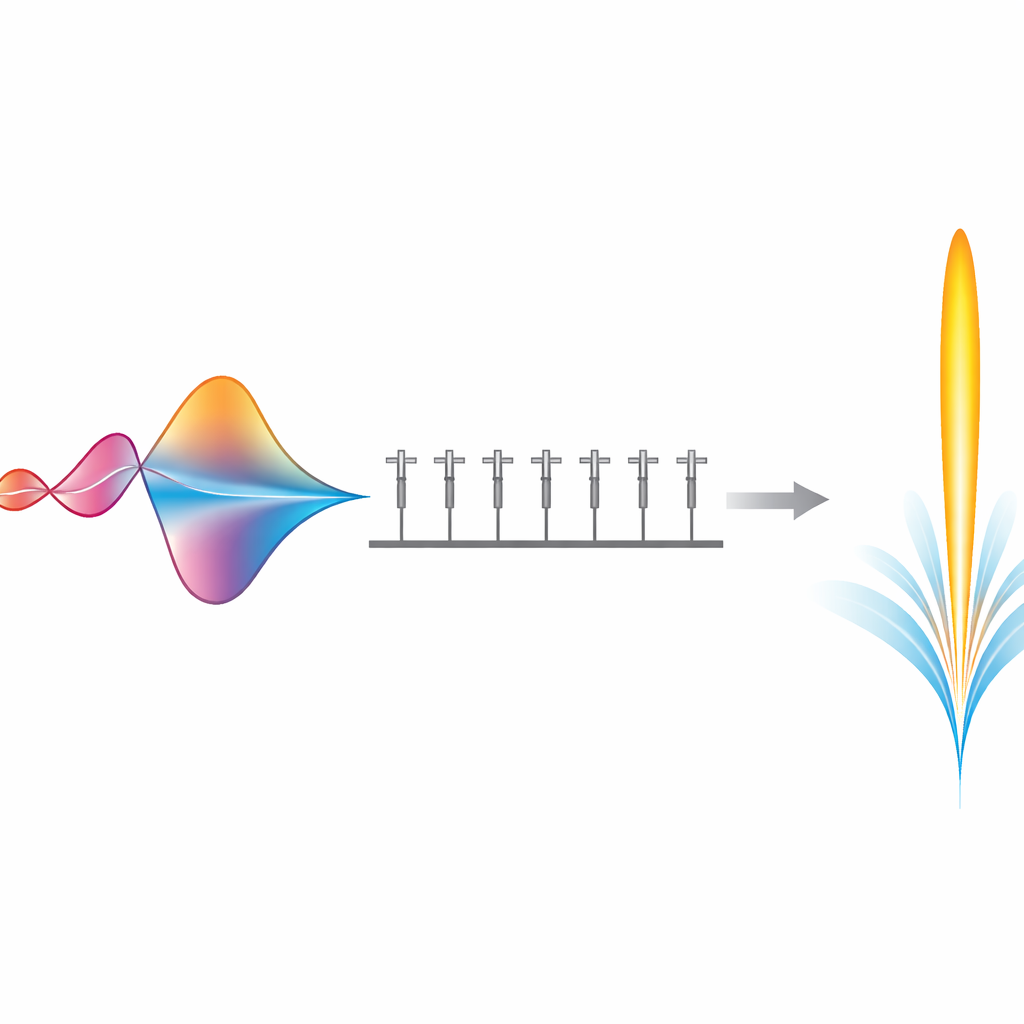
The authors borrow a shaping curve widely used in digital communication, known as a raised cosine pulse, and reinterpret it in space rather than time. In communication systems, this gently rounded pulse keeps signals from smearing into one another while staying spectrally efficient. Here, the same mathematical shape is mapped onto the angles around a linear antenna array. Instead of simply multiplying a standard array pattern by a window, the raised cosine curve is treated as the desired beam shape itself. The authors derive a precise link between the pulse’s time variable and the array’s viewing angle, then set up a matrix equation whose solution gives the exact drive levels each antenna element should have to mimic that ideal shape.
Let Evolution Fine-Tune the Geometry
Once the target beam pattern is fixed analytically, the problem shifts from “guessing everything” to asking only how far apart the elements should be. This spacing strongly affects sidelobes but is notoriously hard to optimize. The authors use a genetic algorithm—a search strategy inspired by evolution—to explore different spacing patterns while their closed-form equations instantly update the element drive levels for each candidate. A cost function rewards layouts that suppress sidelobes, keep the main beam narrow, and respect practical spacing limits, while automatically penalizing numerically unstable solutions. This split between exact math for the amplitudes and evolutionary search for the positions slashes the size and difficulty of the optimization task.
Cleaner Beams with Practical Hardware
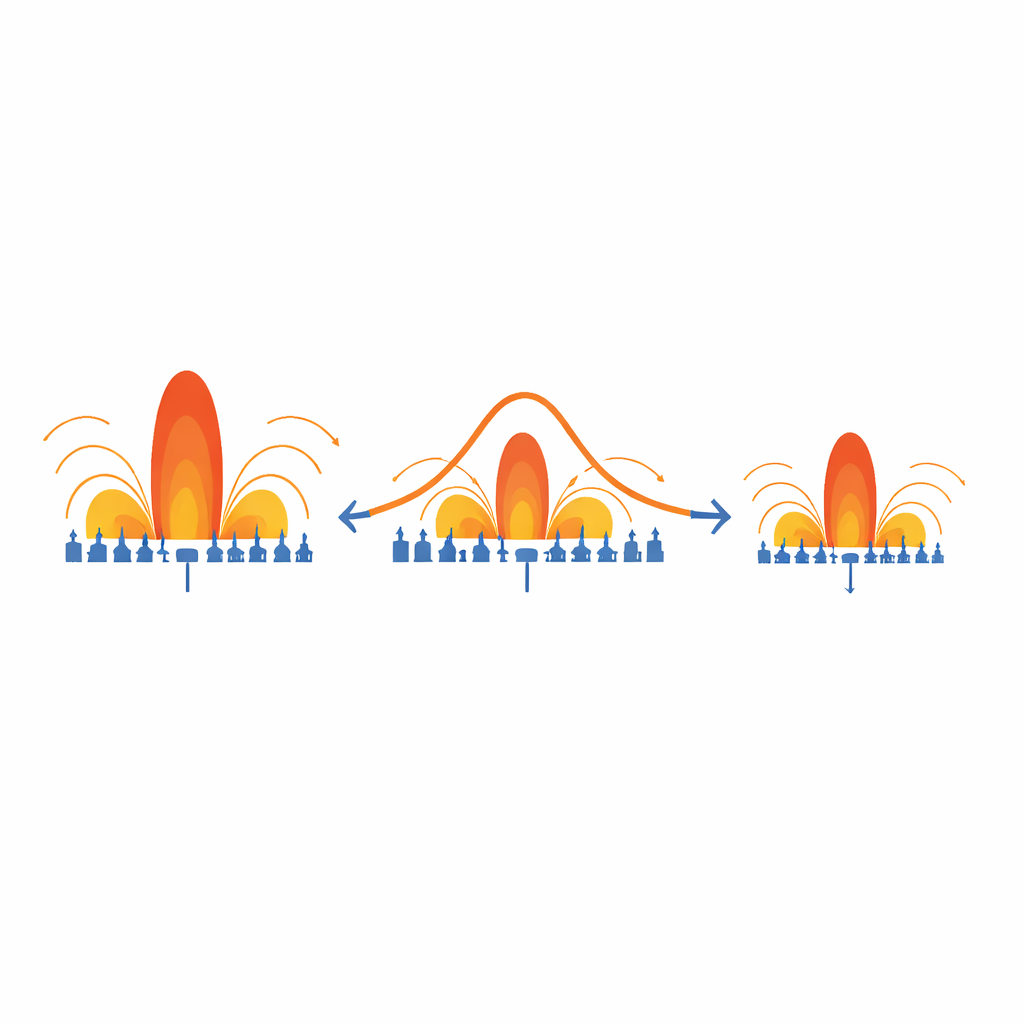
Simulations of a 15-element array showcase the payoff. Compared with a standard uniformly driven array, the new method cuts sidelobes to roughly one-third their original strength while trimming the main beam’s width by more than half. For one key setting of the roll-off parameter (which tunes the raised cosine’s “roundness”), the sidelobes drop to about –38 dB with a beam width a little over 5.5 degrees, outperforming popular Chebyshev, Taylor, and Kaiser designs of similar size. By varying this roll-off factor, designers can slide smoothly between deeper sidelobe suppression and sharper beams, depending on whether interference rejection or fine angular resolution matters more. Importantly, the spread between the weakest and strongest element drives stays within realistic limits for modern electronics, and full 3D electromagnetic simulations of dipole-based arrays confirm that the predicted improvements hold up in more detailed models.
From Equations to Real-World Scanners and Sensors
For radar, electronic warfare, and microwave medical imaging, where tiny echoes must be separated from clutter and jamming, this hybrid approach offers a powerful new design knob: an analytically defined beam shape combined with geometry tweaked by evolutionary search. Instead of relying purely on heavy iterative tuning, engineers start from a mathematically exact target and then let optimization refine the spacing. The result is a practical recipe for antenna arrays that deliver cleaner, narrower beams with less computational slog, helping future systems see more clearly and communicate more reliably in an increasingly crowded electromagnetic world.
Citation: Elkhawaga, A.M., Aboualalaa, M. & Abd Elnaby, M.M. A hybrid analytical–optimization framework for sidelobe suppression and beamwidth control in linear antenna arrays. Sci Rep 16, 12223 (2026). https://doi.org/10.1038/s41598-026-46772-8
Keywords: antenna arrays, beamforming, sidelobe suppression, genetic optimization, microwave imaging