Clear Sky Science · en
The role of native defects in organic-inorganic hybrid zinc halide luminescent materials
Why tiny crystal flaws matter for future lighting
White light from compact, efficient sources powers everything from smartphone screens to room lamps. Many researchers hope that a class of materials called hybrid metal halides can deliver bright, tunable light using cheap, less toxic ingredients. This study looks at zinc based hybrids that already glow a pleasant blue white, and asks a key question a product designer would care about: what hidden features inside these crystals make their light weaker than rival materials, and how might we fix that?
Small building blocks with big potential
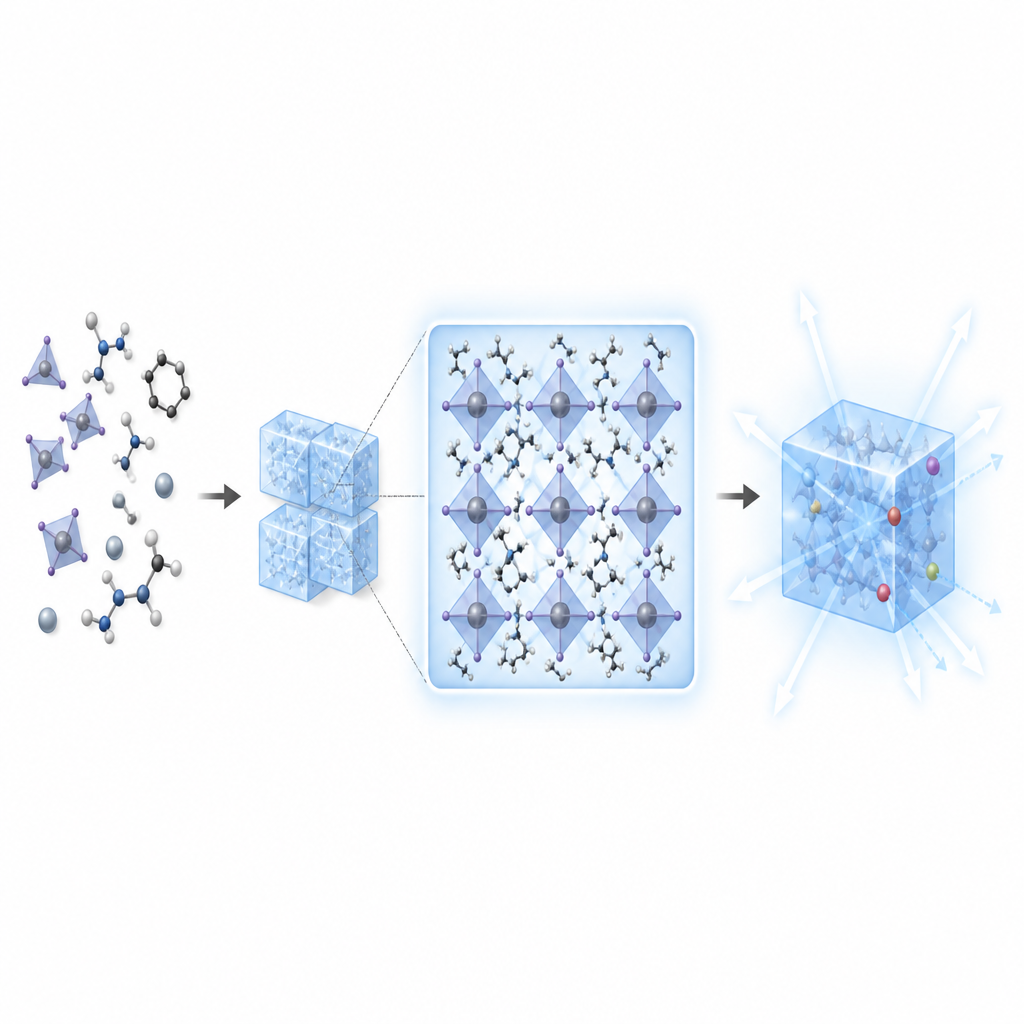
The team worked with three closely related crystals that pair zinc and different halogen elements with an organic molecule derived from phenylethylamine. At the atomic level, each crystal is built from isolated zinc halide tetrahedra surrounded by organic ions, forming what chemists call a zero dimensional structure. Instead of extended three dimensional networks, these small clusters sit apart like islands in an ocean of organic molecules. When the crystals are illuminated with ultraviolet light, they emit broad blue white light, which is attractive for white light emitting diodes that aim to replace rare earth based phosphors.
Measuring how well the crystals shine
To see how efficiently these materials turn light in into light out, the researchers measured their photoluminescence quantum yield, a number that tells how many photons emerge for each photon absorbed. The three zinc compounds managed only modest values, from about 12 percent down to just 2 percent depending on the halogen. The team recorded how the crystals absorbed light, how their glow changed with color of excitation, power, and temperature, and how quickly the light faded after a short pulse. All three showed very broad emission bands and large shifts between absorption and emission, but their light decayed in only a few billionths of a second, much faster than in materials where the glow comes from self trapped excitons. This mismatch hinted that a different mechanism must be responsible.
Hidden defects that both help and hurt
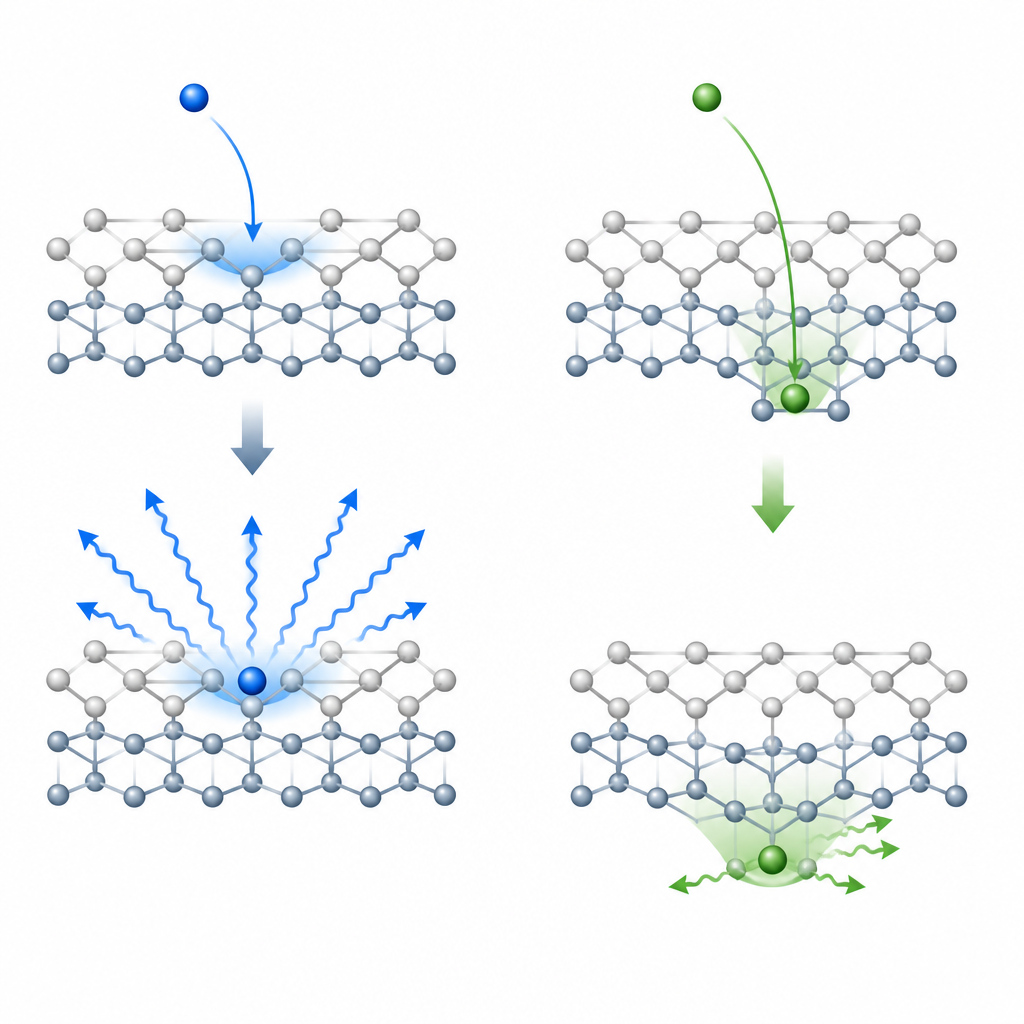
The scientists gathered several lines of evidence pointing to native defects in the crystal lattice as the main light sources. When they increased the amount of halide during a heat treatment designed to heal defects, both the brightness and lifetime of the emission dropped, as would be expected if certain defects act as radiative centers. Electron paramagnetic resonance, a technique that detects unpaired electrons, revealed clear signals typical of zinc related defects. By varying the excitation energy, the team could separate two components of the glow: a blue band that can be triggered even when the incoming light has slightly less energy than the bandgap, and a green band that appears only when the excitation energy exceeds the bandgap. Their analysis supports a picture where blue light comes from electrons falling from shallow zinc interstitial states just below the conduction band, while green light arises from deeper defect levels that require higher energy to populate.
How bonding and structure shape performance
Computational modeling backed up this defect based view. Using density functional theory, the authors calculated that zinc atoms sitting in interstitial positions form donor like defects with relatively low formation energies, making them thermodynamically favored under typical growth conditions. These defect levels sit close to the conduction band and have transition energies that closely match the observed blue emission. The study also examined how hydrogen bonds between the organic cations and the zinc halide clusters influence stability and light output. Stronger hydrogen bonding in the chloride version makes the structure more rigid, raises the temperature at which the material decomposes, and appears to reduce non radiative losses, explaining why this variant glows more efficiently than its bromide and iodide cousins.
What this means for better light sources
For non specialists, the key message is that in these zinc based hybrid crystals the very flaws that enable them to glow also act as leaks that waste energy. Zinc interstitial defects provide pathways for blue and green light emission but at the same time cap the maximum efficiency of the material. Hydrogen bonds and the choice of halogen tune how rigid and stable the crystals are, which in turn affects how many excited states lose their energy as heat rather than light. The work does not yet deliver a perfect, highly efficient phosphor, but it clearly maps out why zinc hybrids lag behind other metal based systems and points to strategies such as tighter control of defect formation and stronger structural bonding to push their performance higher.
Citation: Zhang, Y., Liu, Q., Wang, R. et al. The role of native defects in organic-inorganic hybrid zinc halide luminescent materials. Sci Rep 16, 15529 (2026). https://doi.org/10.1038/s41598-026-46769-3
Keywords: zinc halide, luminescent materials, crystal defects, hybrid perovskites, photoluminescence