Clear Sky Science · en
Compact 2-port linearly and circularly polarized antennas using low cross-polarization miniaturized patch
Smaller antennas for crowded wireless spaces
Smartphones, home routers, and tiny sensors all rely on compact antennas to send and receive data. As devices shrink and connections multiply, engineers need antennas that fit into tight spaces without signals interfering with each other. This study shows how to reshape a common flat antenna so that it works at a lower frequency, takes up less room, and still keeps two nearby signal paths cleanly separated for more reliable wireless links.

Why two antennas matter in one device
Modern wireless gadgets often use two antennas side by side so that each one handles a different polarization of the signal. This trick, called polarization diversity, helps fight signal fading and boosts data rates in multi-antenna (MIMO) systems. The problem is that when these antennas are squeezed close together, part of the power from one leaks into the other, raising interference and reducing the benefit of having two channels. Many existing designs solve this by adding extra structures between or above the antennas, but these additions make the hardware bigger and more complex.
Taming unwanted signal directions
The authors focus on a subtle but important issue called cross polarization. Ideally, an antenna should radiate in just one preferred direction of the electric field. In reality, especially when the antenna is miniaturized, extra fields appear at right angles to the desired direction. In a two-port system where each port is meant to use a different polarization, these stray components act like a shortcut for energy to jump from one port to the other. By carefully analyzing how the electric fields from two perpendicular antennas interact, the study shows that if the unwanted cross-polarized fields are kept very small, the coupling between the ports can also be kept very low even when the antennas are extremely close.
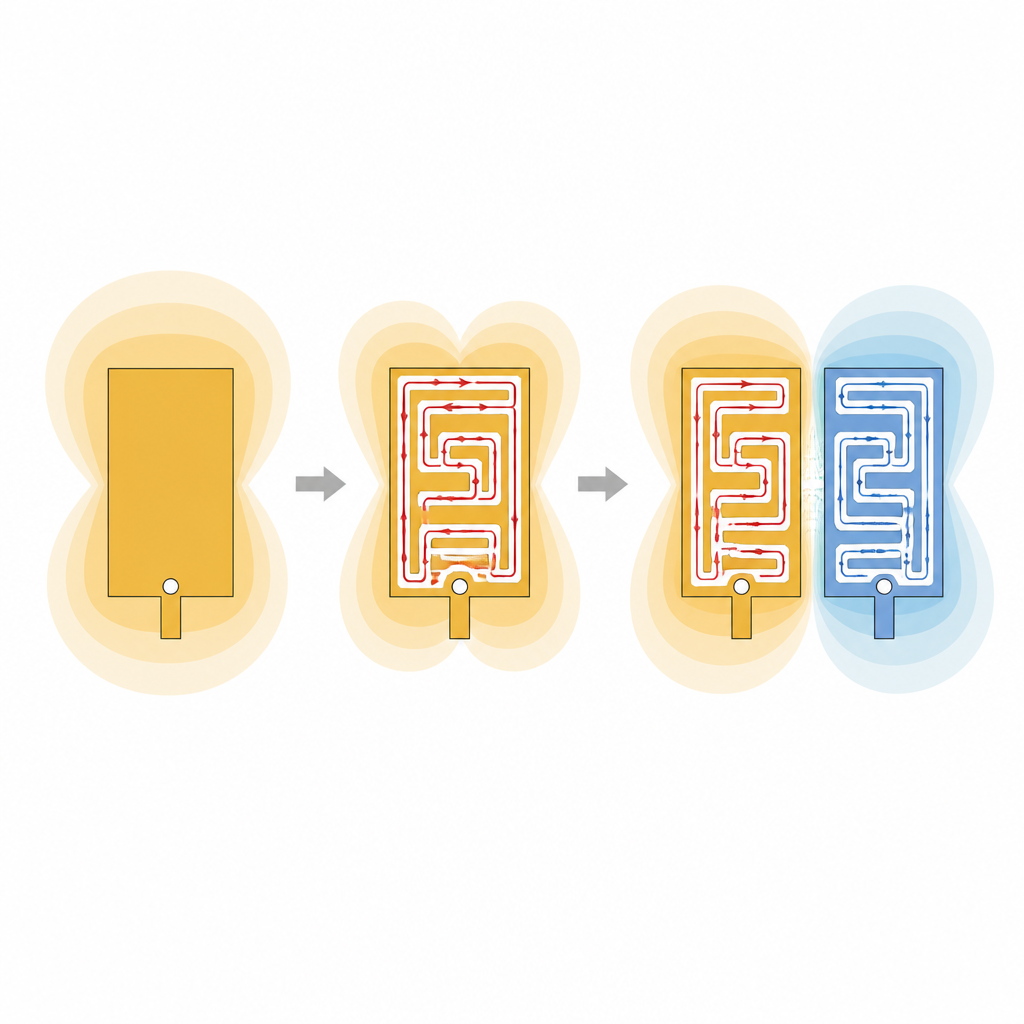
A new patch shape that shrinks size yet stays clean
To achieve both compactness and clean polarization, the researchers redesign a standard rectangular patch antenna. They cut the metal patch into several narrow sections, add tiny gaps between them, and connect selected parts to the ground through metal vias. They also weave a meander-shaped strip into the patch. Together, these features make the electrical path longer and more capacitive without enlarging the outer outline, allowing the antenna to resonate around 4.3 GHz instead of the much higher frequency expected for its size. Simulations show that this miniaturized patch keeps good gain while pushing unwanted cross polarization down to about 50 decibels below the main signal, which is exceptionally low.
Two-port antennas with linear and circular polarization
Building on the new patch, the team constructs two kinds of two-port arrays. In the first, two miniaturized patches are placed at right angles on the same board to create a dual linearly polarized antenna. Even with an edge-to-edge spacing of only a tiny fraction of the wavelength, the ports remain well matched and the measured isolation stays higher than 30 decibels, all without extra decoupling hardware. In the second design, the same compact patches are combined with a printed hybrid coupler to produce two circularly polarized outputs, one rotating right-hand and the other left-hand. This dual circularly polarized array also operates around 4.3 GHz, maintains isolation above 10 decibels, and delivers stable radiation patterns with modest gain suitable for practical use.
How this helps future wireless devices
When compared with similar two-port antennas reported in the literature, both of the proposed designs occupy some of the smallest electrical areas while still offering competitive bandwidth, gain, and isolation. Because the clean separation between the two ports comes from the intrinsic behavior of the miniaturized patch rather than from bulky add-on structures, the overall layouts remain simple and low-profile. For engineers designing phones, sensors, or other space-limited wireless products, these compact, low cross-polarization antennas provide a promising way to pack more reliable links into ever smaller devices.
Citation: Tran-Tuan, A., Hoang-Thu, T., Le-Tuan, T. et al. Compact 2-port linearly and circularly polarized antennas using low cross-polarization miniaturized patch. Sci Rep 16, 15768 (2026). https://doi.org/10.1038/s41598-026-46704-6
Keywords: compact antenna, MIMO, polarization, wireless systems, patch antenna