Clear Sky Science · en
Mode hybridisation strategies for subwavelength sound attenuation in miniaturised Helmholtz resonators
Why tiny sound absorbers matter
From quieter cars and planes to more peaceful homes and offices, many modern technologies need to tame loud, low-pitched sounds without adding bulky walls or heavy panels. This study explores how to shrink classic sound absorbing devices known as Helmholtz resonators down to sizes far smaller than the sounds they control, while still keeping them effective, tunable and suitable for compact noise-control systems. 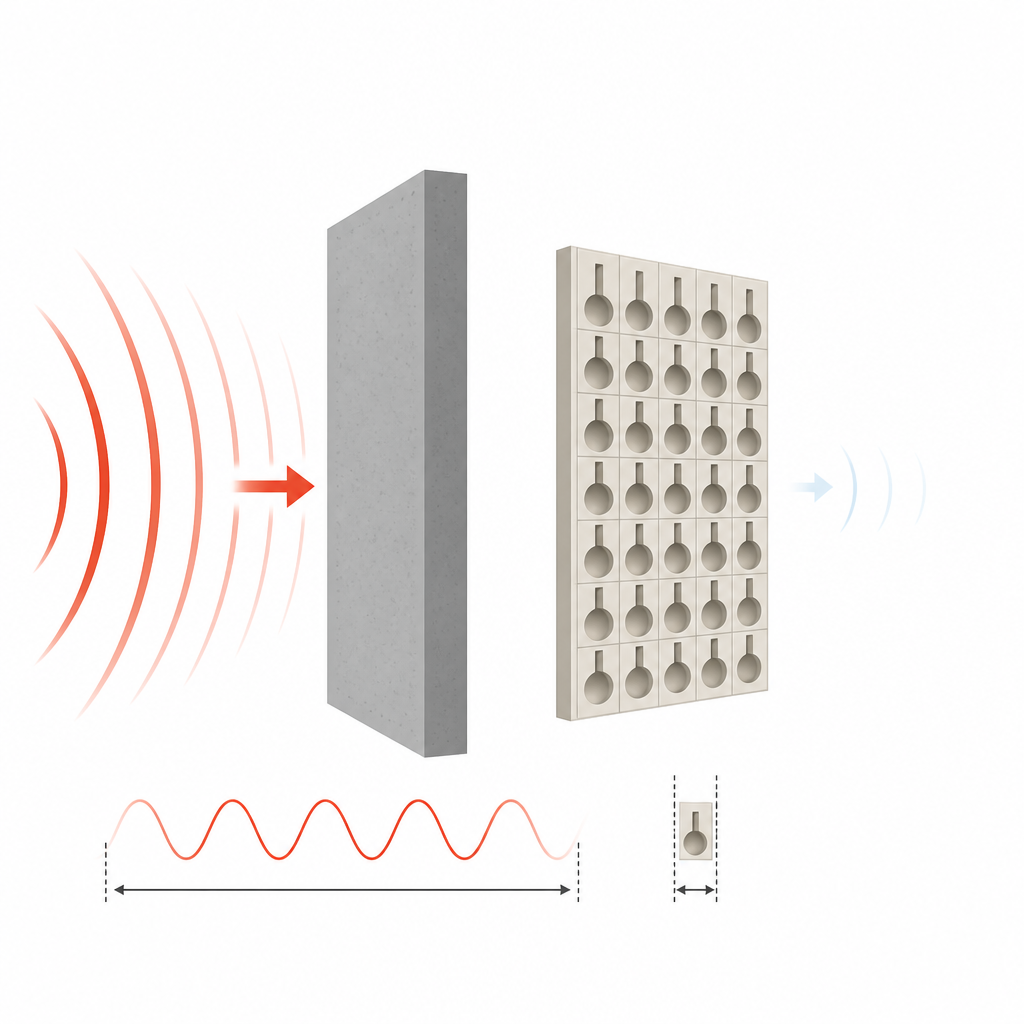
The challenge of shrinking sound traps
Traditional sound barriers work mainly by being thick and heavy, so they struggle with low tones whose wavelengths can be meters long. Helmholtz resonators, which are like tiny bottles with a neck and cavity, can absorb specific tones even when they are much smaller than the wavelength. But if you simply scale them down or change their shape, you quickly run into limits. Smaller necks and sharper corners increase tiny friction and heat losses in the air, which blur and weaken the resonant effect. The authors first map out these trade-offs using conventional rigid resonators, showing that geometry alone cannot keep lowering the tone without either growing the volume or sacrificing how strongly they absorb sound.
Making the walls themselves participate
To push beyond these limits, the team lets the resonator walls themselves flex and move. They add thin membranes and soft elastomer parts that are able to vibrate under sound pressure. This creates hybrid modes, where the air in the neck and cavity and the compliant structures all oscillate together. In experiments, a membrane placed over the resonator opening splits the single resonance into two distinct bands, one at a much lower frequency than the original. At the lowest band the system works at a deep subwavelength scale, around one thirty eighth of the sound wavelength, and can nearly completely absorb sound. Because sound can now enter through both the neck and the membrane, their combined motion can also steer how energy is sent back into space, producing a directional, cardioid-like pattern that depends on the angle of incoming sound. 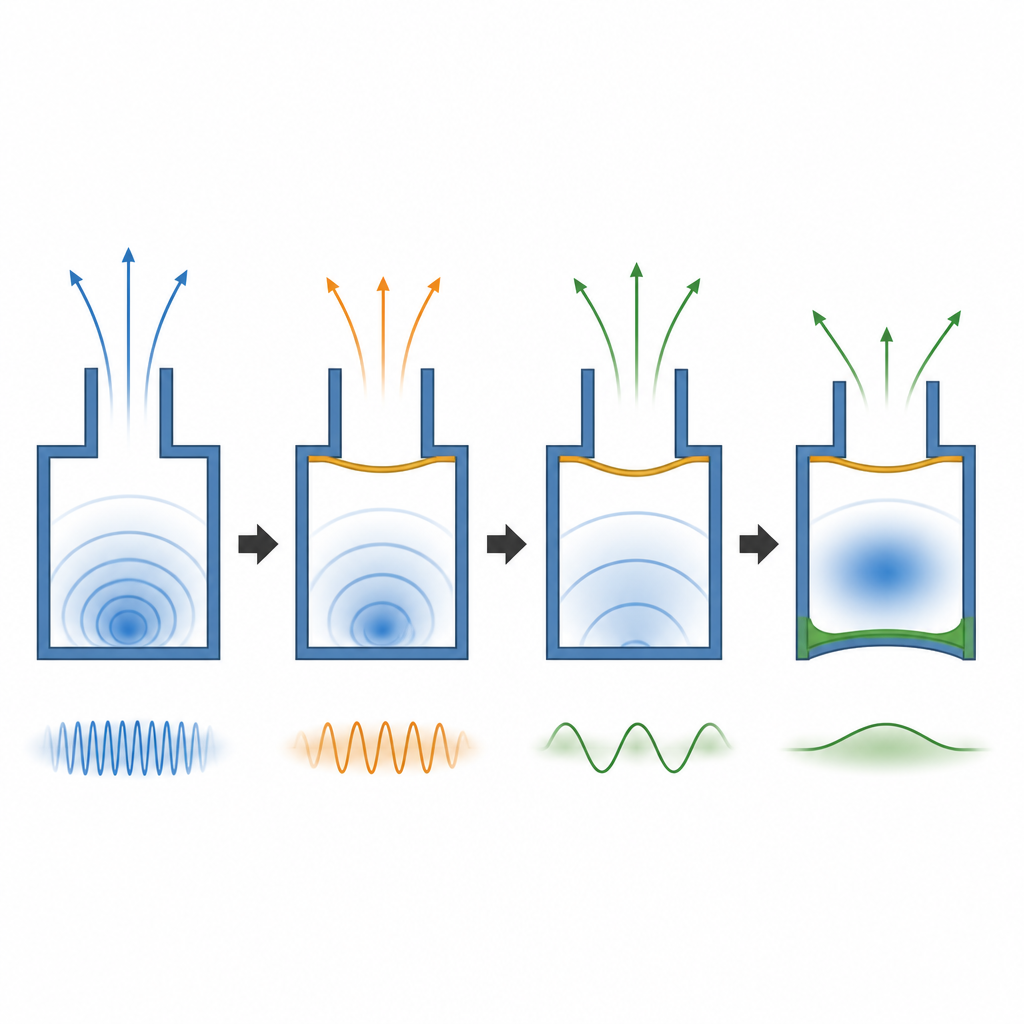
Soft elements without fiddly tuning
While membranes are powerful, they are also tricky to tension and reproduce reliably at miniature scales. The researchers therefore explore an alternative based on soft 3D-printed elastomers built directly into the resonator. In one design the wall around the neck is made compliant, in another a flexible backplate is added behind the cavity, and finally both are combined. These soft sections add extra springiness and internal damping without requiring post assembly or manual adjustment. The added compliance shifts the resonant bands downward, allowing lower operating tones at the same physical size. At the same time, the strong internal friction within the elastomer spreads and shallows the absorption peaks, showing a clear balance between miniaturisation and how deeply sound can be trapped.
A new way to think about compact sound control
To tie these results together, the authors analyse how the system’s resonances move in the complex frequency plane, where each resonance appears as a pair of mathematical features called poles and zeros. As more soft elements are added and material losses increase, these features shift in ways that clearly reflect changes in frequency, bandwidth, and directionality. This shared framework applies equally to simple rigid resonators and to the new membrane and elastomer designs, revealing mode hybridisation as the common organising idea. It shows that by carefully combining geometry with structural compliance, engineers can systematically design arrays of tiny, 3D-printed resonators that work far below the wavelength of sound, offer tunable and even directional noise control, and remain small enough for real-world applications ranging from stealth and vehicle cabins to bio inspired hearing devices.
What this means for everyday sound
In plain terms, the study shows that instead of endlessly making cavities bigger or necks thinner, we can teach small sound traps to work smarter by letting their walls flex in controlled ways. This turns each unit into a tiny, multi-part musical instrument whose notes can be shifted and shaped through its internal springs and masses. By using light based multi material 3D printing, these intricate mini devices can be made as single pieces without assembly. The result is a practical recipe for creating compact panels that hush deep rumbling sounds while staying much thinner and lighter than traditional barriers, pointing toward more efficient and adaptable noise control in many settings.
Citation: Domingo-Roca, R., Feeney, A., Jackson-Camargo, J.C. et al. Mode hybridisation strategies for subwavelength sound attenuation in miniaturised Helmholtz resonators. Sci Rep 16, 15638 (2026). https://doi.org/10.1038/s41598-026-46693-6
Keywords: acoustic metamaterials, Helmholtz resonators, sound absorption, noise control, subwavelength acoustics