Clear Sky Science · en
Joint MVMD-based optimal feature selection and FW-LS-TWSVM for motor imagery recognition
Teaching Computers to Read Imagined Movement
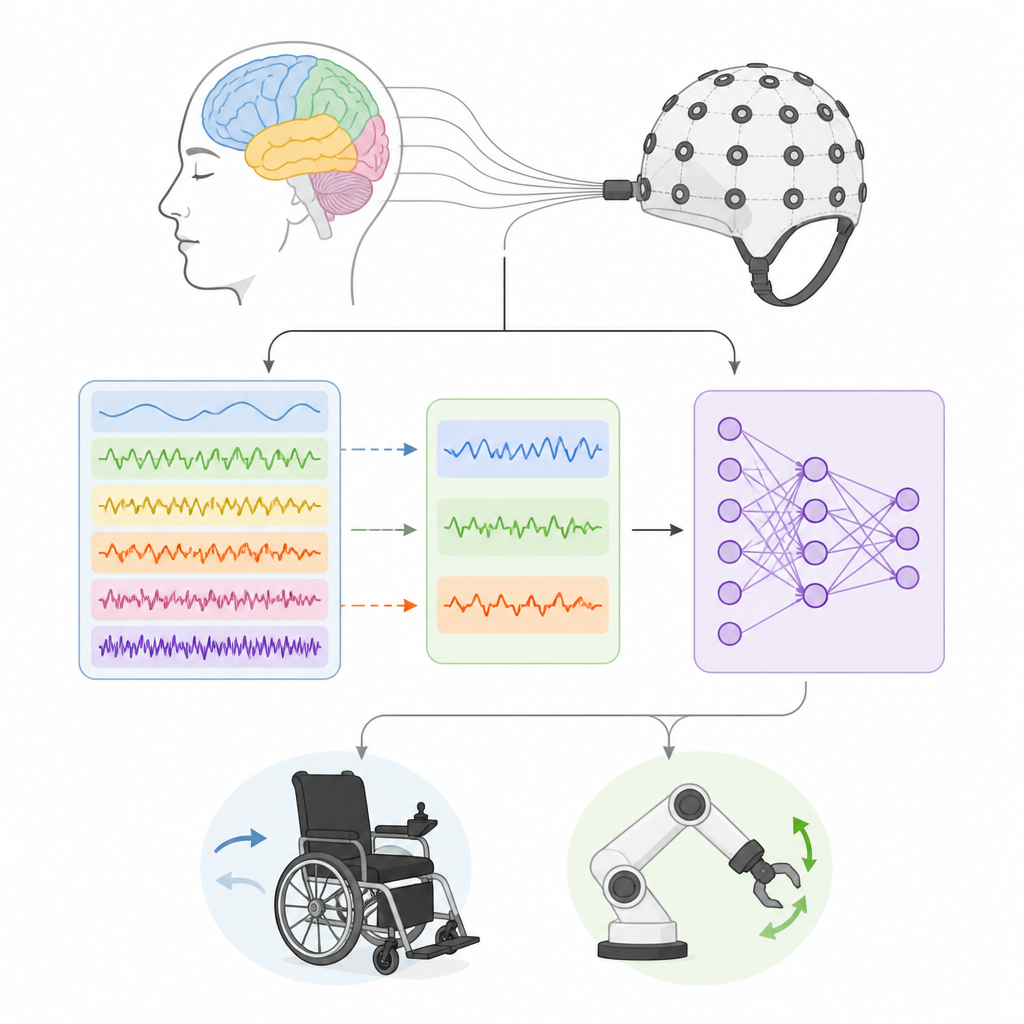
Imagine guiding a wheelchair or robotic arm just by thinking about moving your hand. This study explores how to make that kind of brain-controlled technology more accurate and fast, so it can better help people with movement problems and support smooth human–machine cooperation.
Why Brain Signal Control Is Hard
Brain–computer interfaces turn tiny electrical signals from the scalp into commands for external devices. In motor imagery systems, people only imagine moving a hand or foot, and sensors record the resulting brain activity. These signals are very weak and easily disturbed by differences between people, changes in mood or fatigue, and background noise. As a result, many existing systems are not accurate or reliable enough for everyday use, especially when only limited training data are available.
Finding the Right Pieces of the Brain Signal
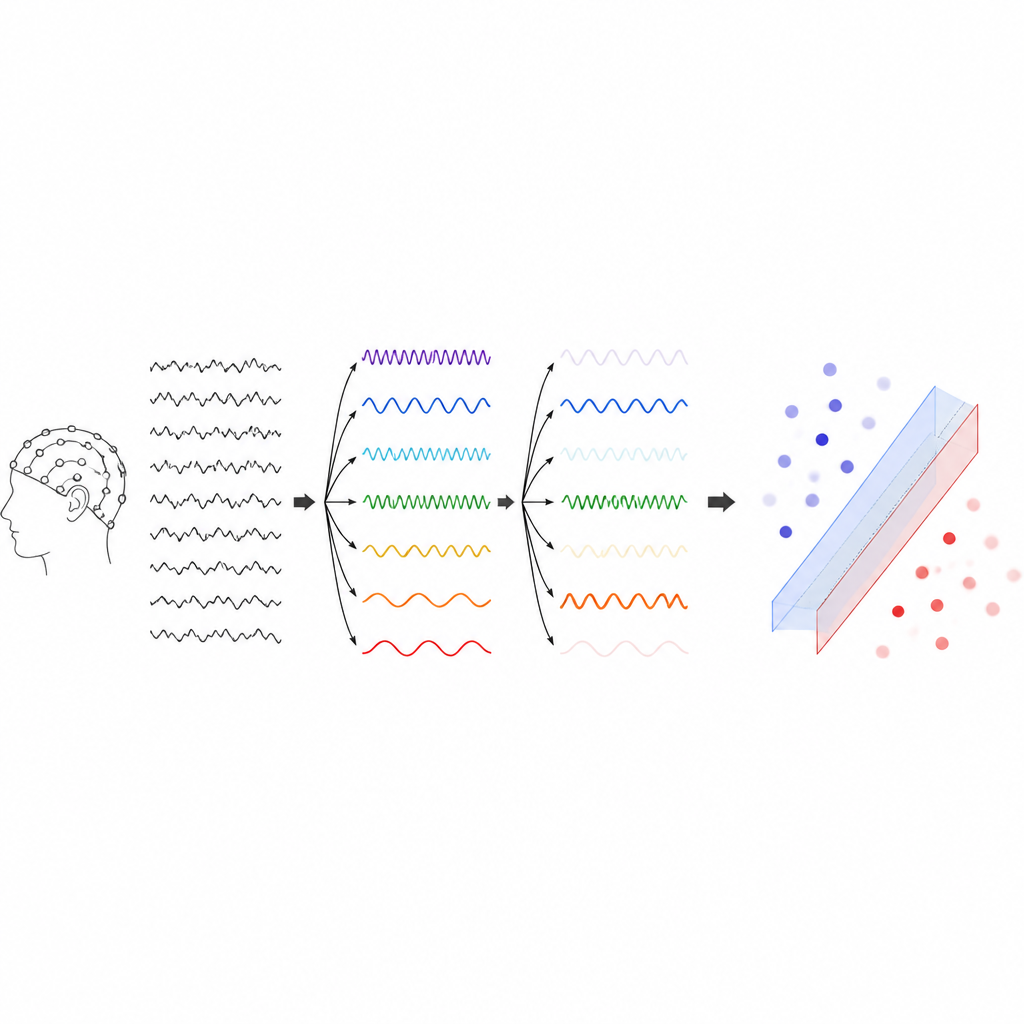
The authors focus on carefully crafting and selecting features from the brain signals rather than relying purely on deep learning. They first clean the signals and slice them into short time windows to find the period that best reflects the imagined movement. Then they break each signal into several components that correspond to different frequency ranges, using a method that analyzes all channels together. This step helps separate meaningful patterns linked to movement from other activity and noise. From each component, they extract spatial patterns that emphasize how groups of electrodes change together during different imagined movements.
Picking Only What Really Helps
Not every frequency band or spatial pattern is helpful. Using a statistical approach, the method tests how much each feature improves the ability to tell left-hand from right-hand imagination. Features that do not contribute much are removed, leaving a compact set of the most informative pieces of the signal. This adaptive selection can differ from person to person and even from session to session, reflecting the fact that each brain and each recording day has its own quirks. By trimming away redundant and unstable features, the system becomes both more accurate and more efficient.
A Smarter Way to Draw the Decision Line
Once the best features are chosen, the system still needs a classifier that can handle outliers, such as noisy or unusual trials. The study introduces a fuzzy weighted version of a fast support vector machine that learns two decision planes instead of one. Each training example is given a weight based on how typical it is for its class, so suspicious or noisy samples have less influence. This design reduces the impact of bad data while keeping training quick enough for near real-time use.
How Well the Method Works
The researchers tested their full pipeline on two large public datasets of imagined hand movements, recorded with dozens of scalp electrodes. Their approach reached about 87 to 88 percent average accuracy, clearly better than several recent deep learning systems and other advanced classifiers that used the same data. They also showed that using their adaptive frequency decomposition and feature selection together gave a sizable boost over simpler fixed-band filters or older decomposition methods.
What This Means for Future Brain Control
For a layperson, the takeaway is that this study shows how carefully selecting which parts of the brain signal to trust, and reducing the influence of noisy examples, can make thought-controlled devices more dependable and responsive. While more work is needed before such systems are common in daily life, this approach brings us a step closer to practical tools that can assist rehabilitation, restore lost movement, and extend how people interact with machines using only their minds.
Citation: Zhi, J., Zhang, Q., Li, Y. et al. Joint MVMD-based optimal feature selection and FW-LS-TWSVM for motor imagery recognition. Sci Rep 16, 15648 (2026). https://doi.org/10.1038/s41598-026-46642-3
Keywords: motor imagery, brain computer interface, EEG decoding, feature selection, support vector machine