Clear Sky Science · en
A non-linear pattern of exercise capacity in heart failure across ejection fraction categories
Why moving with heart failure matters
For many people living with heart failure, one of the most troubling questions is how far they can safely walk or cycle before feeling worn out. Doctors often use a simple measure called ejection fraction to judge how well the heart pumps blood. But this study shows that how strong the heart looks at rest does not neatly predict how well someone can actually exercise, and that other health problems like anemia, kidney disease and diabetes can quietly shape day to day stamina.
Three kinds of weak hearts
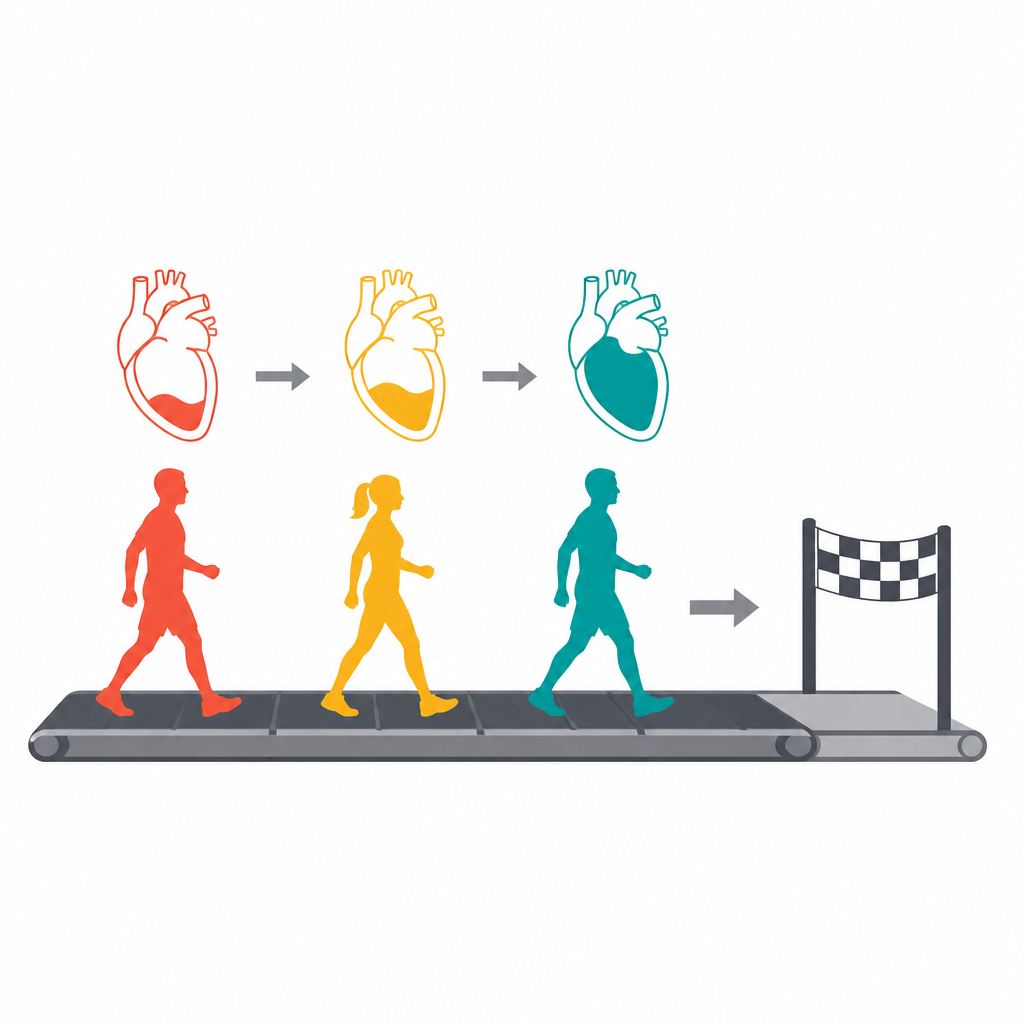
The researchers looked at 196 patients with established heart failure who were referred for cardiac rehabilitation after a recent heart problem or procedure. They fell into three groups based on how much blood their hearts pushed out with each beat: a preserved group with nearly normal pumping, a mildly reduced group, and a clearly reduced group. All of them performed a detailed exercise test on a bike that measured oxygen use and breathing, as well as a six minute walk test that reflects everyday activity such as walking to the store.
Exercise ability does not fall in a straight line
As expected, patients whose hearts pumped the least had the poorest results on the exercise test. Their peak oxygen uptake, a key sign of how much work the body can do, was clearly lower and more often fell into the range doctors consider a moderate to severe drop in fitness. They also showed more inefficient breathing, meaning they had to breathe more to clear the same amount of carbon dioxide. Yet the mildly reduced group performed much like the near normal group on these measures. When the team compared simple outcomes like how far people walked in six minutes or how much workload they reached on the bike, all three groups looked surprisingly similar.
The hidden weight of other illnesses
The study also explored common companion conditions that travel with heart failure and can quietly drain strength. People in the mildly reduced group had the lowest rates of chronic kidney disease and type 2 diabetes, both of which are known to stiffen blood vessels, damage muscles and make exercise harder. In contrast, those in the preserved group had the lowest blood counts and the highest rates of anemia. Anemia means fewer red blood cells to carry oxygen, so the heart and breathing system must work harder to fuel the muscles. Earlier research shows that anemia in heart failure is linked with worse quality of life and higher risks of hospital stays and death.
Breath, blood and muscles working together
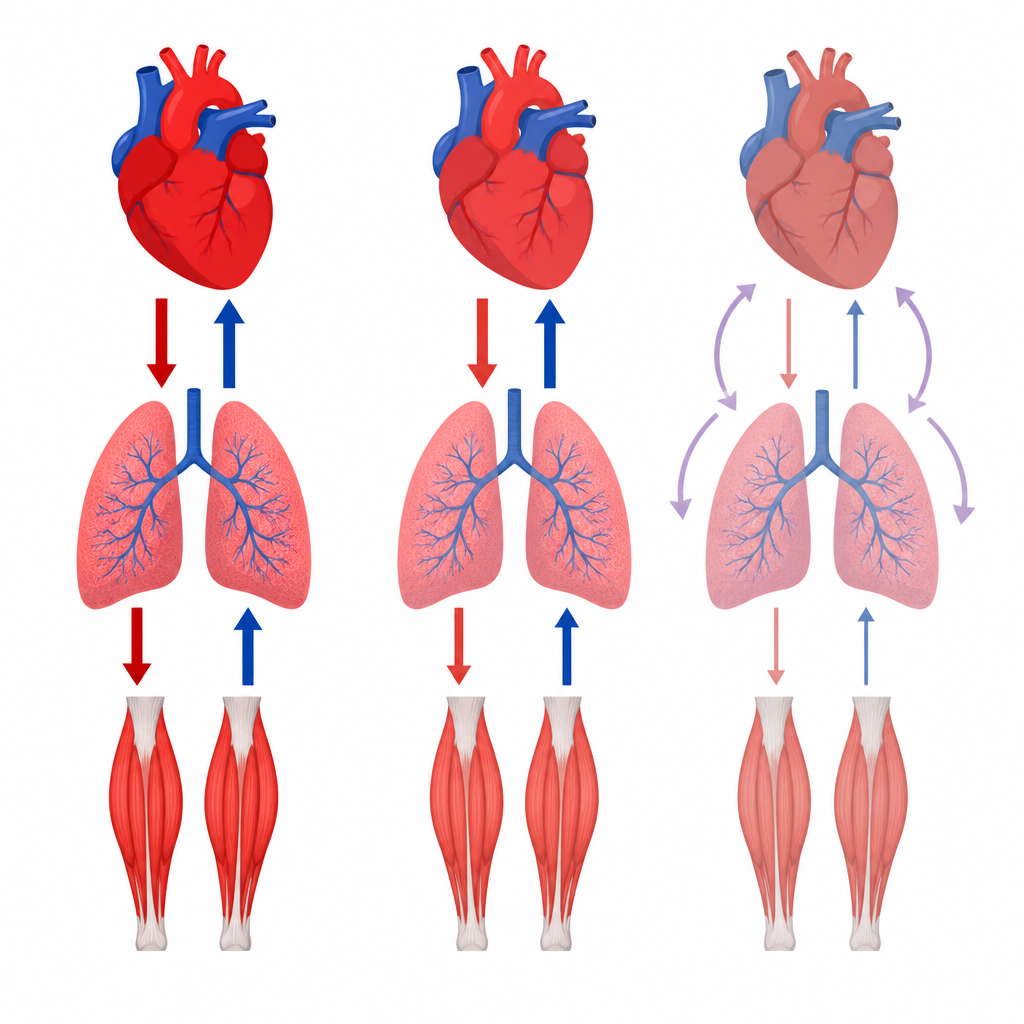
The authors argue that shortness of breath and early fatigue in heart failure do not come from the heart alone. Instead, they arise from a mix of factors, including how well the lungs exchange gases, how effectively muscles extract and use oxygen and how much oxygen the blood can carry in the first place. Measures from the exercise test that capture breathing efficiency and oxygen use turned out to offer rich clues about these processes in all three heart failure types. Interestingly, even though the preserved group had hearts that looked stronger on ultrasound, their high burden of anemia may have erased any advantage when it came to real world exercise ability.
What this means for people with weak hearts
In everyday terms, this work suggests that two patients whose hearts look very different on a scan may still tire at about the same point on a walk, because problems like anemia, kidney disease and diabetes play a big role in how the body handles effort. The mildly reduced group looked more similar to the preserved group than to those with clearly weak hearts, at least in how they performed on the exercise bike. The authors conclude that detailed exercise testing can reveal patterns that resting heart scans miss, and that treating comorbidities such as anemia may be just as important as measuring ejection fraction when trying to help people with heart failure stay active and independent.
Citation: Kurpaska, M., Krzesiński, P., Świerkowska, M. et al. A non-linear pattern of exercise capacity in heart failure across ejection fraction categories. Sci Rep 16, 15772 (2026). https://doi.org/10.1038/s41598-026-46615-6
Keywords: heart failure, exercise capacity, cardiopulmonary exercise test, anaemia, ejection fraction