Clear Sky Science · en
A structure-preserving diffusion-based zero-shot learning framework for multimodal magnetic flux leakage signal analysis
Why pipeline health matters to everyone
Oil and gas pipelines run for thousands of miles beneath fields, cities, and oceans, quietly moving the fuels that power homes and industry. When these steel arteries fail, the result can be fires, explosions, and long-lasting pollution. Yet the early warning signs of trouble—tiny pits, cracks, and weld flaws—often hide inside thick metal walls and are buried under noise in sensor data. This study presents a new artificial intelligence framework that can both clean up those messy signals and recognize even never-before-seen types of damage, offering a safer and more reliable way to monitor large pipelines.
Hidden flaws in giant steel pipes
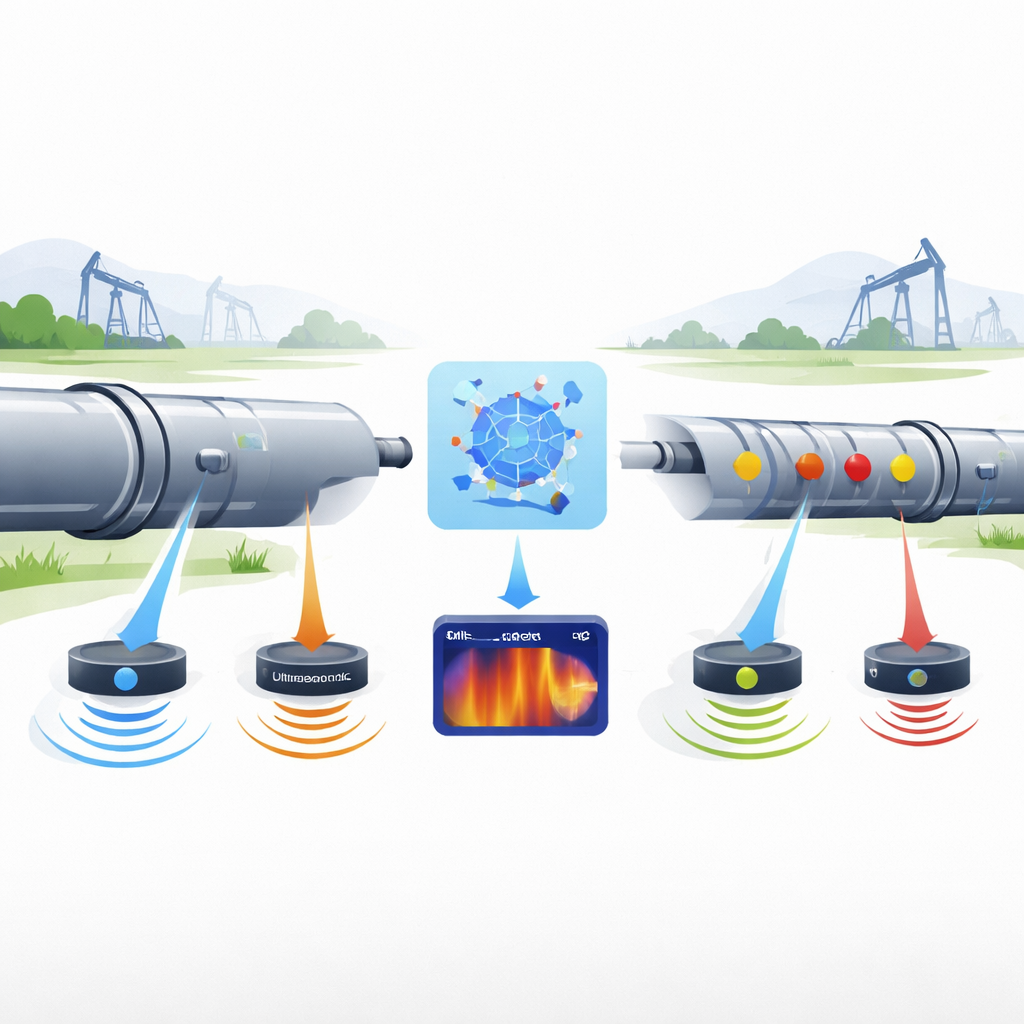
Large-diameter pipelines work for decades in harsh conditions, slowly accumulating damage from corrosion, fatigue, and stray impacts. Inspectors rely on non-destructive testing tools, such as ultrasound, infrared cameras, and magnetic flux leakage (MFL) sensors, which magnetize the steel and listen for distortions in the field caused by missing metal. In practice, those MFL signals are badly contaminated by electrical noise, sensor lift-off, and variations in the steel itself. The result is that small or unusual defects can be missed, and traditional machine-learning methods—trained only on defect types they have seen before—struggle when confronted with rare or new forms of damage.
Cleaning the signal without blurring the damage
The first pillar of the new framework is a structure-preserving diffusion model. Diffusion models are a new class of generative AI that gradually strip noise away from data in many small steps. Here, the authors adapt that idea to one-dimensional MFL signals and add three targeted constraints so that denoising does not wash away the very features inspectors care about. One constraint keeps the sharpness of signal edges where defects begin and end, another protects the overall shape of the waveform around a defect, and a third checks that repeating patterns in the frequency spectrum are preserved. Working together, these checks more than double the signal-to-noise ratio of MFL data—from 12.3 to 24.1 decibels—while keeping the geometry of the flaws intact.
Letting different sensors cooperate, not compete
The second pillar is a multimodal fusion network that teaches different sensors to support each other. In the experimental setup, magnetic, ultrasonic, and infrared data are gathered simultaneously along the same pipe section. Each sensor stream is first processed by a specialized neural network designed for its data type. Then, an attention mechanism learns, for each case, how much weight to give to the extra information from ultrasound and infrared when refining the MFL-based view. Instead of blindly stacking all data, the model highlights complementary details and suppresses conflicting or redundant signals. This cross-modal attention strategy delivers a macro F1-score of 0.93 on known defect classes, outperforming simpler early- and late-fusion schemes.
Recognizing flaws the model has never seen
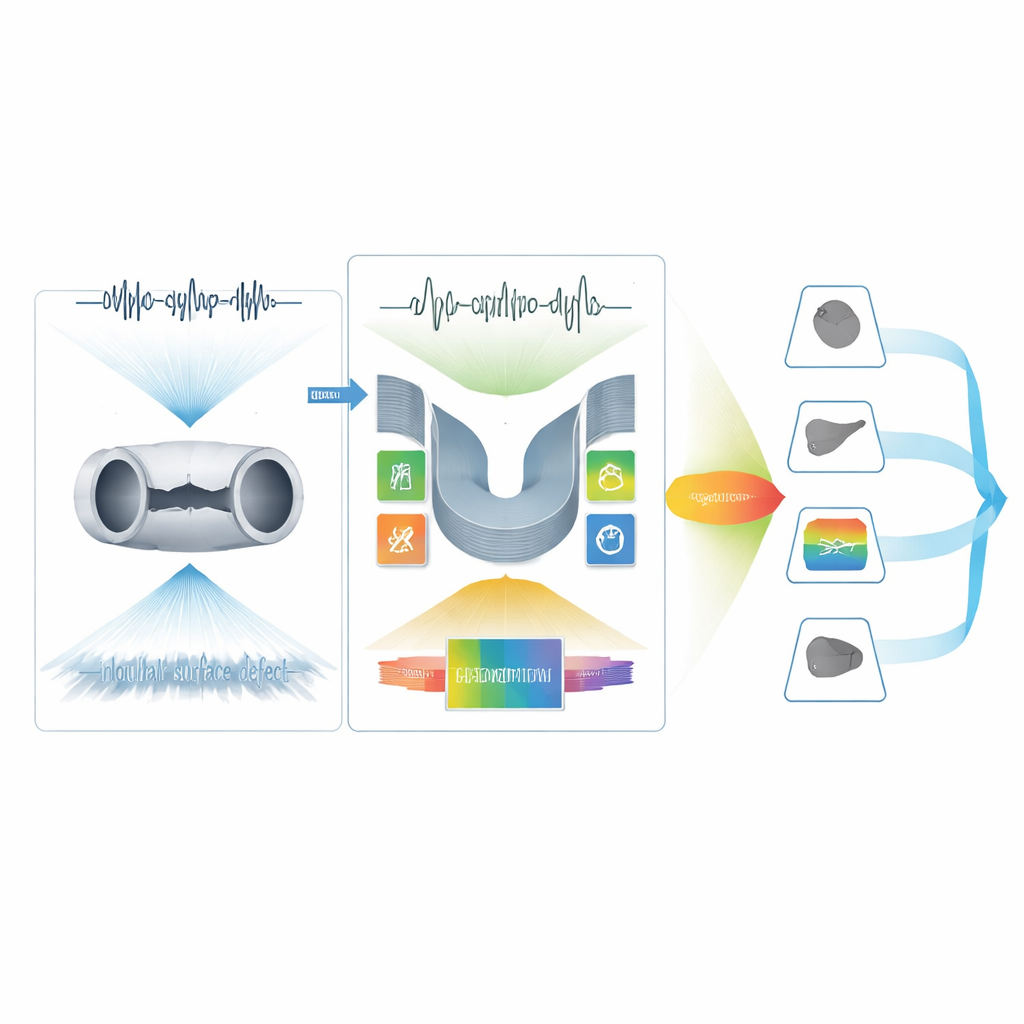
The most striking advance comes from how the system deals with completely new defect categories. Rather than learning only from labels like “crack” or “corrosion pit,” the model operates in an interpretable attribute space defined by properties that engineers use in practice: overall shape (point-like, line-like, patch-like), depth level, likely cause (corrosion, mechanical damage, weld problem), and direction along the pipe. During training, the system learns to align fused sensor features with these attribute descriptions using contrastive learning, pulling matching visual and semantic representations together and pushing mismatches apart. At test time, the model can be asked about defect types it has never seen but that are described by combinations of these attributes. On such “zero-shot” tasks involving four unseen defect categories, it achieves an accuracy of 0.84 and a balanced score (harmonic mean of seen and unseen performance) of 0.88, outperforming several advanced vision-language models originally built for natural images.
From laboratory pipe to real-world networks
To test practicality, the researchers built a large-diameter steel pipeline mock-up with both carefully machined flaws and real aging damage from retired pipes, and then examined how well their method carried over to pipes of different sizes, wall thicknesses, and steel grades. Without any retraining, the framework maintained an average zero-shot accuracy of 0.81 across four additional pipeline types. It also ran fast enough—about one-tenth of a second per inspection window on a single modern graphics card—and used moderate memory, making it realistic for integration into in-line inspection vehicles that must operate continuously.
What this means for safer pipelines
For non-specialists, the key outcome is that this approach is better at hearing the faint whispers of damage inside big steel pipes and at recognizing new kinds of problems without having to see thousands of examples first. By denoising signals in a way that keeps the true shape of defects, intelligently blending multiple sensing methods, and reasoning in a human-understandable attribute space, the framework moves pipeline monitoring from rigid pattern matching toward more flexible, explainable understanding. While challenges remain for extremely tiny defects and harsh environments, the method offers a promising route to earlier warnings, fewer missed flaws, and more reliable energy infrastructure.
Citation: Dou, Q., Ren, C. A structure-preserving diffusion-based zero-shot learning framework for multimodal magnetic flux leakage signal analysis. Sci Rep 16, 10807 (2026). https://doi.org/10.1038/s41598-026-46518-6
Keywords: pipeline inspection, magnetic flux leakage, multimodal sensing, zero-shot learning, diffusion models