Clear Sky Science · en
Optimization of multiple tuned mass dampers for vibration control of a nonlinear beam
Why calming vibrations matters
From swaying skyscrapers to humming wind turbine blades, many modern structures behave like slender beams that can shake themselves into trouble. Designers often bolt on extra “helper” weights called tuned mass dampers to calm this motion, but getting the size and placement of these devices right becomes tricky once the structure behaves in a nonlinear way—that is, when it does not respond in a simple, proportional fashion to pushing and pulling. This study asks a practical question with broad relevance to civil, mechanical, and aerospace engineering: how many dampers should we use, where should we put them, and how should we tune them so a flexible beam quiets down as quickly and safely as possible?
How add-on weights tame a shaking beam
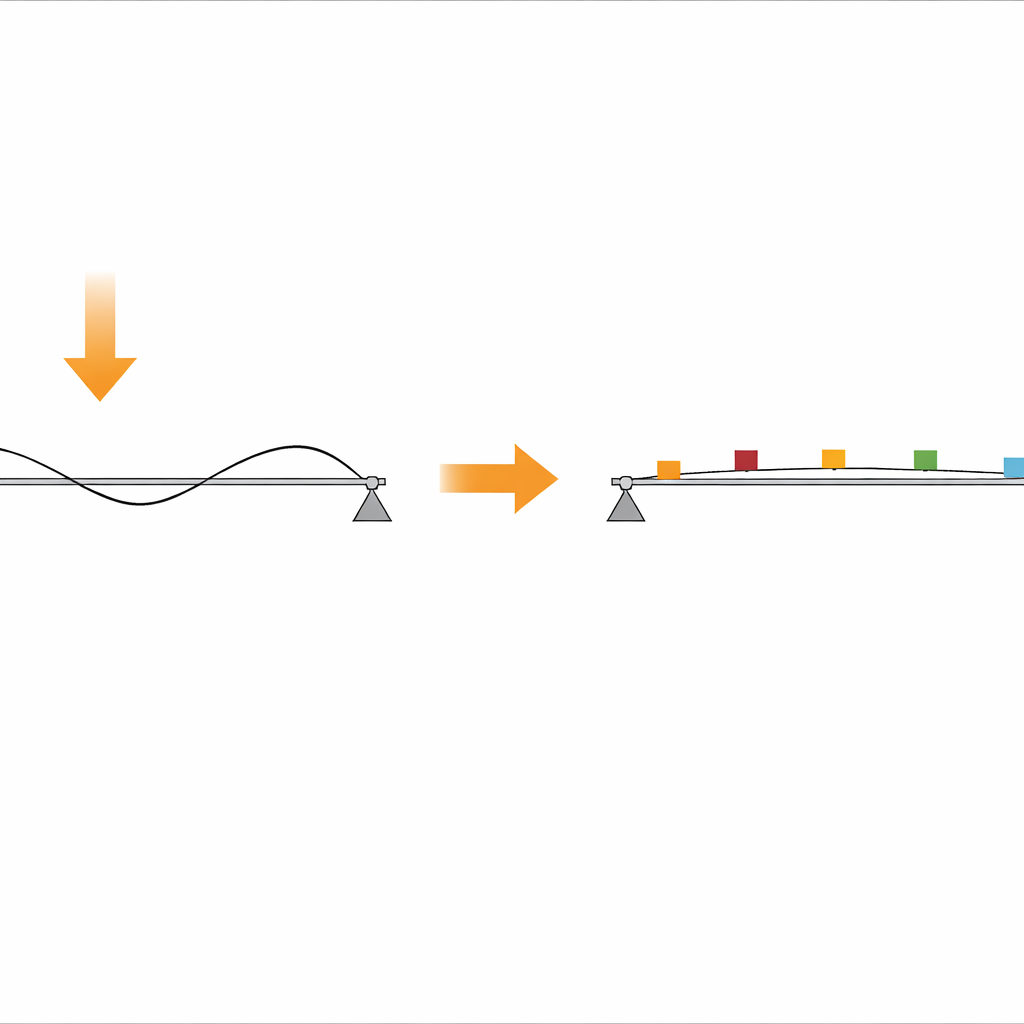
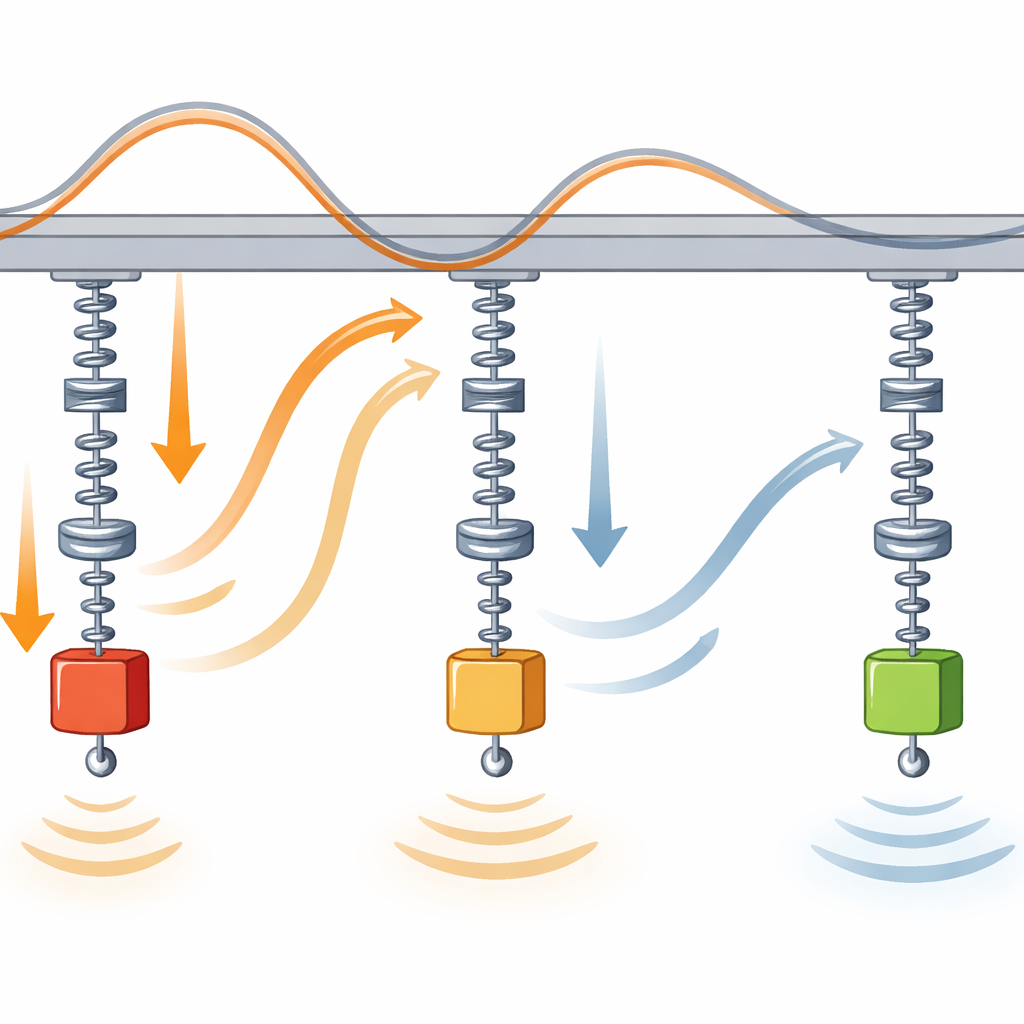
A tuned mass damper is a small secondary system—a mass on a spring with a dashpot—that is attached to a main structure. When the main structure vibrates, the add-on mass is designed to move out of step, pulling energy out of the motion and turning it into harmless heat. The authors focus on long, slender beams, idealized as simple supports at each end, to represent components such as bridge decks, floors, or robotic arms. In these elements, even a brief shove, like an impulsive load, can launch long-lasting oscillations. The work explores not just the classic case of one damper, but arrangements with two and three dampers distributed along the beam and asks how these multiple devices can cooperate to tackle vibrations more effectively than any single one.
Building a realistic digital test bed
To probe this problem, the researchers construct a detailed mathematical model of a beam that can exhibit both linear and nonlinear behavior. In the linear regime, the motion is directly proportional to the applied force; in the nonlinear regime, large deflections and stretching change the beam’s apparent stiffness and shift its natural frequencies. The team uses an energy-based approach to derive the governing equations and then simplifies the continuous beam into a handful of dominant vibration shapes. Each damper interacts with these shapes at its attachment point, and the combined system of beam and dampers is then simulated in time under a sharp, short-lived force. This unified framework allows them to test many possible damper layouts for both idealized and more realistic, nonlinear beams, with and without internal material damping.
Letting a digital swarm search for the best design
Because the space of possible damper positions and tuning choices is huge, the authors turn to a computational search strategy known as particle swarm optimization. In this method, many trial designs “fly” through the design space, sharing information about how well they perform, and gradually converge on promising solutions. The team defines performance in a simple but meaningful way: they calculate the total area under the beam’s vibration response at key locations, a measure that captures both how hard and how long the beam shakes. For each scenario—one, two, or three dampers; linear or nonlinear beam; with or without built-in damping—the swarm repeatedly searches for the combination of damper locations, stiffnesses, and damping levels that minimizes this vibration area.
What happens as more dampers are added
The simulations show that adding dampers almost always helps, but the benefit tapers off. For beams without internal damping, a single well-placed damper already slashes vibration levels dramatically. A second damper brings a clear extra reduction, and a third still improves things, but by a smaller margin. When the material of the beam itself dissipates some energy, the pattern shifts: two dampers often provide most of the achievable benefit, while a third one offers only modest or even negligible gains. Across all cases, the optimization repeatedly places the dampers near the point where the main bending shape reaches its greatest deflection—the midpoint for the first vibration mode—sometimes clustering several dampers tightly in this region rather than spreading them widely along the beam.
What this means for real structures
For engineers, the study offers two key messages in accessible terms. First, attaching several small tuned masses to a vibrating beam can greatly shorten the time it spends shaking after a disturbance, whether the behavior is simple and linear or complicated and nonlinear. Second, more is not always better: beyond a certain point, extra dampers mostly add cost and complexity while delivering only small improvements, and in some nonlinear, internally damped cases, a third device can even interfere with the others. By showing how to systematically choose the number, placement, and tuning of dampers using modern optimization tools, this work points toward smarter, leaner designs for calming the vibrations of beams in bridges, buildings, machinery, and future lightweight structures.
Citation: Zakaria, A., Nabawy, A.E. & Abdelhaleem, A.M.M. Optimization of multiple tuned mass dampers for vibration control of a nonlinear beam. Sci Rep 16, 12691 (2026). https://doi.org/10.1038/s41598-026-46499-6
Keywords: tuned mass damper, vibration control, nonlinear beams, structural dynamics, optimization