Clear Sky Science · en
Shallow Au implantation into silicon-on-insulator slot ring resonator waveguide devices
Turning light on a chip
Light can be guided around tiny tracks on a silicon chip, much like cars on a ring road. These light-guiding rings are key parts in sensors and communication devices. This study asks what happens when you deliberately add tiny specks of gold to such rings, in the hope of boosting their performance, and finds that the answer is more complicated than expected. 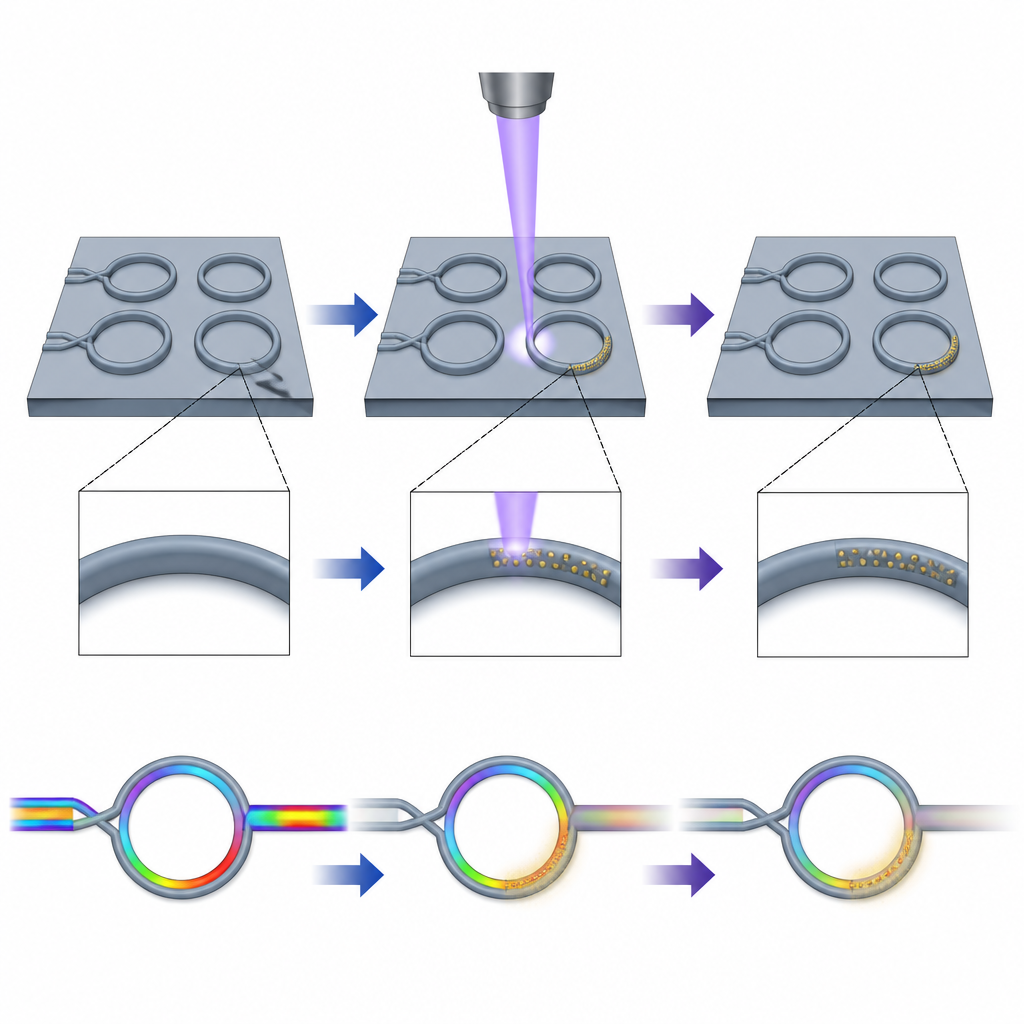
Why gold and tiny rings matter
Modern data networks and many chemical and biological sensors rely on guiding light through narrow paths on silicon, the same material used for electronics. Ring-shaped paths, called micro-ring resonators, trap light so that it circles many times, making these devices very sensitive to small changes in their surroundings. Gold nanoparticles can strongly interact with light on their own. If these two ideas could be combined in a controlled way, it might lead to very compact sensors able to detect faint signals or tiny amounts of a substance.
Placing gold into the light path
The researchers worked with a common industrial platform known as silicon-on-insulator, which stacks a thin layer of silicon on glass-like material. They used ring-shaped waveguides with a narrow slot that squeezes the light into a tiny region. Focused beams of gold ions were aimed at selected sections of these rings, with different doses and coverage. Afterwards, the chips were heated for short periods at temperatures between 500 and 700 degrees Celsius. This heat allows the implanted gold atoms to move and gather into small particles near the surface of the waveguides, close to where the light is most intense. 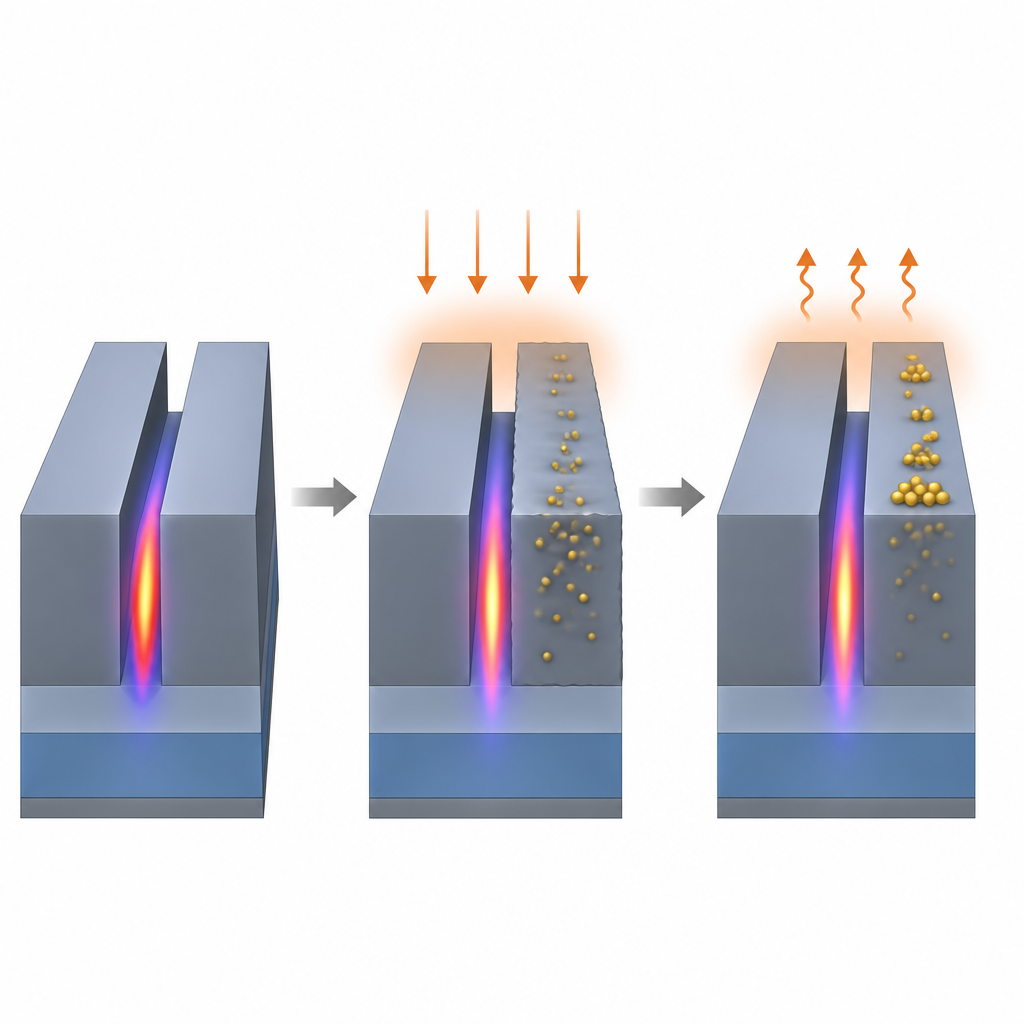
Checking the gold and the light
To see whether gold particles had formed, the team used electron microscopes and a technique that detects X rays from the material. These images showed gold nanoparticles about ten billionths of a metre across, sprinkled along the ring surfaces, with more particles appearing when higher doses of gold ions were used. The next step was to measure how well the rings still guided light. A broad light source around the familiar 1550 nanometre telecom band was shone into each device, and the transmitted signal was recorded. By carefully analysing the resonance dips in the spectrum, the team extracted two key measures of performance: the extinction ratio, which reflects how deeply the ring can filter light at certain colours, and the quality factor, which describes how sharply it can pick out those colours.
How heat and gold change performance
Right after gold implantation, all treated rings showed worse performance: the extinction ratio dropped, and the quality factor generally fell, especially for higher gold doses or larger implanted areas. Heating at 500 degrees Celsius allowed gold nanoparticles to form but did not repair the damage caused by the ion beam. As the temperature was raised step by step to 700 degrees, the extinction ratio of both treated and untreated rings kept decreasing, meaning the rings became less effective as filters. This decline was linked to structural changes and stress release in the glass-like cladding. Interestingly, for the gold-treated rings the quality factor, which had been reduced by implantation, climbed back close to its original value after heating to around 650 degrees, even though the overall filtering strength continued to suffer.
What this means for future devices
The work shows that gold nanoparticles can indeed be formed directly within complex light-guiding rings on standard silicon chips using focused ion beams and short high-temperature treatments. However, at the infrared wavelengths used here the gold particles do not provide a useful extra optical effect, because their natural colour response lies in the visible range. Instead, both the implantation and the heating steps mostly harm how well the rings guide and filter light. For anyone hoping to use this route to build better sensors or photonic circuits, the message is clear: while gold can be precisely written into the devices, keeping the rings working well will require different wavelengths, gentler processing, or new designs that better harness the presence of the nanoparticles.
Citation: Liu, QS., Coke, M., Lincoln, A. et al. Shallow Au implantation into silicon-on-insulator slot ring resonator waveguide devices. Sci Rep 16, 15959 (2026). https://doi.org/10.1038/s41598-026-46478-x
Keywords: silicon photonics, ring resonators, gold nanoparticles, ion implantation, optical sensing