Clear Sky Science · en
Phenotypic features of EYS-associated retinitis pigmentosa with the c.2528 G > A (p.Gly843Glu) mutation in a Japanese cohort
Why this eye study matters
Retinitis pigmentosa is a group of inherited eye diseases that slowly rob people of their sight, often starting with trouble seeing at night and gradually shrinking the field of vision. This study focuses on a common genetic change in Japanese patients and asks a simple but important question: do some versions of this disease progress more gently than others, and can eye scans reveal who is likely to keep useful vision for longer?
A closer look at a single gene
The research centers on a gene called EYS, which is active only in the eye and helps keep light-sensing cells in the retina structurally stable. When this gene is damaged, these cells break down over time, causing retinitis pigmentosa. In Japan, changes in EYS are one of the leading causes of this condition. Among many possible changes, the team focused on one specific variant, called G843E, which earlier work suggested might weaken the gene without destroying its function completely.
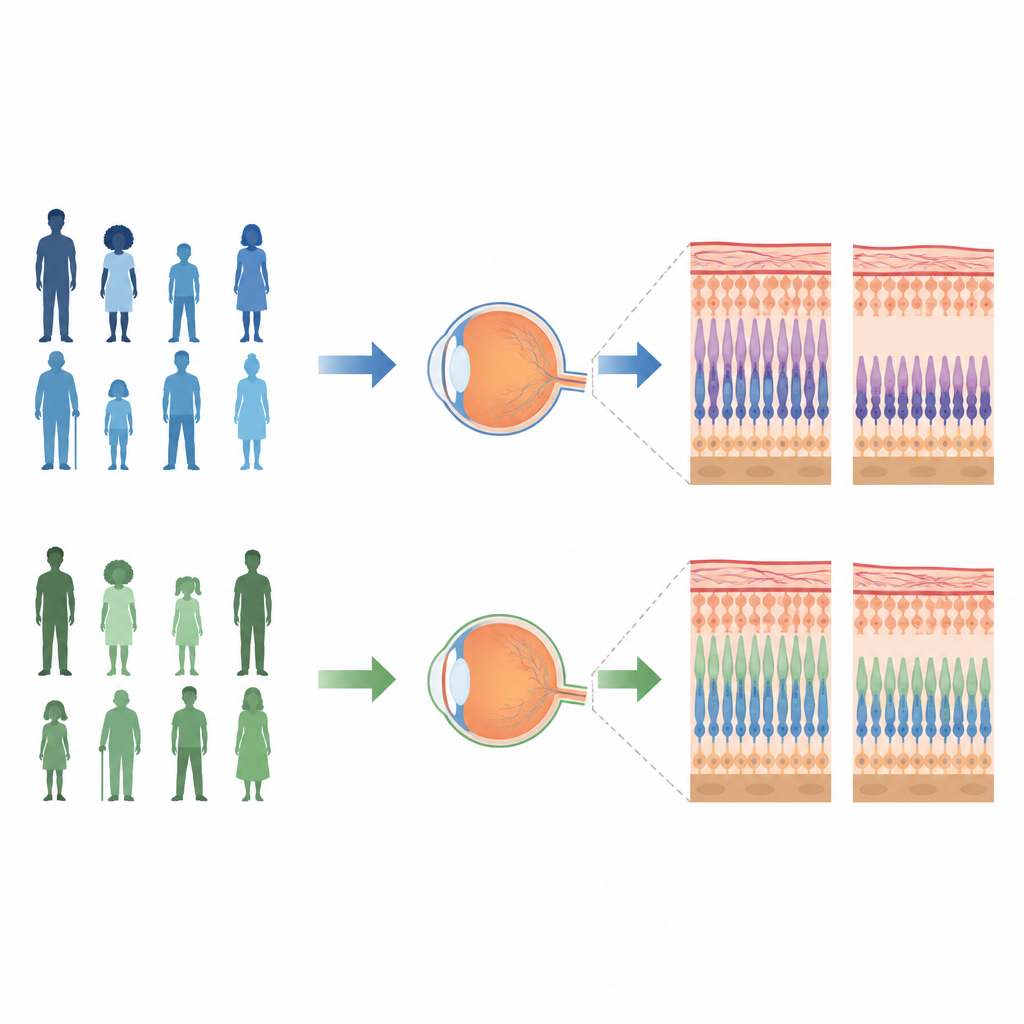
Comparing two patient groups
The investigators reviewed medical records and genetic data from 127 Japanese patients who each had disease-causing changes in both copies of the EYS gene. They split them into two main groups: 32 patients who carried the G843E variant along with another harmful EYS change, and 52 patients whose EYS changes were of more severe types that tend to completely disrupt the protein. To make fair comparisons, they focused on people between 40 and 60 years old and examined several clinical measures, including sharpness of central vision, visual field tests, and a structural feature on retinal scans called the ellipsoid zone, which marks the healthy part of the light-sensing layer.
What the eye scans revealed
On the surface, the two groups looked similar in some ways: they had comparable central vision and visual field results around age 50, and their fundus photographs showed typical signs of retinitis pigmentosa such as narrowed blood vessels and patchy pigment. The striking differences appeared when the researchers examined the ellipsoid zone on optical coherence tomography, a noninvasive imaging technique that slices through the retina in cross section. Patients with the G843E variant developed symptoms later in life and, at a similar age, had roughly twice the width of preserved ellipsoid zone compared with those lacking this variant, meaning a larger stretch of their light-sensing cells remained structurally intact.
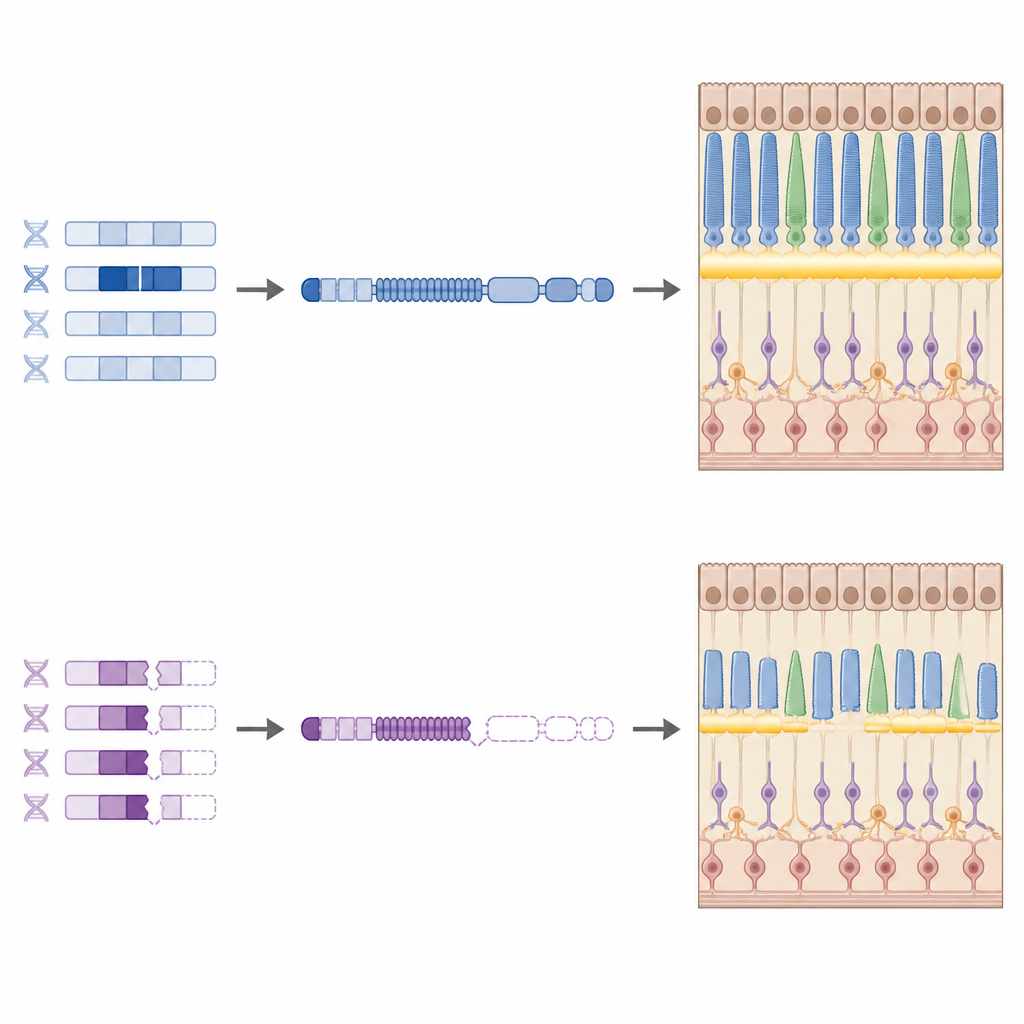
Linking genes, structure, and future care
Using statistical models that weighed several clinical factors at once, the team found that ellipsoid zone width was the only measure that reliably signaled whether a patient carried the G843E variant. This suggests that the way the retina looks on high-resolution scans can mirror subtle differences in the underlying genetic damage. Because the G843E variant appears to leave some EYS function in place, it likely slows the breakdown of photoreceptors. This slower course could give affected patients a longer window in which new treatments, such as advanced gene-editing approaches, might be effective, provided that enough retinal structure is still present.
What this means for people with inherited blindness
For people living with retinitis pigmentosa, the study’s main message is that not all genetic forms of the disease progress at the same pace. In this Japanese group, those carrying the G843E variant tended to develop symptoms later and showed better preserved retinal structure in midlife, even if routine vision tests did not yet reveal a clear advantage. The width of the ellipsoid zone on eye scans emerges as a practical marker that links a specific gene change to how the disease unfolds over time. As personalized therapies for inherited blindness advance, combining precise genetic testing with detailed retinal imaging may help doctors forecast the likely course of disease and choose the right moment to intervene.
Citation: Muto, K., Sajiki, A.F., Goto, K. et al. Phenotypic features of EYS-associated retinitis pigmentosa with the c.2528 G > A (p.Gly843Glu) mutation in a Japanese cohort. Sci Rep 16, 15906 (2026). https://doi.org/10.1038/s41598-026-46464-3
Keywords: retinitis pigmentosa, EYS gene, genetic eye disease, ellipsoid zone, retinal imaging