Clear Sky Science · en
Numerical study on the 6-DOF motions of ship turning in waves
Why ship turns in rough seas matter
Modern cargo ships are enormous, heavily loaded, and often sail through challenging seas. When such a vessel needs to turn—whether to follow a channel, avoid another ship, or react to bad weather—waves can push and twist it in unexpected ways. Understanding how a ship actually moves while turning in waves is essential for keeping crews, cargo, and coasts safe, and for designing future ships that can maneuver reliably without costly full‑scale trials.
How ships really move in six ways at once
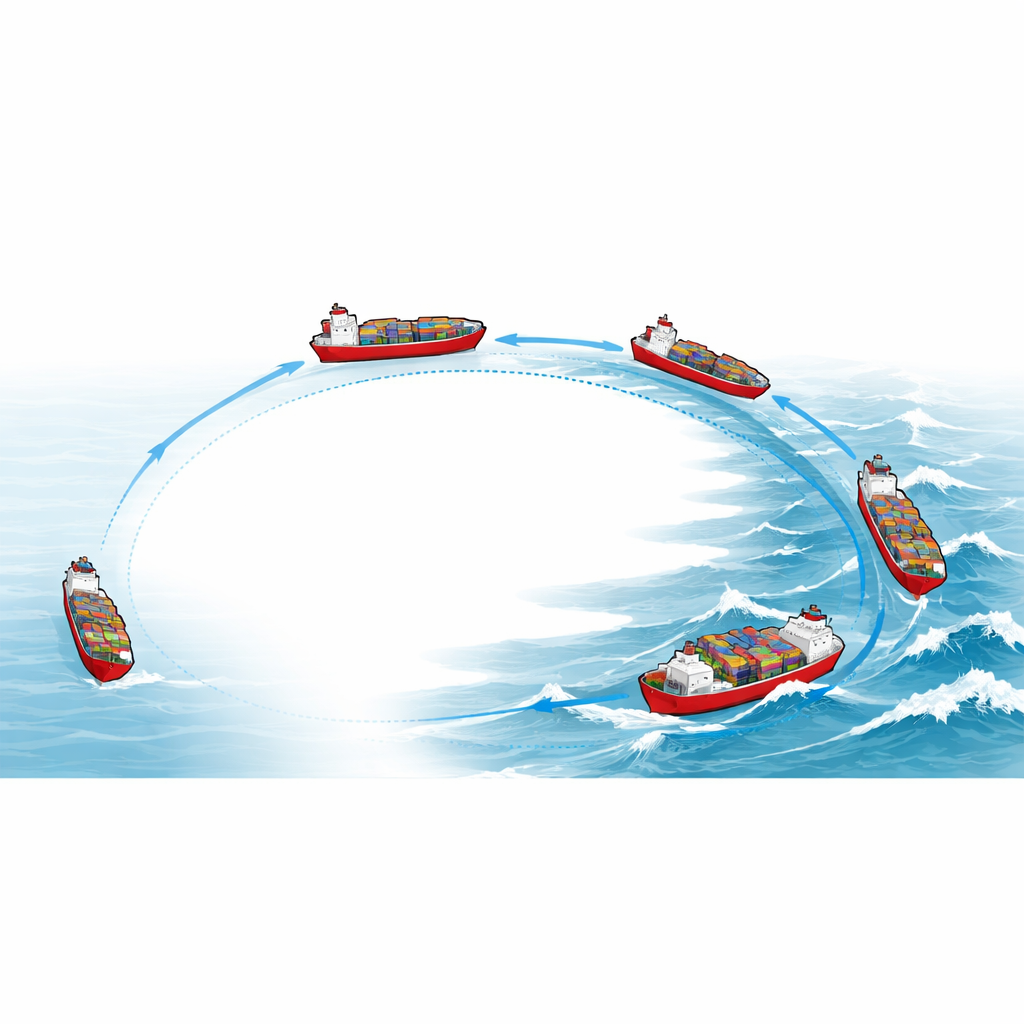
Although a ship looks like it simply glides forward and turns left or right, its motion is far more complex. It can move forward and sideways, rise and fall, and tilt in both roll and pitch—six different motions happening together. In calm water, these are already coupled; in waves, they become tightly intertwined. The authors focus on a standard container ship design known as S‑175 and study how it behaves when performing large turning maneuvers in regular waves, both when waves come head‑on and from the side. Their goal is to capture this full six‑way motion in a way that is faithful to reality but still practical for engineers to use.
Testing in a giant indoor ocean
To anchor their work in real behavior, the team first carried out experiments in a large indoor test basin equipped with sophisticated wave makers. A scaled model of the S‑175 ship, complete with propeller and rudder, was run in calm water and in controlled head and side waves. The researchers measured the ship’s path as it turned through 35‑degree rudder commands, as well as its tilt, rise and fall, and change in heading over time. From these tests they extracted key maneuvering measures such as how far the ship travels before turning 90 or 180 degrees and the size of the circle it describes while turning. These experimental results provide a demanding benchmark for any computer model that claims to predict ship maneuverability in waves.
Simulating every swirl of water at lower cost
Instead of relying on simplified theories, the authors use a detailed fluid simulation approach more commonly seen in advanced aerodynamics. They solve the governing equations for viscous water and air around the hull, a method that can, in principle, capture the fine details of waves, wakes, and turbulence. To make such heavy calculations feasible, they employ two clever simplifications. First, they represent the propeller not with separate spinning blades but as a "body force" disk that pushes the water in the right way without tiny time steps. Second, they use overlapping grids that move with the ship and rudder, allowing high resolution near the hull while keeping the overall mesh modest. With these tools, they run full six‑motion simulations of the ship turning in waves, tracking the same maneuvering measures as in the tank tests.
What happens when a big ship turns in waves
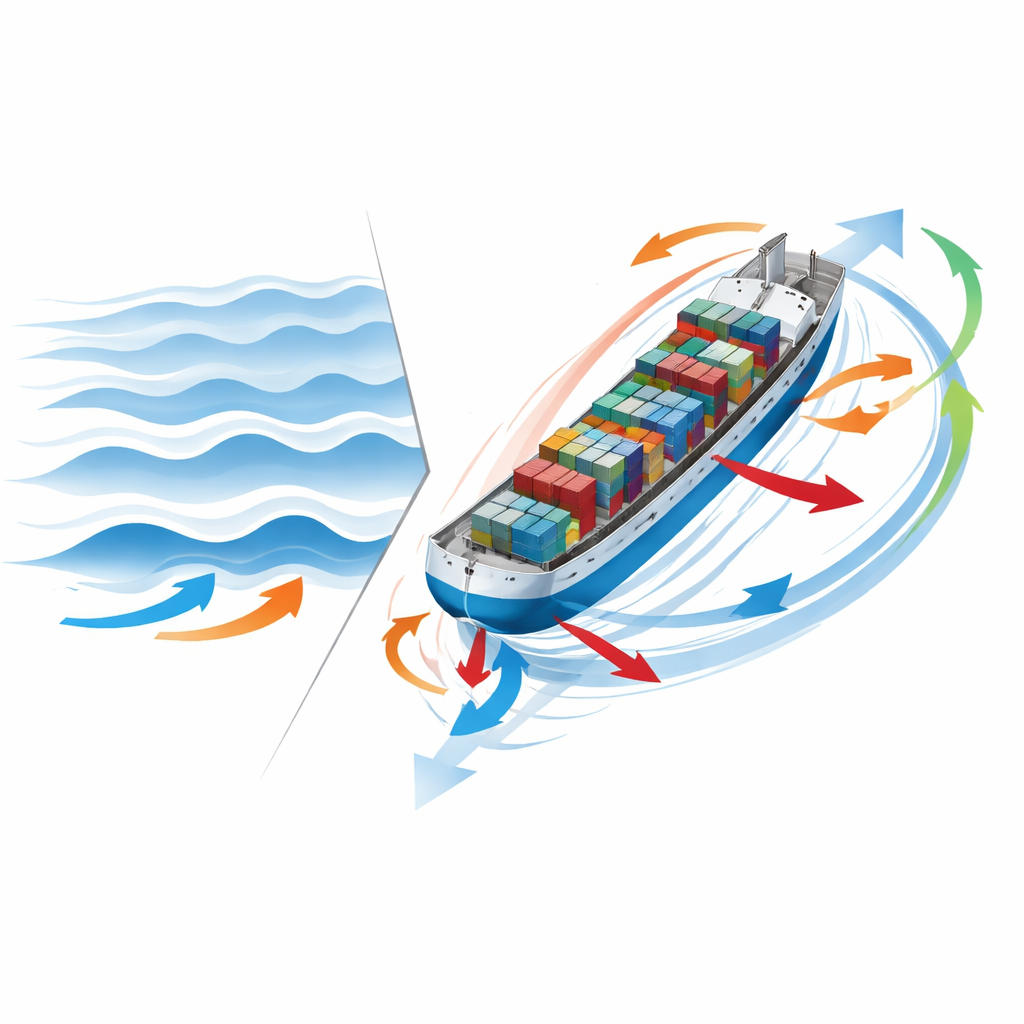
The simulations reveal how the ship’s speed, sideways drift, and tilts change as it swings through different wave directions. As the turn begins in head waves, forward speed drops and side‑slip grows, while the ship’s rise‑and‑fall and tilting show strong oscillations tied to the encounter with the waves. When the ship reaches side‑wave and following‑wave conditions later in the turn, the pattern of forces and motions changes: sideways forces from the hull and rudder compete, roll motions grow in some stages, and the ship’s track can drift more or less depending on the wave angle. By comparing simulated and measured paths, the authors find that their model reproduces the shape of the turning circles and the timing of the maneuvers well, though it tends to predict slightly larger sideways drift in some cases, especially when the waves hit from the side.
Bringing simulations closer to real‑world steering
Overall, the study shows that high‑fidelity fluid simulations, simplified with smart numerical tricks, can predict how a large container ship turns in waves with errors typically under about 15 percent for key maneuvering distances and times. For ship designers and regulators, this means that, as computing power continues to grow, it will become increasingly practical to assess a vessel’s turning safety in rough seas using virtual trials instead of—or in addition to—costly basin tests. The authors note that further work is needed for more violent and irregular seas, but their results mark an important step toward routinely using detailed physics‑based models to ensure that the next generation of giant ships can steer safely through real ocean waves.
Citation: Zhan, J., Ma, Y., Zhan, C. et al. Numerical study on the 6-DOF motions of ship turning in waves. Sci Rep 16, 11681 (2026). https://doi.org/10.1038/s41598-026-46427-8
Keywords: ship maneuverability, waves and ship motion, computational fluid dynamics, ship turning performance, maritime safety