Clear Sky Science · en
Evolution of mesoscale force chains at the structural steel-coal rock interface and macro-scale mechanical response characteristics
Keeping heavy machines steady underground
Deep in coal mines, huge hydraulic supports hold up the roof and keep workers safe. These steel structures must slide forward smoothly as mining progresses, but they actually rest on a thin layer of coal dust lying on rock. This study explores a surprisingly simple question with big safety implications: how does the moisture in that coal dust change the way forces travel between steel, dust, and rock—and how can a little water make the supports more stable?
The hidden layer under the steel base
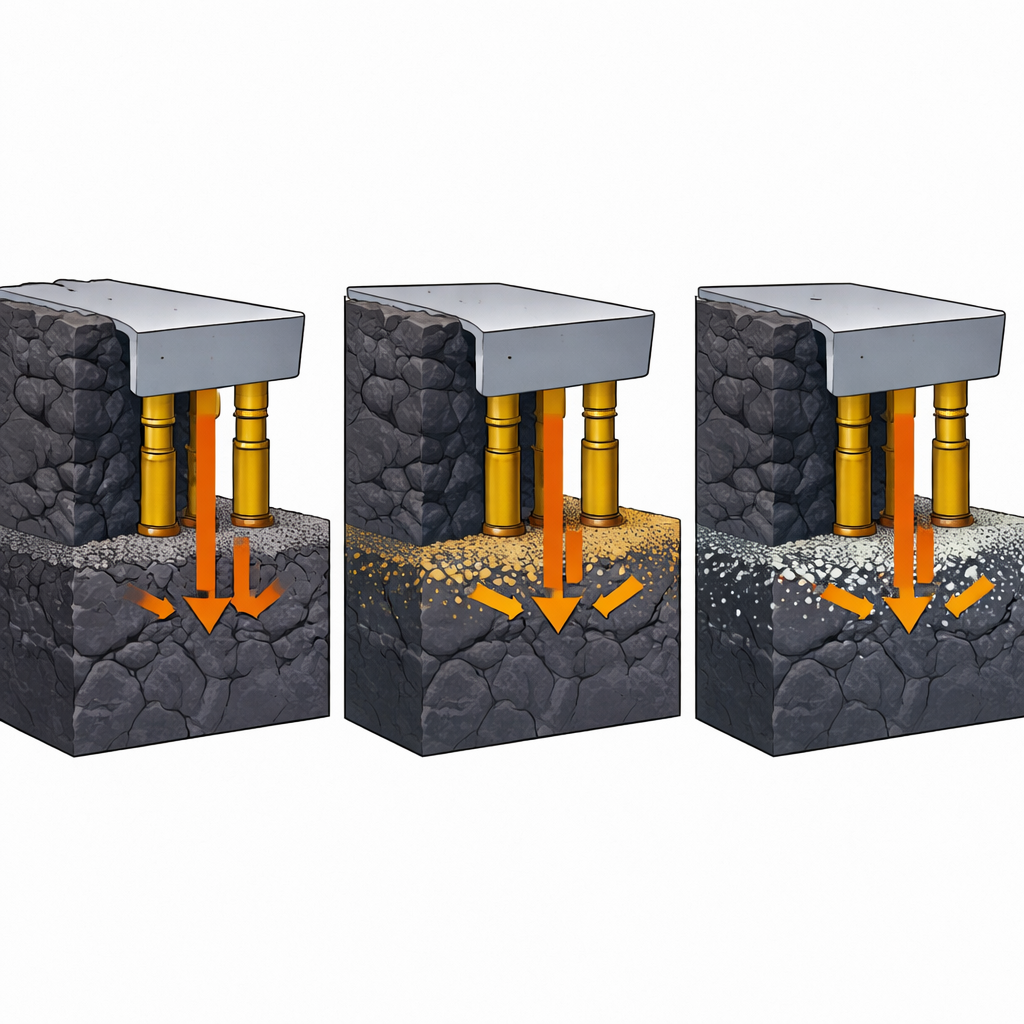
In real mines, the steel base of a hydraulic support does not press directly on bare rock. Instead, there is usually a thin, uneven cushion of coal powder sandwiched between the metal and the coal-rock floor. This turns what might seem like a simple two-body contact (steel on rock) into a three-body system: steel, coal dust, and rock. The tiny particles in this layer carry and redistribute the enormous loads from the support. Their behavior depends strongly on how wet or dry they are, which in turn affects how loads concentrate or spread out under the steel.
How the researchers built a digital mine floor
To study this tricky interface, the authors combined two powerful numerical methods. They used a finite element model to represent the steel base and the underlying coal rock, capturing how these solid pieces deform under load. At the same time, they used a discrete element model to represent each grain of coal powder as an individual particle that can stick, move, and even break. They reconstructed realistic rough surfaces for the steel and rock, then filled the gap with coal powder at different moisture levels. A special contact model described how slightly wet particles attract each other through tiny liquid bridges, while a separate fracture model allowed particles to shatter and generate finer fragments under pressure.
Force chains: from a few long paths to many short ones
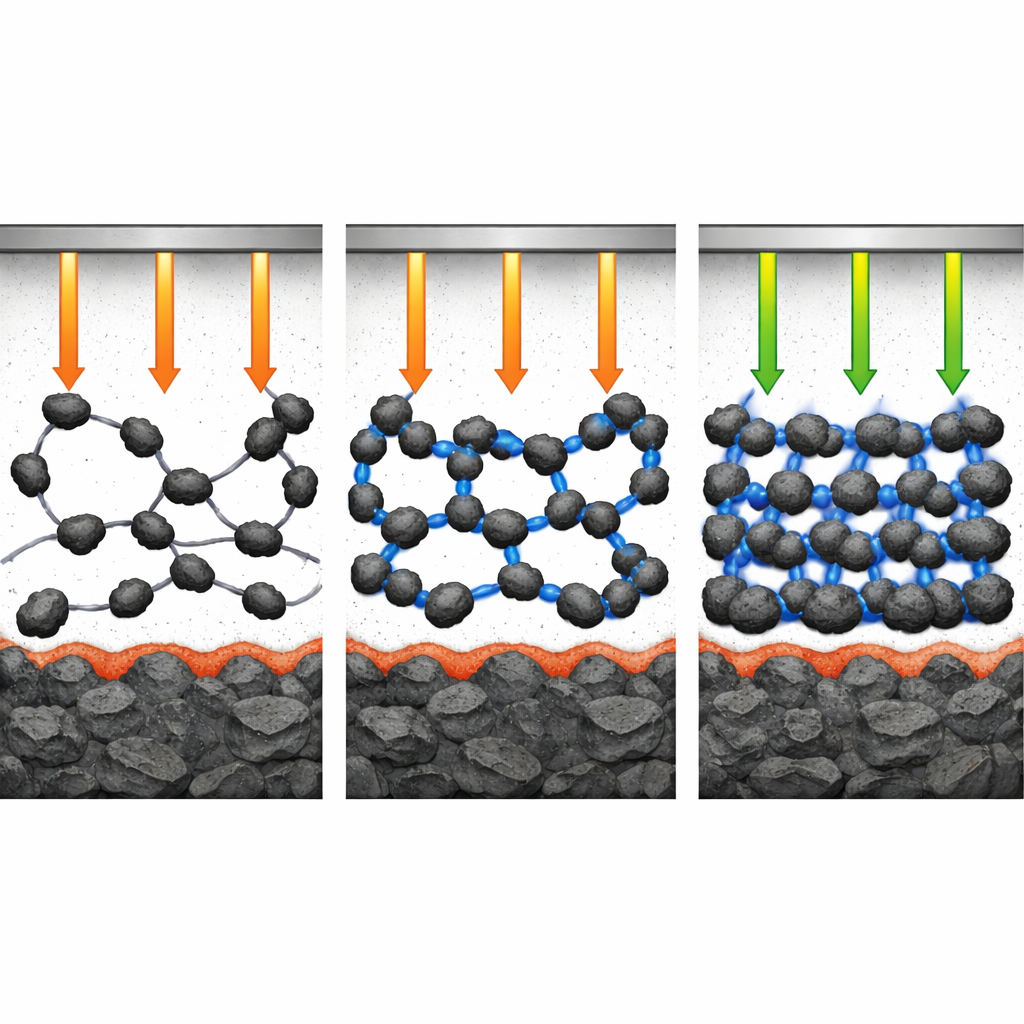
Inside the coal powder layer, the load from the steel plate does not spread evenly from grain to grain. Instead, groups of particles line up and press on each other in strands called force chains, which carry most of the load. The simulations show that the number and length of these chains change over time and with moisture. The total number of chains first increases and then levels off; their average length grows, shrinks, and finally stabilizes. In very dry coal (about 2% moisture), only a few long, weak chains form. They are easy to break and rearrange, making force transfer unstable. As moisture rises to 6% and then 12%, liquid bridges increase cohesion between grains. The network shifts from “few but long” chains that span large regions to “many but short” chains that work together locally, forming a denser and more resilient load-bearing web.
What moisture does to stress on the steel
The team also tracked how the coal powder stores, releases, and dissipates energy as the steel plate presses down. Coal grains compress elastically, rearrange, and sometimes fracture, converting sharp impact into a sequence of energy storage and release events. In moderately wet coal (around 6% moisture), the energy dissipation shows two distinct stages: first dominated by particle breakage, then by rearrangement and smoother sliding assisted by moisture and fine fragments. This behavior leads to a more gradual and uniform transfer of load. Simulations and laboratory tests revealed that dry coal causes the highest peak stress on the steel surface, which then drops quickly as the loose particles collapse. At very high moisture (12%), strong bonding and deformation can again raise local stresses. Remarkably, at about 6% moisture the steel surface experiences the lowest and most evenly distributed peak stress, and the model’s predictions matched experiments within about 10.7%.
A sweet spot for safer support
To a non-specialist, the key message is that a thin, dusty layer under heavy mine supports behaves like a living structure that channels force along particle chains. Adjusting how wet that dust is can tune this hidden structure. The study shows that keeping coal powder moisture around 6% allows the particles to link into a stable network that spreads loads more evenly, lowering dangerous stress peaks on the steel base. In practice, this insight can guide how mine operators manage floor conditions and support movement, helping large hydraulic supports move more smoothly while reducing the risk of instability underground.
Citation: Chen, H., Tao, P., Liu, J. et al. Evolution of mesoscale force chains at the structural steel-coal rock interface and macro-scale mechanical response characteristics. Sci Rep 16, 10686 (2026). https://doi.org/10.1038/s41598-026-46363-7
Keywords: hydraulic supports, coal mine safety, particle force chains, three-body contact, moist coal dust