Clear Sky Science · en
CNN-based compensation of faulty planar phased-array radiation patterns
Keeping wireless signals on track
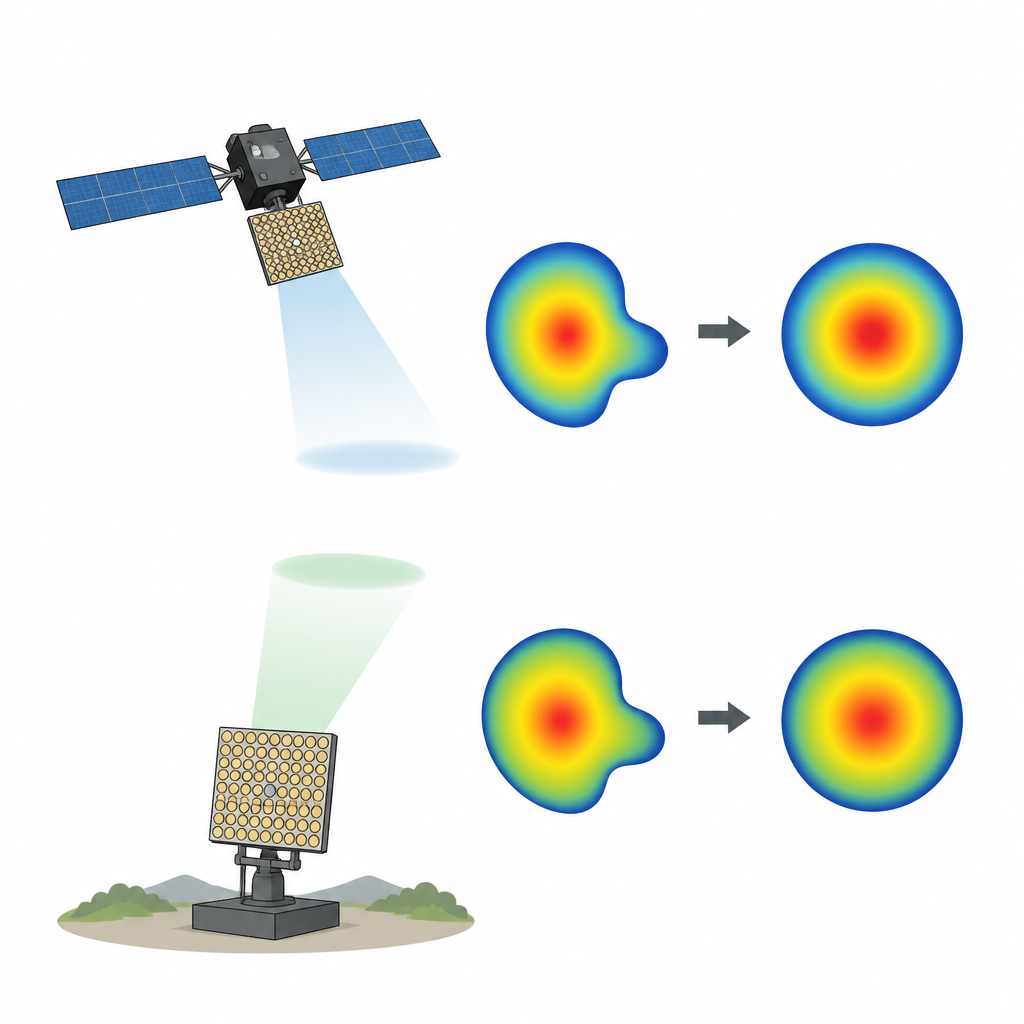
From satellite internet to airport radar, many of today’s most important systems rely on flat antenna panels made of many tiny radiating elements. When even one of these elements fails, the carefully shaped beam of radio energy can warp, weakening links or blurring radar images. This study explores how a type of artificial intelligence, called a convolutional neural network, can rapidly "heal" these damaged beams in software, helping critical systems keep working without physical repairs.
Why broken antenna tiles matter
Modern phased array antennas work a bit like a crowd at a concert clapping in sync. Each small antenna tile adds its signal at just the right moment so that, together, they push energy in a chosen direction and cancel it in others. If one tile suddenly goes silent, that careful timing is disturbed. The main beam can tilt off target, its width can swell, and stray sidelobes can grow, wasting power and causing interference. In places where fixing hardware is hard or impossible, such as satellites in orbit or remote radar sites, a smart way to compensate for these failures from the ground is highly desirable.
Teaching a neural network to read beam shapes
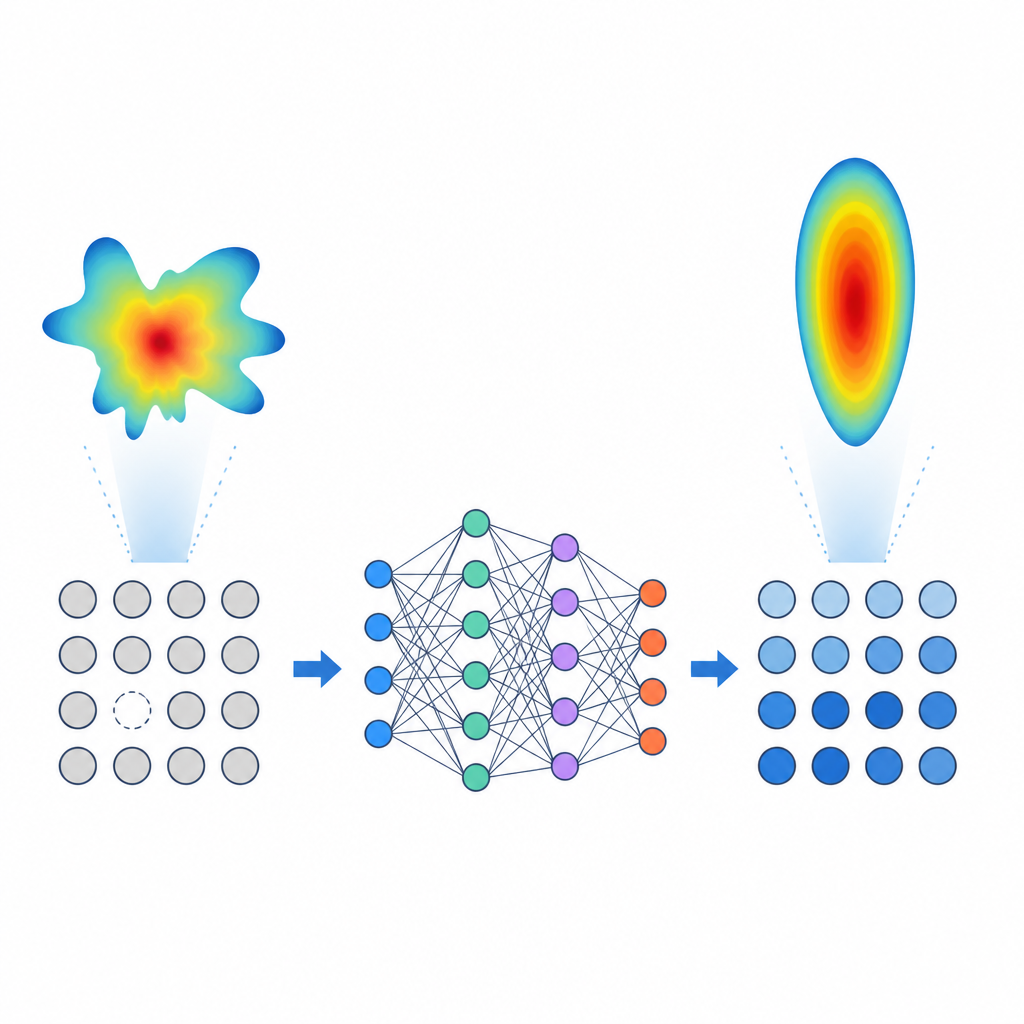
The authors focus on a small but realistic test case: a 4 by 4 square panel of patch antennas working at a frequency used in new communication systems. One element is assumed dead, one is used as a fixed reference, and the remaining fourteen can still be adjusted in phase, which is the timing of their wave peaks. Rather than designing new settings for these elements through slow trial and error, the team trains a neural network that looks directly at a two dimensional picture of the beam in space and predicts which phase values will recreate the desired pattern as closely as possible with the surviving hardware.
Building the learning engine
To teach the network, the researchers generated 8,000 simulated examples of faulty panels using professional electromagnetic software. For each case they randomly chose phase settings for the fourteen controllable elements, calculated the resulting beam pattern, and stored both the "image" of that pattern and the underlying phase values. They then fed these image–phase pairs into a convolutional neural network, the same family of models widely used in image recognition. Layer by layer, the network learned to spot the subtle spatial fingerprints left in the beam when the phases are changed, and to map those fingerprints back to the exact phase settings that created them.
Recovering clean beams in a split second
Once trained, the model is used in reverse: instead of seeing a faulty pattern, it is shown the intact target pattern that the array should produce. The network instantly outputs a new set of fourteen phases that the partially failed array can use to mimic that target. In testing, the predicted phases were accurate to well under a degree for each element. When these phases were applied in simulation, the reconstructed beams closely matched the originals, shrinking errors in the pattern by roughly one third on average across many test cases. Key antenna measures such as beam pointing, width and sidelobe levels moved much closer to their healthy values, while the processing time dropped from minutes with classical search methods to about two tenths of a second on a standard graphics card.
What this means for real systems
For the moment, this method is a proof of concept. It assumes a specific array size, a single failed element and access to clean, detailed beam measurements, conditions easier to meet in software than on a satellite. Still, it clearly shows that a neural network can learn the link between how a damaged antenna radiates and the phase tweaks needed to repair its beam. With future work to handle multiple failures, different panel designs and realistic measurement setups, similar approaches could give communication and radar systems a powerful form of self healing control, improving reliability without touching the hardware.
Citation: Djassem, B.M., Challal, M., Staraj, R. et al. CNN-based compensation of faulty planar phased-array radiation patterns. Sci Rep 16, 15528 (2026). https://doi.org/10.1038/s41598-026-46345-9
Keywords: phased array antennas, beamforming, fault compensation, convolutional neural network, radiation pattern