Clear Sky Science · en
Few-shot learning for classification of SEM images from green-synthesized nanoparticles of Momordica cymbalaria
Plants, tiny particles, and smart computers
What if everyday plants could help make tiny particles for future medicines, and smart computer programs could sort those particles almost as well as a human expert? This study brings together green chemistry and artificial intelligence by using extracts from a medicinal vine, Momordica cymbalaria, to create nanoparticles and then training a compact image recognition model to tell different samples apart using only a handful of microscope images.
Using a medicinal plant to build tiny particles
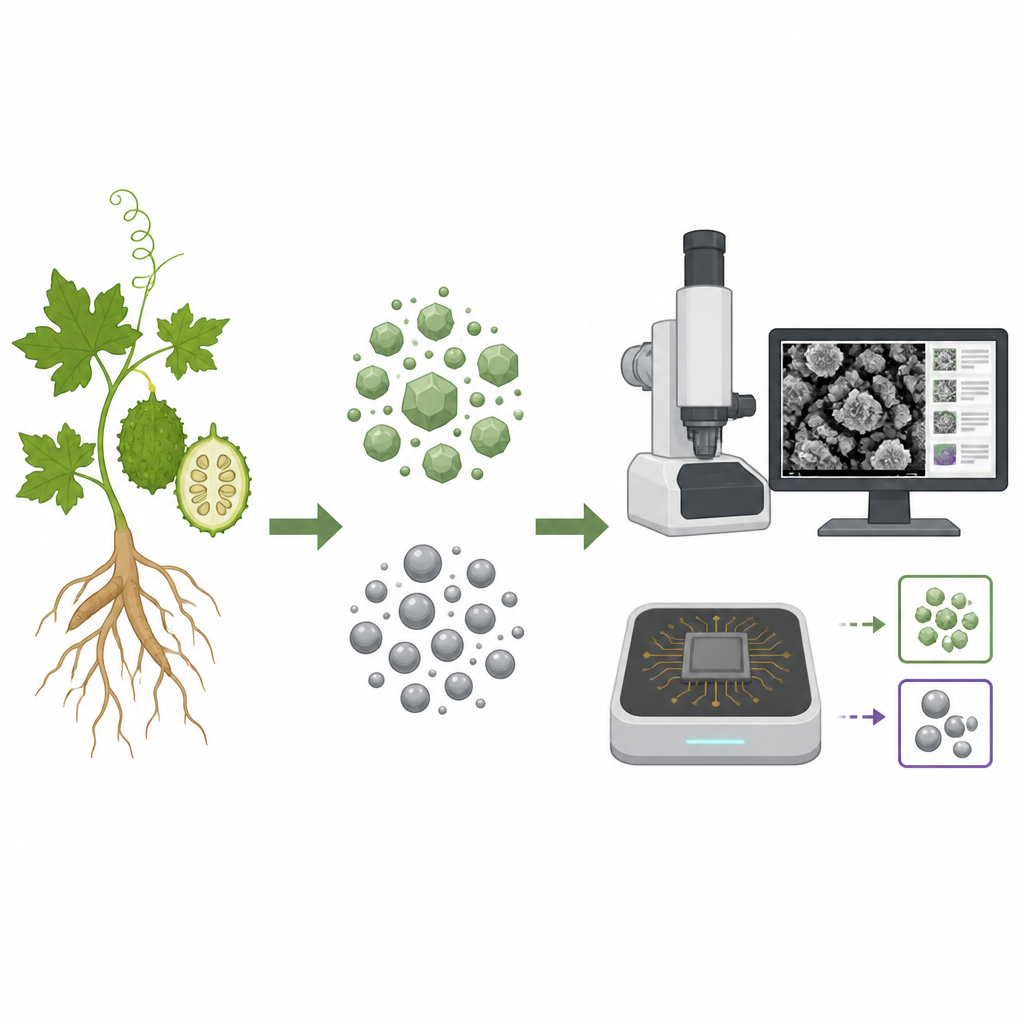
Instead of relying on harsh chemicals, the researchers turned to a plant already known in traditional medicine for its role in blood sugar control. They used its roots and fruits as natural mini factories to make two types of nanoparticles: silver and calcium carbonate. Plant compounds helped drive and stabilize these reactions, offering a cleaner, potentially safer route than standard industrial methods. The resulting powders were carefully examined with several tools to check their size, shape, and chemical makeup.
Peeking at the particles with light and electrons
To understand what they had made, the team shone light through the samples and recorded how they absorbed different colors, a clue that the tiny structures had formed as expected. They also used a powerful electron microscope to create detailed black and white images, showing that the calcium carbonate particles were mostly round and clustered, while the silver particles clumped into larger, irregular shapes. Additional tests confirmed that the calcium-rich samples contained mostly calcium, oxygen, and carbon, whereas the silver samples showed strong silver signals along with organic material from the plant extract. Together, these measurements showed that the green process worked well for calcium carbonate, but that the silver process needs more tuning.
Teaching a computer to read microscope images
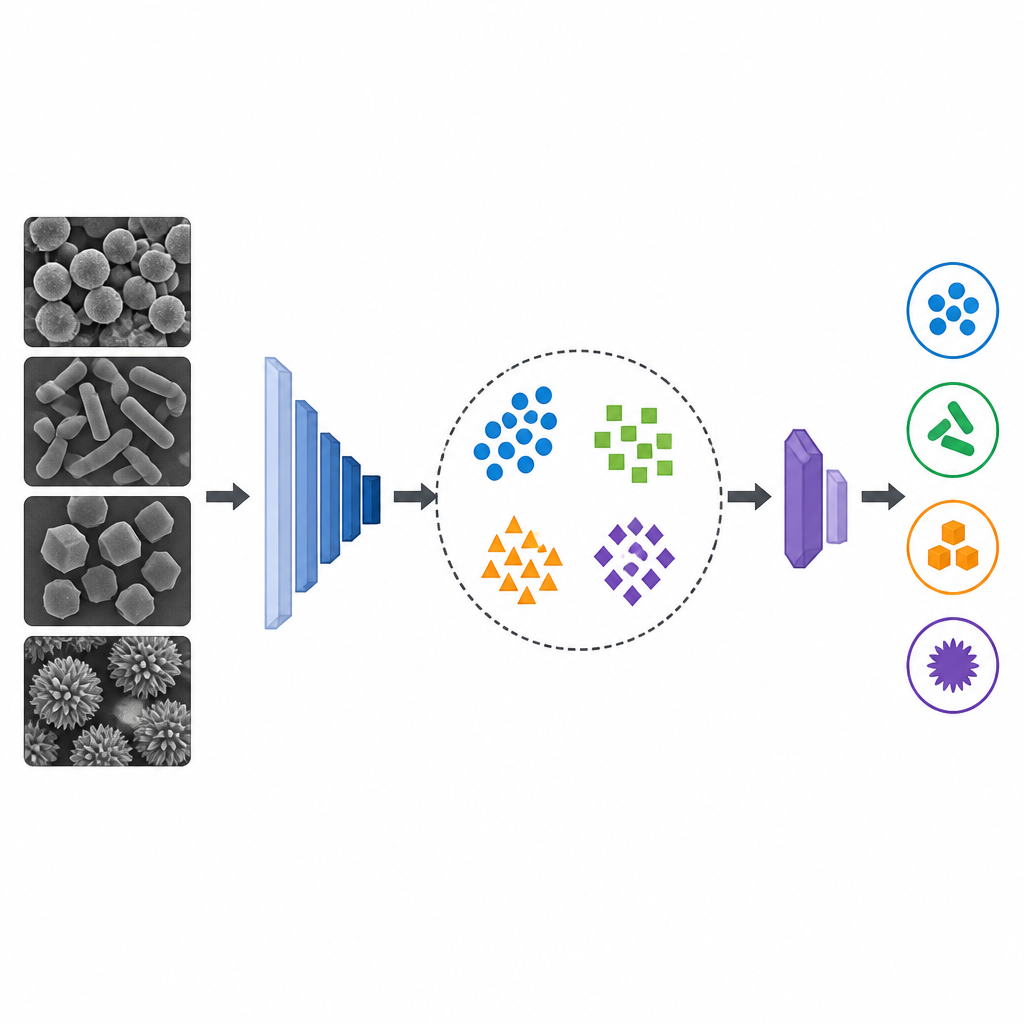
Collecting thousands of microscope pictures is hard and time consuming, especially in small labs. To cope with this, the authors turned to a style of artificial intelligence called few-shot learning, designed to work with very small training sets. They focused on scanning electron microscope images from four groups: silver from roots, silver from fruits, calcium carbonate from roots, and calcium carbonate from fruits. Before training, they cleaned and resized the images and created extra variations by rotating and flipping them to stretch the tiny dataset. Two well-known image analysis networks, MobileNetV2 and ResNet50, were adapted to turn each image into a compact numerical fingerprint.
How the few-shot model makes decisions
Instead of simply feeding all images into a standard classifier, the system learned in small tasks that mimicked real-world low-data situations. In each task, it saw only a few examples from each class, used them to find a typical "center" for that class, and then decided where new images best fit. Distances between images and these centers were measured in a way that takes into account how spread out each class is, making subtle differences easier to detect. By repeating many such episodes, the model gradually learned features that separate the four nanoparticle groups, even though the total dataset was tiny.
A compact model with strong performance
When the researchers compared different training setups, the most advanced few-shot approach, using MobileNetV2, performed best. This version combined episodic training, class centers refined by clustering, and a distance measure that is sensitive to patterns in the data. It reached about 95 percent accuracy while remaining small enough to run on modest computers or even edge devices. Simpler methods that relied on ordinary transfer learning or basic distance measures did noticeably worse, highlighting the benefit of tailoring the training strategy to low-data conditions.
What this means for future lab work
For a non-specialist, the key message is that environmentally friendly nanoparticle production can be paired with smart, data-efficient image analysis to speed up lab workflows. While the plant-based method for calcium carbonate looks promising and the silver route still needs refinement, the few-shot learning framework already shows that reliable particle classification does not require huge image libraries. Approaches like this could one day help small research groups or clinics quickly check the quality and type of nanoparticle materials, supporting safer and more consistent use in medicine and other technologies.
Citation: Venkatappa, U., Bhat, S., Dixit, M. et al. Few-shot learning for classification of SEM images from green-synthesized nanoparticles of Momordica cymbalaria. Sci Rep 16, 16185 (2026). https://doi.org/10.1038/s41598-026-46307-1
Keywords: green nanotechnology, few-shot learning, SEM image classification, Momordica cymbalaria, nanoparticle synthesis