Clear Sky Science · en
Baseline malaria burden and pyrethroid resistance in Muheza, Tanzania informing a cluster randomized trial of the 3D window screens
Why this matters for everyday life
Malaria still kills hundreds of thousands of people every year, most of them young children in Africa. In northeastern Tanzania, families rely heavily on insecticide‑treated bed nets and indoor sprays to keep mosquitoes at bay. But mosquitoes are becoming harder to kill with these chemicals. This study set out to measure how serious the malaria problem remains in one Tanzanian district and to prepare for testing a new kind of window screen that blocks and traps mosquitoes without using insecticides.
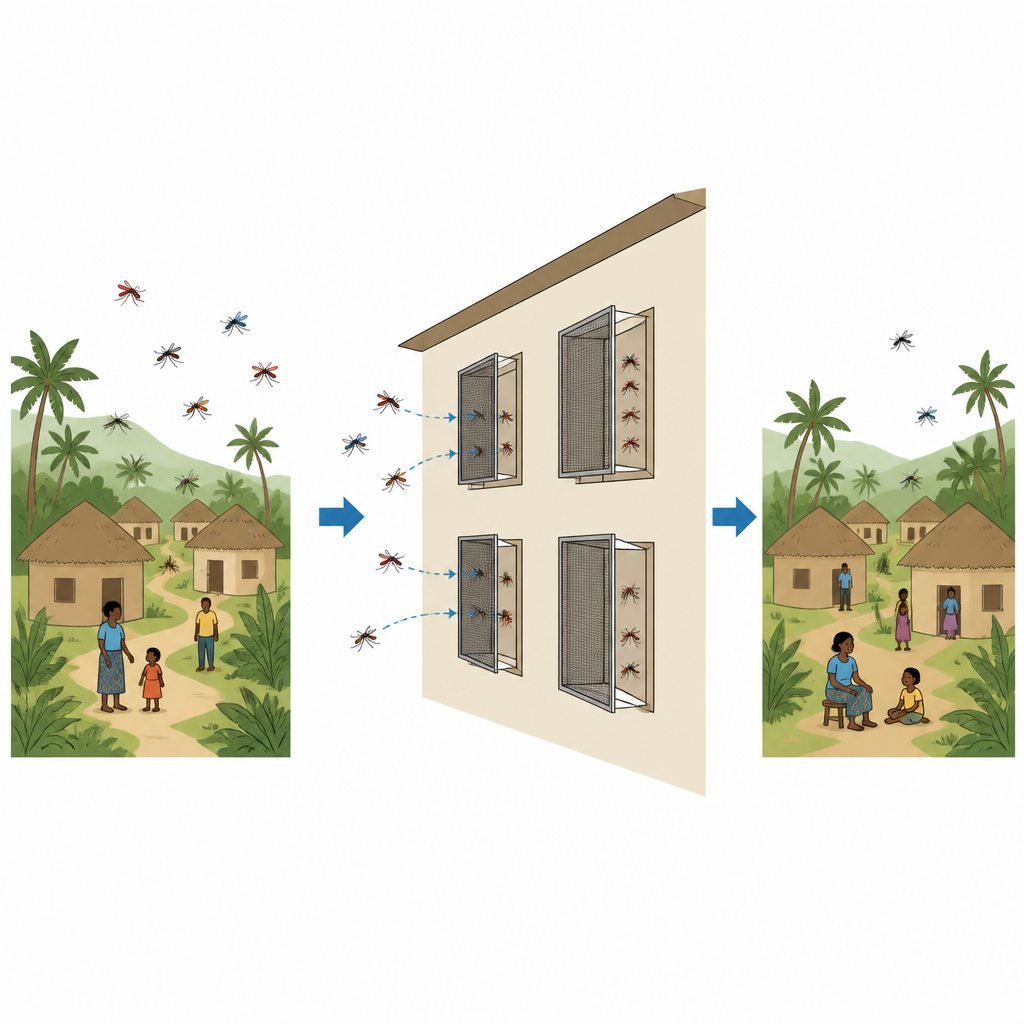
Taking a close look at village life
Researchers visited 20 small communities in Muheza District, a humid, farming region at the foot of the East Usambara Mountains. They interviewed residents in more than 1,200 households about family size, income, house structure and mosquito‑control habits. Most homes were built from mud with thatched or iron roofs, and almost everyone relied on small‑scale agriculture. While more than four out of five households owned at least one insecticide‑treated bed net, only about half had enough nets for everyone to sleep under one, and many families reported no other way of keeping mosquitoes away.
Illness and hidden weakness in children
The team tested 778 children between six months and 14 years of age for malaria using rapid tests and measured their blood level to screen for anaemia, a shortage of healthy red blood cells. They found that about four in ten children carried the malaria parasite, even if they did not feel sick, and more than half were anaemic. Older children, aged five years and above, were roughly three times more likely to be infected than younger ones, perhaps because they spend more time outdoors or sleep less consistently under nets. Children who did sleep under a net the previous night were much less likely to test positive, confirming that nets are still helpful even where resistance is spreading.
What the mosquitoes reveal
To understand how malaria spreads in these villages, the researchers hung light traps inside houses and caught more than 14,000 mosquitoes. Two main mosquito groups that transmit malaria dominated the collections. One group, known locally for resting indoors and feeding on people, made up about 70 percent of the malaria‑carrying mosquitoes caught. The other, although less common in the traps, showed the strongest link with how many children in a village had malaria, underlining its key role in passing on the parasite. By combining mosquito infection rates with biting rates, the team estimated that people in these communities receive around 28 infectious bites per year on average, enough to keep malaria firmly established.
Insecticides are losing their edge
The study also tested how well common mosquito‑killing chemicals still work. Mosquitoes raised from local breeding sites were exposed to standard doses of two widely used insecticides, permethrin and deltamethrin. After 24 hours, only about half of the insects had died, far below the level that signals full susceptibility. Genetic tests showed that many mosquitoes carried a known resistance mutation that helps them survive on treated surfaces. This pattern varied between related species, with the most human‑biting type carrying the mutation far more often than its more cattle‑biting cousin. The findings confirm that relying on insecticides alone is becoming increasingly risky in this area.
Preparing the ground for new house protection
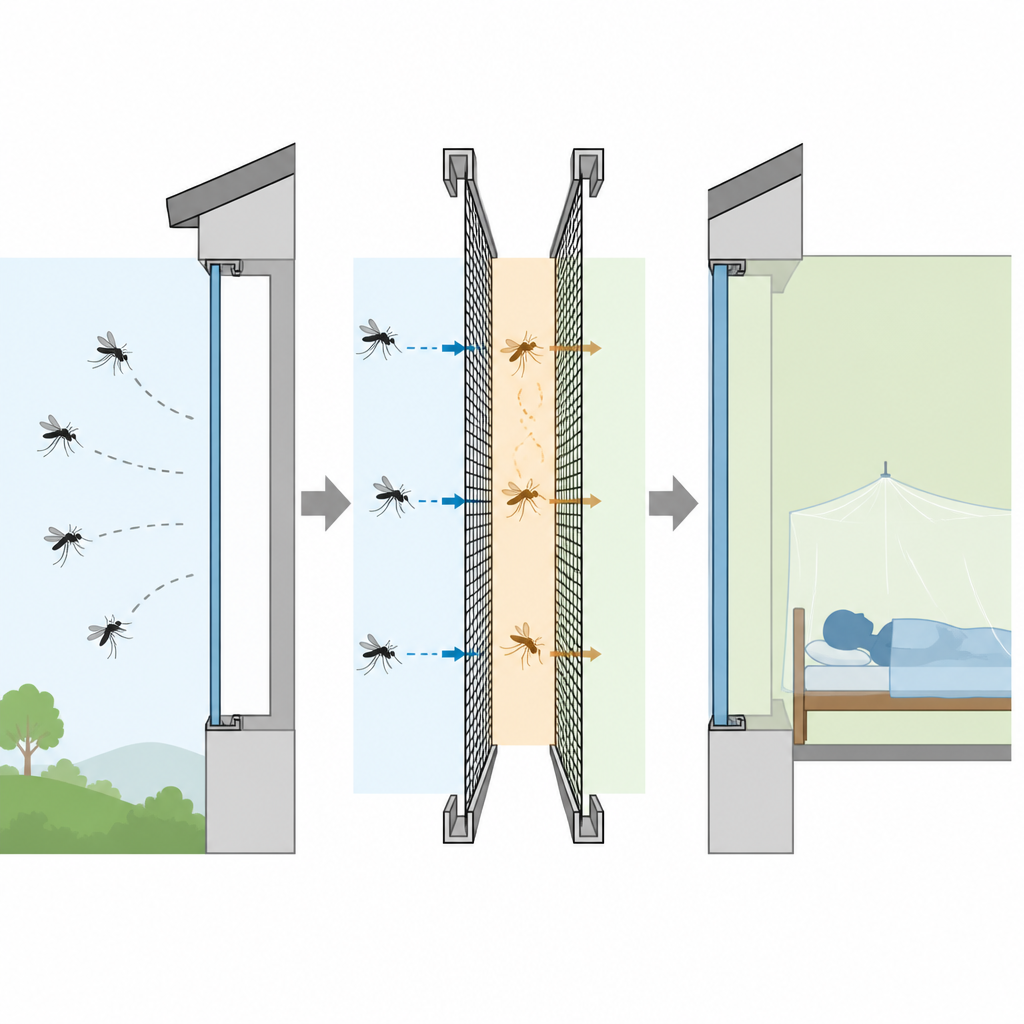
Alongside these measurements, the researchers mapped each community, recorded house layouts and identified which homes could be fitted with a new three‑dimensional window double screen. This device uses the mosquitoes’ own attraction to people: it allows them to fly in through small funnel‑like openings but traps them between two layers of mesh before they can reach the room. Earlier tests in wind tunnels and semi‑field huts suggested the screens can catch a large share of malaria‑carrying mosquitoes without any chemicals. The detailed baseline data from Muheza will guide a large community trial where some villages will receive the new screens while others will continue with bed nets alone.
What this means for families at risk
The study shows that malaria remains common in Muheza, many children are anaemic, and local mosquitoes are becoming hard to kill with standard insecticides. Bed nets still protect those who use them, but they are no longer enough on their own. By documenting the burden of disease, the behaviour of mosquitoes and the level of insecticide resistance, this work sets the stage for testing insect‑free window screens as an extra layer of protection. If these simple house modifications reduce mosquito bites in the upcoming trial, they could become a practical tool that communities across Africa use alongside nets and other measures to make their homes safer from malaria.
Citation: Kathet, S., Bwana, V.M., Fereji, M.A. et al. Baseline malaria burden and pyrethroid resistance in Muheza, Tanzania informing a cluster randomized trial of the 3D window screens. Sci Rep 16, 15895 (2026). https://doi.org/10.1038/s41598-026-46221-6
Keywords: malaria, mosquito control, insecticide resistance, Tanzania, window screens