Clear Sky Science · en
Topology optimization of wheel spoke cavities for lightweight design under bending fatigue and impact load cases
Why lighter wheels matter
Every time a car speeds up, slows down, or bumps over a curb, its wheels quietly take a beating. Making those wheels lighter helps cut fuel use and emissions, and it can even improve how the car feels to drive. But shaving off too much metal risks cracks, dents, or even failure in safety tests. This study tackles a practical puzzle for automakers: how to subtly reshape the hidden side of aluminum wheel spokes so they handle repeated bending and curb impacts more safely—while trimming a little weight—without changing the visible style buyers care about.

The challenge of safe and light wheels
Vehicle makers know that reducing weight is one of the most effective ways to boost efficiency. Cutting a small amount from the wheel—part of the car’s "unsprung" mass—has an outsized effect, because it directly influences how the suspension moves. Yet a wheel must also survive harsh tests that mimic years of cornering and sudden curb hits. The baseline wheel in this study, an 18-inch aluminum design used as a real industrial example, actually failed two key standards: a long-duration bending fatigue test and a 13-degree angled impact test that represents curb strikes. In both cases, high internal stresses appeared near the spokes, and cracks in physical tests lined up with the computer’s stress hot spots.
A smart way to search for better shapes
Instead of relying on trial-and-error grooves and pockets in the back of the spokes, the researchers used a mathematical technique called topology optimization. In simple terms, they filled in the existing weight-reduction cavities on the hidden rear side of each spoke, then let a computer "carve out" material where it helped most and remove it where it did little work. Crucially, they froze the front-facing style of the wheel—the part customers see—and only allowed changes inside a carefully defined rear-cavity region. They also built in practical limits: minimum wall thicknesses, smooth draft angles so the wheel can be cast in metal molds, and symmetry so each spoke repeats the same pattern.
Balancing two tough test conditions
The wheel must endure both millions of bending cycles and a violent angled impact, and improving one test can sometimes worsen the other. To avoid this, the team treated the problem as a combined design challenge. They ran detailed simulations for both bending and impact and then used a "compromise" method that weighs how much each load case contributes to stored energy in the structure. That energy is a stand-in for stiffness and safety margin. With this blended yardstick, the optimization algorithm searched for a shape that improves performance in both tests at once, rather than trading one off against the other.
What changed inside the spokes
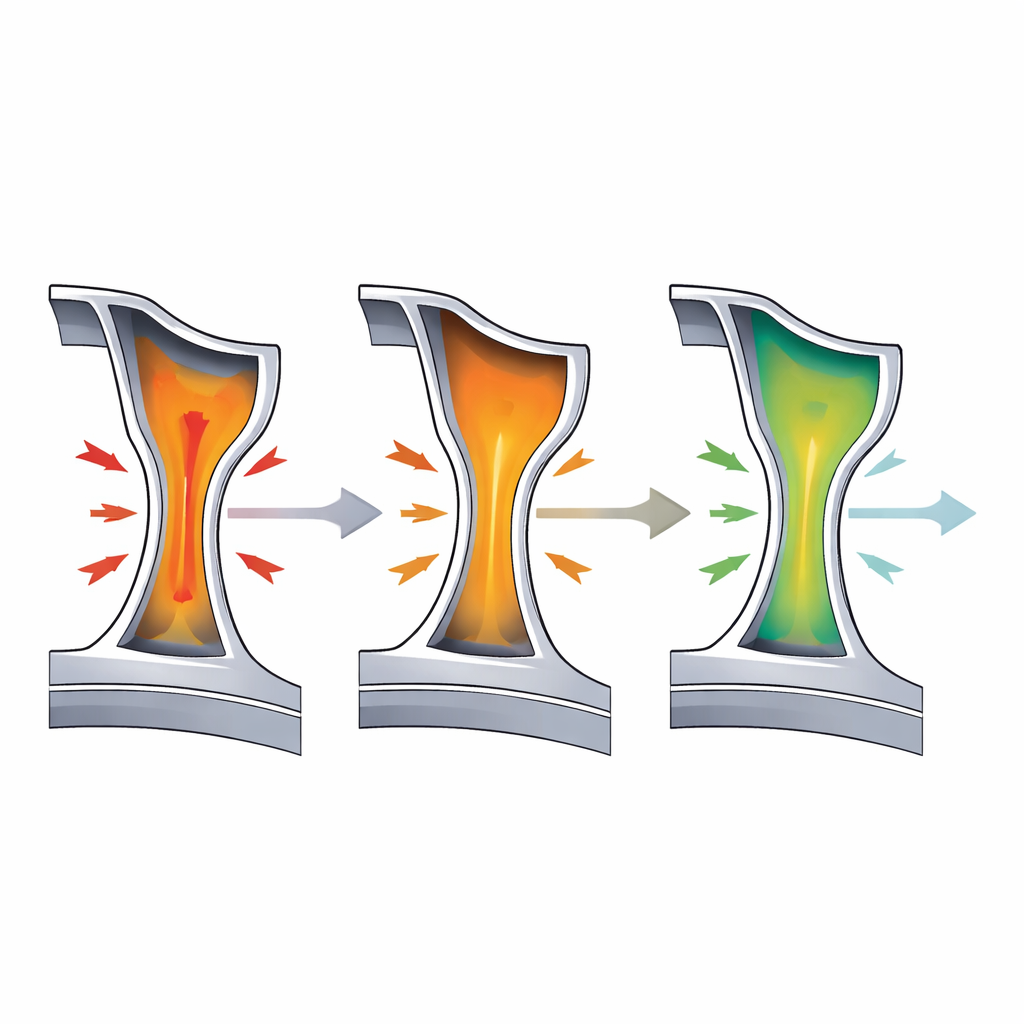
The computer’s answer was not a radical new wheel, but a subtle internal reshaping. Shallow, broad cavities in the spokes’ rear side were replaced by deeper pockets whose depth changes gradually along the spoke. These depth-gradient cavities guide forces more smoothly from the rim into the hub, reducing stress concentrations where cracks like to start. After rebuilding the computer-derived shape into a smooth, castable 3D model, the team re-ran the safety simulations. Peak stress under bending fatigue dropped by 19.25%, and peak stress under the 13-degree impact fell by 14.57%, both now comfortably under required limits. The mass fell only slightly—by about 0.5%—but the once non-compliant wheel now passed both virtual tests.
What this means for everyday vehicles
To a driver, the redesigned wheel looks unchanged from the outside. The gains come from carefully sculpted metal where no one usually looks: deep within the spoke cavities. By using rigorous computer search instead of guesswork, the study shows how manufacturers can turn a failing wheel into a safe one while trimming a little weight and keeping their styling intact. The main benefit here is not dramatic slimming but the removal of dangerous stress hot spots, which makes the wheel more resistant to long-term bending and sudden curb hits. The same approach—confining design changes to hidden regions while satisfying casting rules—could help engineers quietly upgrade many other safety-critical parts across cars, trains, and other vehicles.
Citation: Zhang, G., Cui, X., Zang, Y. et al. Topology optimization of wheel spoke cavities for lightweight design under bending fatigue and impact load cases. Sci Rep 16, 10817 (2026). https://doi.org/10.1038/s41598-026-46183-9
Keywords: lightweight wheel design, topology optimization, aluminum alloy wheels, fatigue and impact safety, automotive structural engineering