Clear Sky Science · en
A hybrid deep learning model for robust and efficient plant leaf disease detection using ResNet50, PCA, and SVM
Why spotting sick leaves early matters
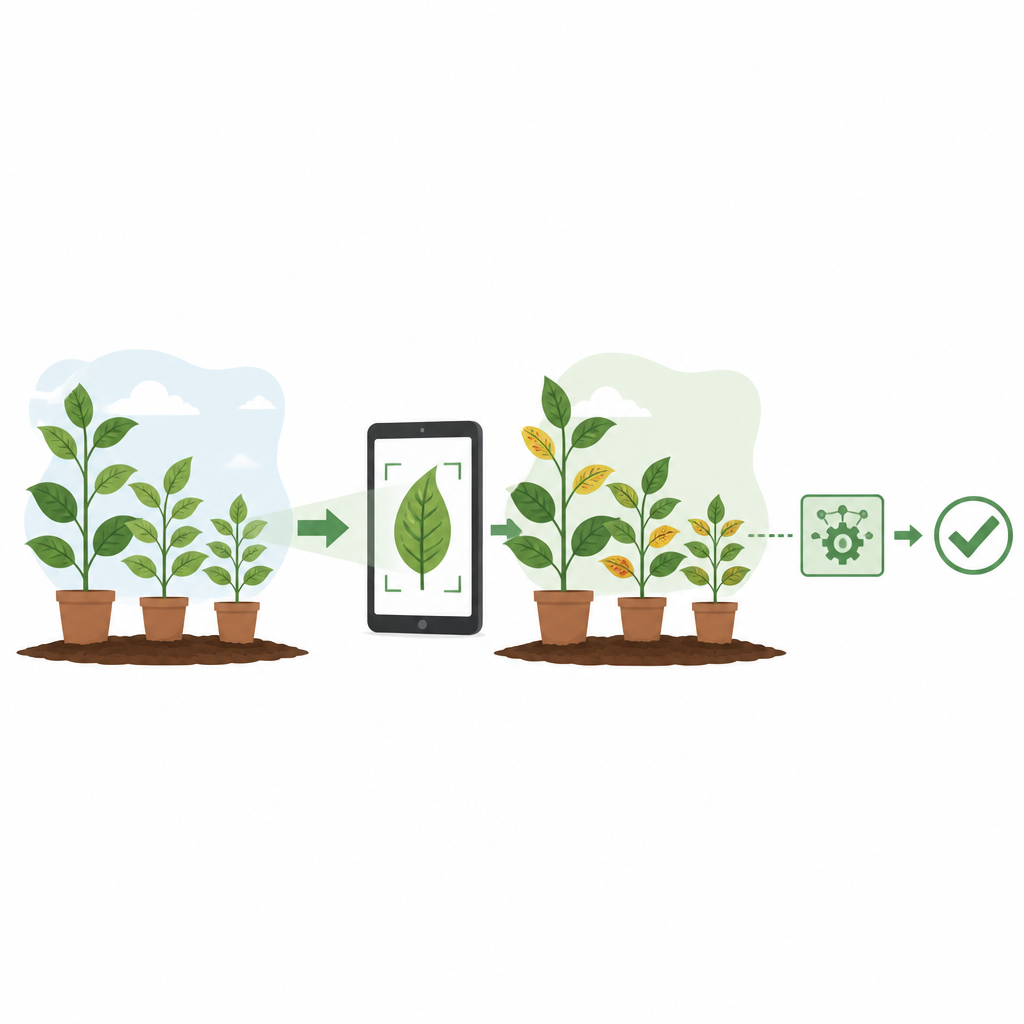
For many farmers, a single outbreak of plant disease can mean losing an entire season’s income. Catching illness early by looking at the leaves helps protect harvests, but doing this by eye is slow and often unreliable. This study explores how a carefully designed computer system can look at photos of plant leaves and quickly tell whether they are healthy or sick, without needing huge computers or massive amounts of training data. The goal is a tool that could one day run on modest devices and help guide decisions in precision agriculture.
A smarter way to read leaf photos
The researchers focus on a practical question: how can we get strong disease detection from leaf images while keeping the computer workload low? Many modern image-recognition methods use very large neural networks that demand powerful hardware and long training times. These can work well in research labs, but are hard to deploy on phones, small farm computers, or low-cost sensors. Instead of inventing a brand-new algorithm, the authors combine well-known building blocks in a way that balances accuracy, speed, and simplicity. Their system works on a popular public collection of 38 types of healthy and diseased leaves called the PlantVillage dataset.
Building a lean detection pipeline
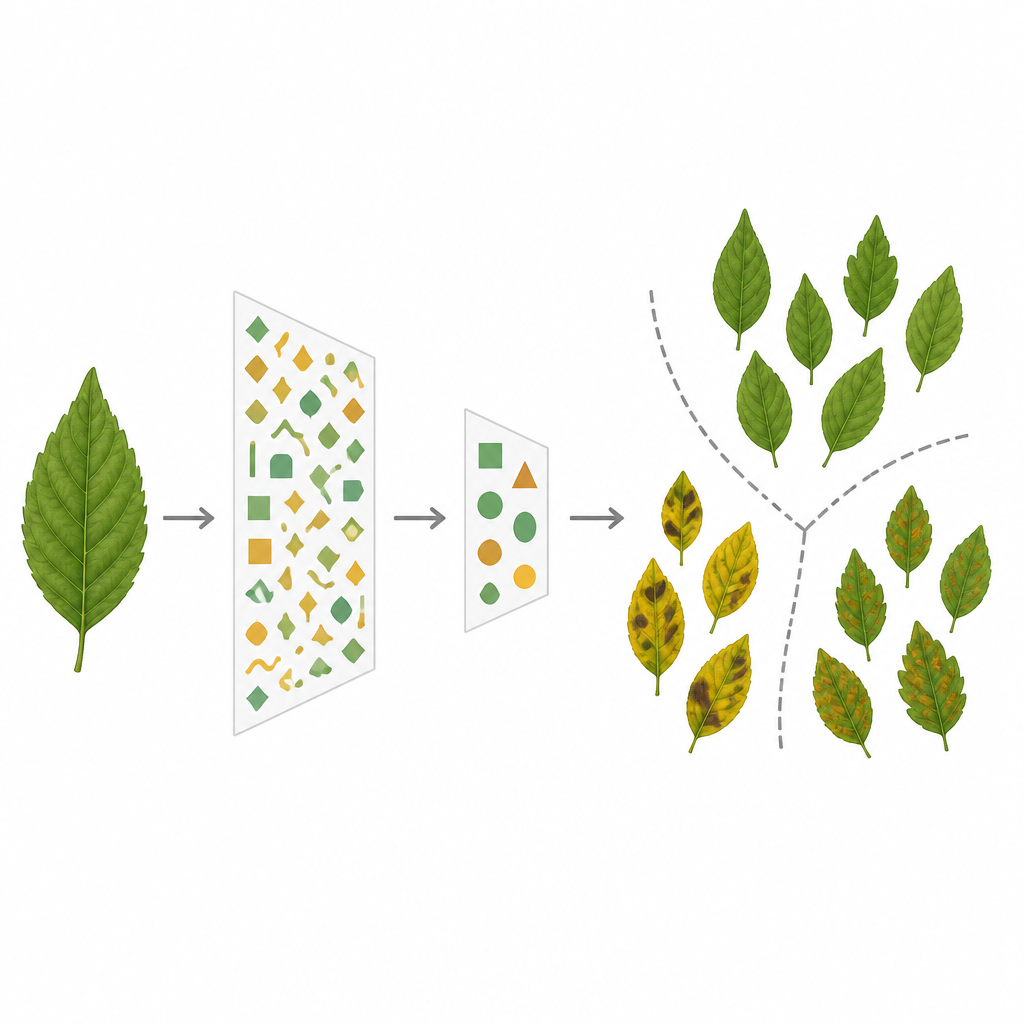
The pipeline begins with simple image preparation. Leaf photos are resized to a standard shape and lightly processed, and in some tests an optional color step is used to highlight reddish or brown patches that often signal disease. The heart of the system is a pre-trained image network known as ResNet50, which has already learned to recognize many patterns from a large general photo collection. Here, ResNet50 is not retrained from scratch; it acts like a frozen feature reader, turning each leaf image into a long numerical fingerprint that captures shapes, colors, and textures linked to disease.
Cutting down data while keeping meaning
Those fingerprints are very long and contain repeated information, which slows later processing and can lead to overfitting, where a model memorizes the training data instead of learning general rules. To tackle this, the team applies Principal Component Analysis, a classic method that squeezes the long fingerprint into a much shorter one while preserving most of the meaningful variation. This step sharply reduces how much the computer has to store and process. The compact fingerprints are then passed to a Support Vector Machine, a traditional classifier that draws boundaries between different disease types and healthy leaves in this reduced space.
How well the system works
The hybrid design was tested in several ways. Using a single train–validation split, the system reached nearly 99% accuracy on training data and about 89% on validation images, with detailed scores reported for precision, recall, and F1 across all 38 classes. To check reliability, the authors ran five-fold cross-validation, where the data are repeatedly shuffled into new training and test sets. This produced an average accuracy of about 98.6%, suggesting the method is stable and not tied to one lucky split. An ablation study, which turns components on and off, showed that the full combination of ResNet50 features, dimensionality reduction, and the SVM classifier outperformed simpler setups that skipped PCA or used a neural network’s own final layer.
Limits, robustness, and future use in the field
The study also probes how the system behaves in more realistic conditions by mimicking changes in lighting and adding noise to images. Performance stayed strong when brightness varied but dropped when random noise was added, pointing to a weakness that future work could address. The optional color-based segmentation, which highlights red or brown spots, turned out to have only a minor impact on overall accuracy for this clean, lab-style dataset, so it is treated as an interpretable but non-essential stage. Importantly, the authors stress that their experiments use controlled images, not messy field photos, and that real-world performance still needs to be tested.
What this means for farmers and tools
In simple terms, this work shows that a carefully tuned mix of existing tools can recognize many plant leaf diseases with high accuracy while keeping memory use and computation in check. By freezing a powerful image network, trimming its outputs, and relying on a lean classifier, the framework offers a blueprint for disease detection systems that could one day run on modest hardware in resource-limited farms. It does not claim to solve all field challenges, but it lays a practical foundation for building affordable, reliable leaf-scanning tools to support precision agriculture.
Citation: Begum, S., E, N. & N. N., S. A hybrid deep learning model for robust and efficient plant leaf disease detection using ResNet50, PCA, and SVM. Sci Rep 16, 15805 (2026). https://doi.org/10.1038/s41598-026-46085-w
Keywords: plant disease detection, leaf image analysis, deep learning, precision agriculture, hybrid model