Clear Sky Science · en
An integrated VIKOR–AHP method for green energy systems based on q-fractional hesitant fuzzy multi-criteria decision-making
Why choosing green power is so tricky
Countries everywhere are racing to swap fossil fuels for cleaner energy such as sun, wind, water and heat from the Earth. But deciding which green option to build where is far from simple. Each technology has its own mix of cost, reliability, pollution and public acceptance, and experts often disagree or feel unsure about their judgments. This paper introduces a mathematical "referee" that helps governments and planners sort through these messy trade‑offs and pick a balanced energy solution under deep uncertainty.

Balancing many goals at once
Modern energy planning no longer focuses only on the cheapest option. A hydropower dam may generate lots of steady electricity but flood valleys and disrupt rivers. Wind farms are clean but can face opposition over noise or views. Solar farms are getting cheaper but only work when the sun shines. The authors frame planning as a many‑sided problem where alternatives must be judged at the same time on cost, energy output, environmental damage and social acceptance. Because these aspects clash with one another, the goal is not to find a perfect winner but a compromise that most fairly balances gains and drawbacks.
Letting experts hesitate instead of forcing yes or no
In real life, experts rarely think in clear-cut terms such as "good" or "bad." They may waver between saying that a project is moderately acceptable or only slightly acceptable. Traditional decision methods force each opinion into a single number, throwing away that hesitation. This study uses a newer idea called q‑fractional hesitant fuzzy sets, which allow experts to list several possible scores for how much a project satisfies or fails a criterion, and to tune how tolerant the model is of this hesitancy. A specially designed distance measure, based on least common multiples, makes it possible to compare such mixed and fractional opinions fairly, even when different experts give different numbers of possible scores.
Combining human priorities with a compromise engine
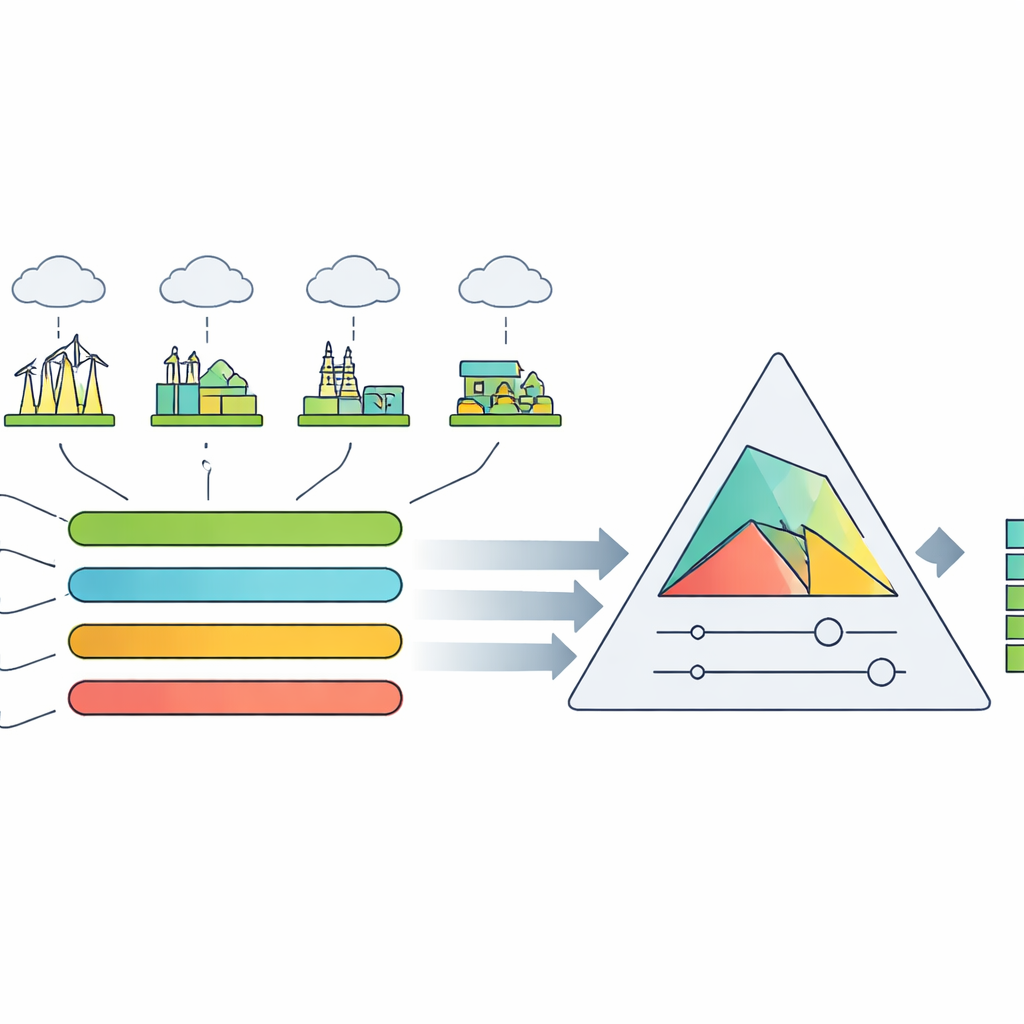
The method blends two well‑known decision tools. First, the Analytic Hierarchy Process is used to capture how important each criterion is relative to the others through simple pairwise comparisons. In the case study, energy output and cost receive slightly more weight than environmental harm and public acceptance, though all four matter. Second, the VIKOR technique takes the fuzzy assessments of each green energy option and searches for a compromise: it rewards alternatives that perform well on average across all criteria while also keeping the worst shortfall on any single criterion within reasonable bounds. The new fuzzy distance formula plugs into this compromise engine so that hesitant and uncertain judgments are handled consistently.
Putting the method to work on five green options
To show how the framework behaves, the authors compare hydropower, wind parks, biomass plants, geothermal plants and solar farms. Experts evaluate each option on initial cost, energy output, environmental impact and social acceptance using the hesitant fuzzy format. The model then ranks the options. For a broad range of parameter choices, solar farms emerge as the preferred compromise: they offer strong environmental performance and good acceptance at moderate cost, even though their output varies with sunlight. Wind parks closely follow and become the top choice once the parameters are adjusted to be more forgiving of conflicting opinions. Hydropower, biomass and geothermal usually trail behind under the chosen criteria and weights.
Testing robustness and comparing with other tools
The authors systematically vary three key settings: how strict the hesitation constraint is, how the distance between opinions is measured, and how much the compromise engine favors overall group benefit versus the worst individual shortfall. Across these tests, the ranking of the middle and lower options remains stable, while the top spot shifts only between solar and wind. The new method is also compared with several existing fuzzy decision approaches. Despite using different mathematical machinery, all methods broadly agree on the same two front‑runners, but the proposed framework handles uneven and hesitant inputs more gracefully and yields steadier rankings as conditions change.
What this means for clean energy choices
In plain terms, the study offers planners a more realistic calculator for hard energy choices—one that accepts expert doubt, weighs many goals at once, and searches for fair compromises rather than simple winners. In the example explored here, solar farms generally come out as the best all‑around choice, with wind close behind, given the selected costs, outputs, impacts and social factors. More importantly, the approach can be reused and customized for other regions, technologies and priorities, helping decision‑makers design greener power systems in a structured and transparent way even when the facts are fuzzy.
Citation: M.Salih, H.F., Ameen, Z.A., Alharbi, B. et al. An integrated VIKOR–AHP method for green energy systems based on q-fractional hesitant fuzzy multi-criteria decision-making. Sci Rep 16, 10618 (2026). https://doi.org/10.1038/s41598-026-46076-x
Keywords: green energy planning, multi-criteria decision, fuzzy logic, renewable energy systems, decision support methods