Clear Sky Science · en
A three-level discretization framework for dynamic behaviors of graphene-coated rotational blades with preset-angle sandwich structure under complex loads
Stronger Wings for Harsher Skies
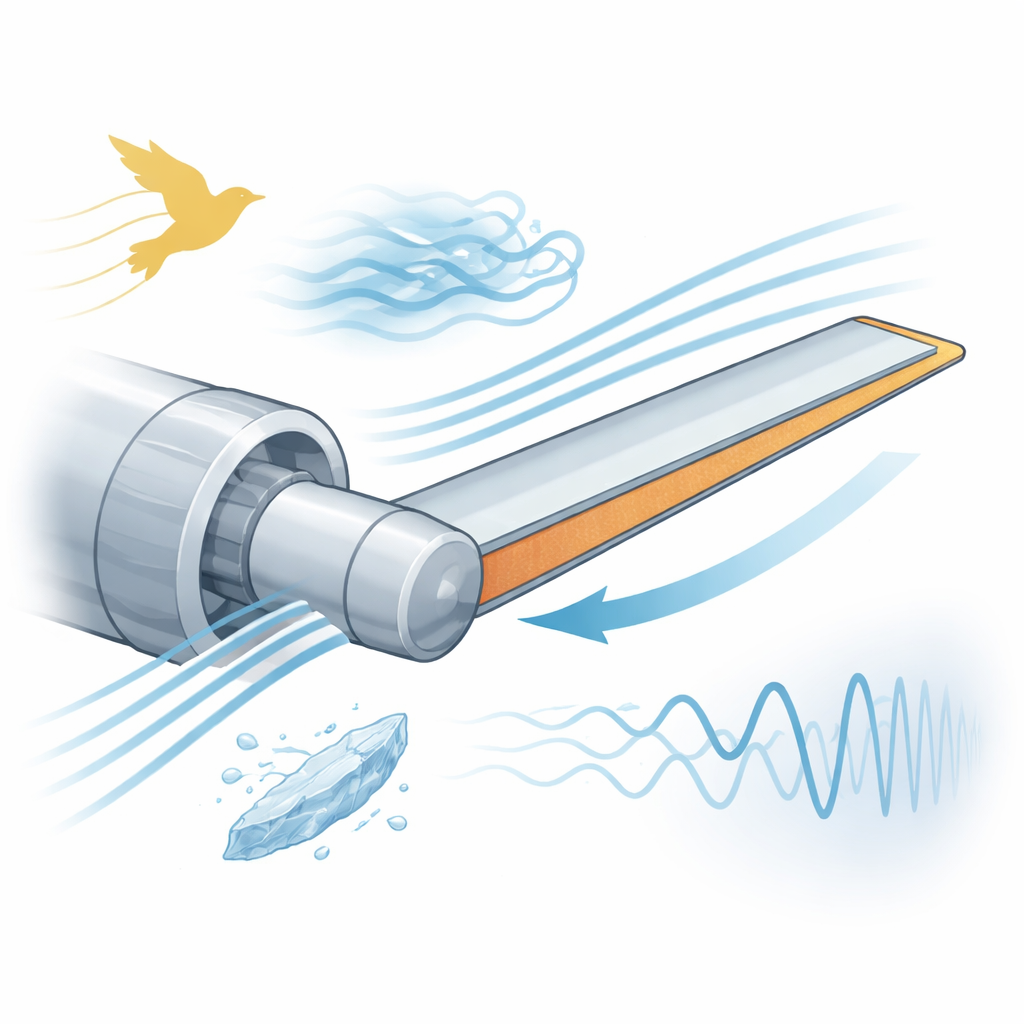
Aero-engine turbine blades spin at thousands of revolutions per minute in scorching, high‑pressure air while enduring sudden hits from birds, ice chunks, or explosive blasts. When these blades vibrate too strongly, they can crack or even fail, threatening engines and aircraft. This study explores a new way to design lighter yet tougher rotating blades by adding ultra‑thin graphene coatings and building a powerful mathematical model to predict how such blades behave under brutal, fast‑changing loads.
Why Modern Blades Need an Upgrade
Today’s turbine blades must squeeze ever more power out of engines while staying reliable for years. Traditional metal blades are heavy and can only be pushed so far before vibration and fatigue become limiting. The authors focus on a new concept: a “sandwich” blade made of a light central core wrapped in two thin outer layers reinforced with graphene platelets, all mounted at a preset angle on a rotating hub. Graphene—a sheet of carbon only one atom thick—dramatically stiffens the surface when mixed into a coating, which is exactly where impacts and airflow forces strike first. By concentrating graphene in the outer layers and keeping the middle light, the design aims to combine low weight with strong resistance to bending and surface damage.
Building a Virtual Test Rig
Physically testing many blade designs at high speed and under violent impacts is expensive and risky, so the heart of the paper is a detailed mathematical twin of the blade. The researchers idealize each blade as a rectangular plate with a preset mounting angle and a three‑layer thickness structure. They use a micromechanical formula to translate graphene content and platelet shape into effective stiffness and density of the coating. Rotational effects, such as centrifugal forces that stretch and stiffen the spinning blade, and geometric nonlinearities that appear at large deflections, are all included. Because the resulting equations are extremely complex, the team develops a three‑step discretization strategy that blends Chebyshev polynomials, the Ritz method, and Galerkin’s method to convert hard‑to‑solve partial differential equations into a compact set of ordinary differential equations. These can then be integrated in time to predict how the blade moves and bends.
Simulating Real‑World Blows
To mimic dangerous in‑service events, the model includes three kinds of short‑lived loads: a sudden step pulse like an ice chunk or bird strike, a sinusoidal pulse representing periodic gusts or flow fluctuations, and an air‑blast‑type pulse that rises quickly and then decays, similar to a shock wave. Aerodynamic pressure and structural damping are also accounted for. Before exploring new designs, the authors rigorously validate their framework against published experiments, finite‑element simulations, and analytical results for plates and rotating panels, showing that natural frequencies and dynamic deflections are captured with errors typically below a few percent—even at rotation speeds exceeding 10,000 revolutions per minute. This gives confidence that the virtual blade responds realistically when hit by complex, time‑varying loads.
What Graphene and Geometry Really Do
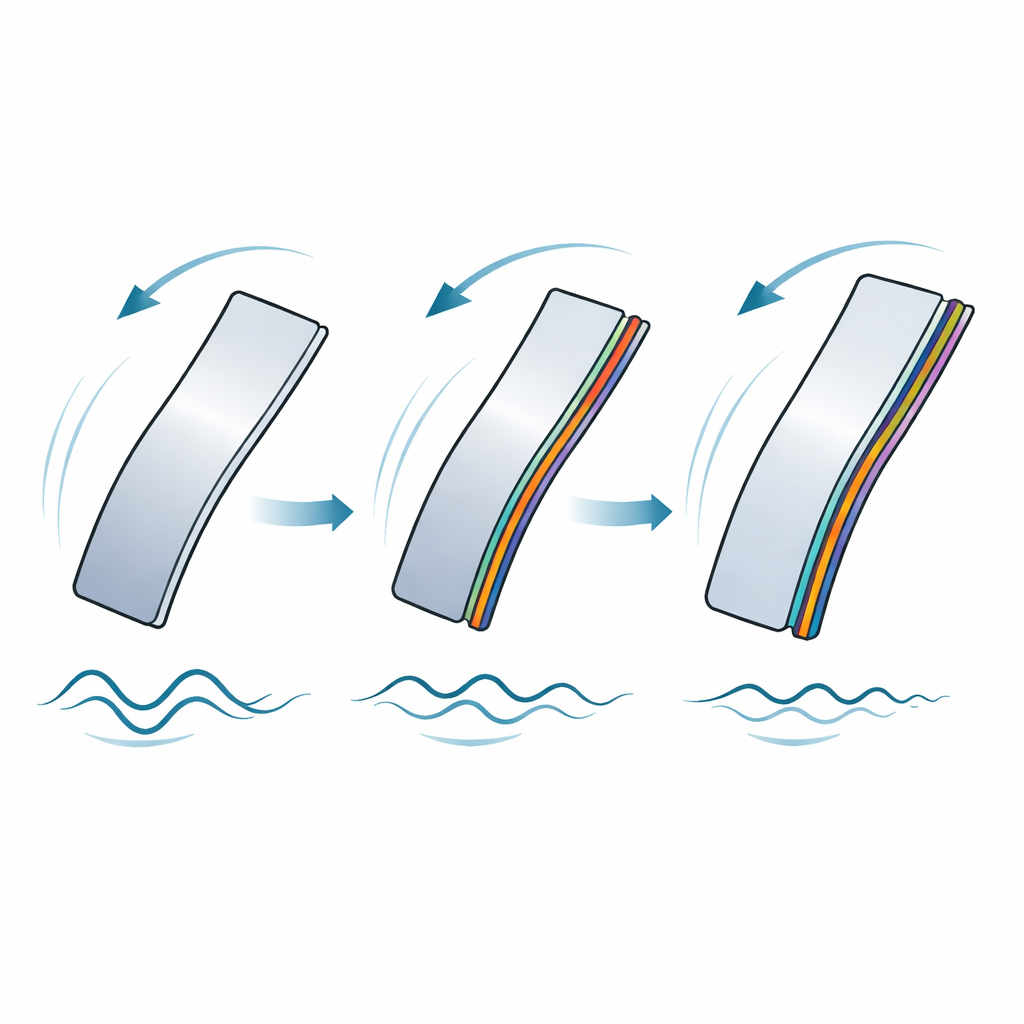
With validation in hand, the study maps out how key design knobs influence vibration and stress. Increasing the blade’s length‑to‑width ratio makes it more flexible, while shortening it too much can actually worsen response by turning it into a stubby plate with unfavorable deformation patterns. A moderate aspect ratio around two to three offers the best compromise between stiffness and weight. Adding a small amount of graphene—up to about 1.2 percent by weight in the coatings—substantially raises natural frequencies and cuts vibration amplitudes, especially in the low‑frequency modes that dominate fatigue damage. Longer, thinner graphene platelets are more effective, but benefits level off beyond a certain aspect ratio as the material reaches a saturation point. Higher rotation speeds further stiffen the blade through centrifugal stretching, shrinking deflections and increasing oscillation frequency. Damping, whether built into the structure or introduced through coatings and joints, helps most under sharp, transient loads and is somewhat less effective for smooth sinusoidal forcing.
From Equations to Engine Design
By comparing the new graphene‑coated sandwich blade with a conventional titanium blade of the same size, the authors show that peak dimensionless bending under impact can be cut by more than half, and vibrations die out notably faster, all while reducing weight. In practical terms, this means a blade that is both lighter and more resistant to bird strikes, ice hits, and gusts, and that lasts longer before fatigue cracks appear. The modeling framework doubles as a design tool: engineers can tune blade aspect ratio, rotational speed, damping, and graphene content to hit specific vibration and durability targets without exhaustive testing. In doing so, this work lays out both a conceptual blueprint and an actionable design guideline for the next generation of high‑speed turbomachinery blades that are smarter, safer, and more efficient.
Citation: Bai, B., Li, H., Yi, X. et al. A three-level discretization framework for dynamic behaviors of graphene-coated rotational blades with preset-angle sandwich structure under complex loads. Sci Rep 16, 10787 (2026). https://doi.org/10.1038/s41598-026-46068-x
Keywords: graphene-reinforced turbine blades, rotating sandwich structures, vibration and fatigue of blades, pulse loading on aero-engine components, composite blade design modeling