Clear Sky Science · en
Quad-band SIW antenna with micro-pocket enabled frequency-agile design for 5G/6G IoT applications
Smaller gadgets, smarter signals
From smart speakers and home sensors to connected cars and farm drones, tomorrow’s wireless gadgets must talk over several radio channels at once without growing bulky or power-hungry. This study presents a new kind of tiny antenna that can handle four different communication bands by itself and even retune those bands after it has been built. That mix of flexibility, compact size, and efficiency is aimed squarely at the crowded airwaves of 5G, 6G, and the Internet of Things.
Why talking on many channels is hard
Modern wireless devices often need multiple antennas or extra circuitry to send and receive signals on different frequency bands—for example, for Wi‑Fi, cellular, and satellite links. Traditional multiband antennas usually rely on external filters and multiplexers that sort the signals, which adds cost, size, and signal loss. Some recent designs combine several channels into a single “self‑multiplexing” antenna, but the different ports often use different polarizations (signal orientations) or cannot be adjusted once manufactured. That makes them less attractive as drop‑in replacements for classic multiband antennas, which typically keep the same polarization across all bands.
A single antenna with four aligned channels
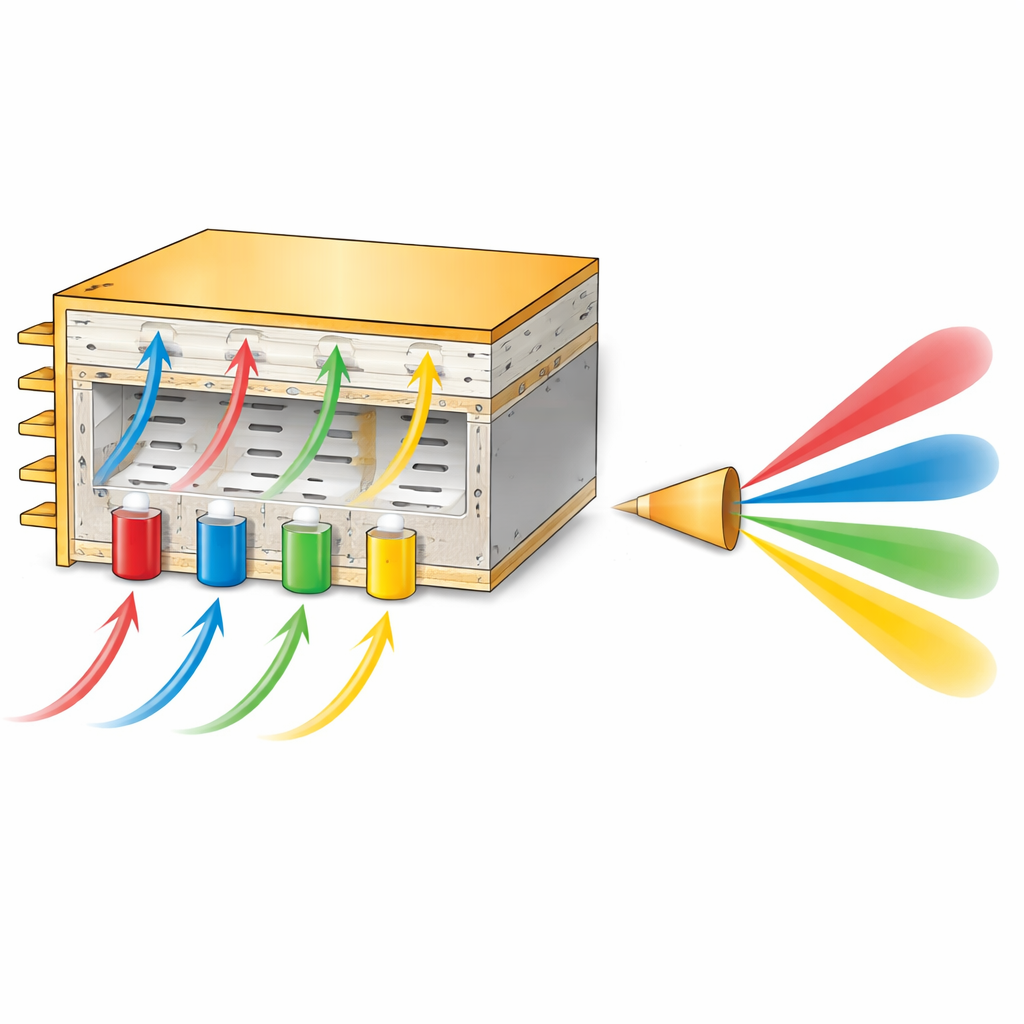
The authors introduce a compact “self‑quadruplexing” antenna that supports four separate radio channels within one shared structure. It is built around a rectangular substrate integrated waveguide cavity—a hollow pathway for radio waves that is etched and drilled into a flat circuit board. On the top surface sit four metal patches, each fed by its own microstrip line, all arranged along one axis so that every port produces the same polarization. Clever use of stepped patch shapes and extra metal vias inside the cavity keeps energy from leaking between ports, delivering more than 32 decibels of isolation—meaning that when one channel is active, only a tiny fraction of its power reaches the others. The prototype operates at about 3.29, 4.47, 5.85, and 7.07 gigahertz with strong, forward‑directed beams and peak gain up to 7.6 dBi, all in a footprint only a few wavelengths across.

Tuning the channels before and after build
Beyond simply fitting four bands into one antenna, the design is deliberately frequency‑agile. Before fabrication, the center frequency of each port can be shifted by adjusting the length of its patch, allowing the four channels to be placed anywhere between roughly 3.5 and 8.4 gigahertz while still maintaining good separation and radiation quality. The team further quantified how the ratios between neighboring frequencies change with patch length, showing that each band can be tuned largely independently. This gives designers a set of simple geometric “knobs” to place the channels at preferred spectrum allocations for Wi‑Fi, 5G/6G, radar, or satellite services.
Liquid-filled pockets that retune on demand
A key innovation is hidden under the cavity: small cylindrical micro‑pockets that can be filled with different materials, especially liquids, using a micropipette. Changing the filling alters the effective electrical properties inside the cavity and nudges each resonance to a new frequency without touching the metal structure. By loading the pockets with copper, distilled water, acetone, ethyl acetate, isopropyl alcohol, common circuit board material, or simply air, the researchers demonstrated smooth shifts of all four operating bands across a wide range, from about 3.29 to 7.84 gigahertz. Importantly, the radiation patterns and polarization stay stable through these changes, and the ports remain well isolated. Measurements in an anechoic chamber closely match computer simulations, and an equivalent circuit model reproduces the same behavior, lending further confidence in the design.
What this means for future wireless devices
Put simply, the work shows that one very compact antenna can cleanly host four independently tunable channels, all with the same signal orientation and strong separation, and can be retuned after it leaves the factory just by changing what fills a few tiny pockets. Compared with earlier multi‑band and tunable antennas, this approach offers higher isolation, better control over beam direction, and a smaller footprint. Such a device could help phones, sensors, and network nodes adapt to shifting 5G and 6G spectrum allocations, or repurpose the same hardware for different regions and applications, without redesigning the radio front end each time.
Citation: Vaishali, P., Dash, S.K.K., Barik, R.K. et al. Quad-band SIW antenna with micro-pocket enabled frequency-agile design for 5G/6G IoT applications. Sci Rep 16, 10774 (2026). https://doi.org/10.1038/s41598-026-46067-y
Keywords: 5G antennas, 6G communications, frequency agile design, substrate integrated waveguide, IoT wireless systems