Clear Sky Science · en
Numerical study on mist-assisted film cooling performance under supersonic condition with discrete coolant injection
Keeping jet engines from melting
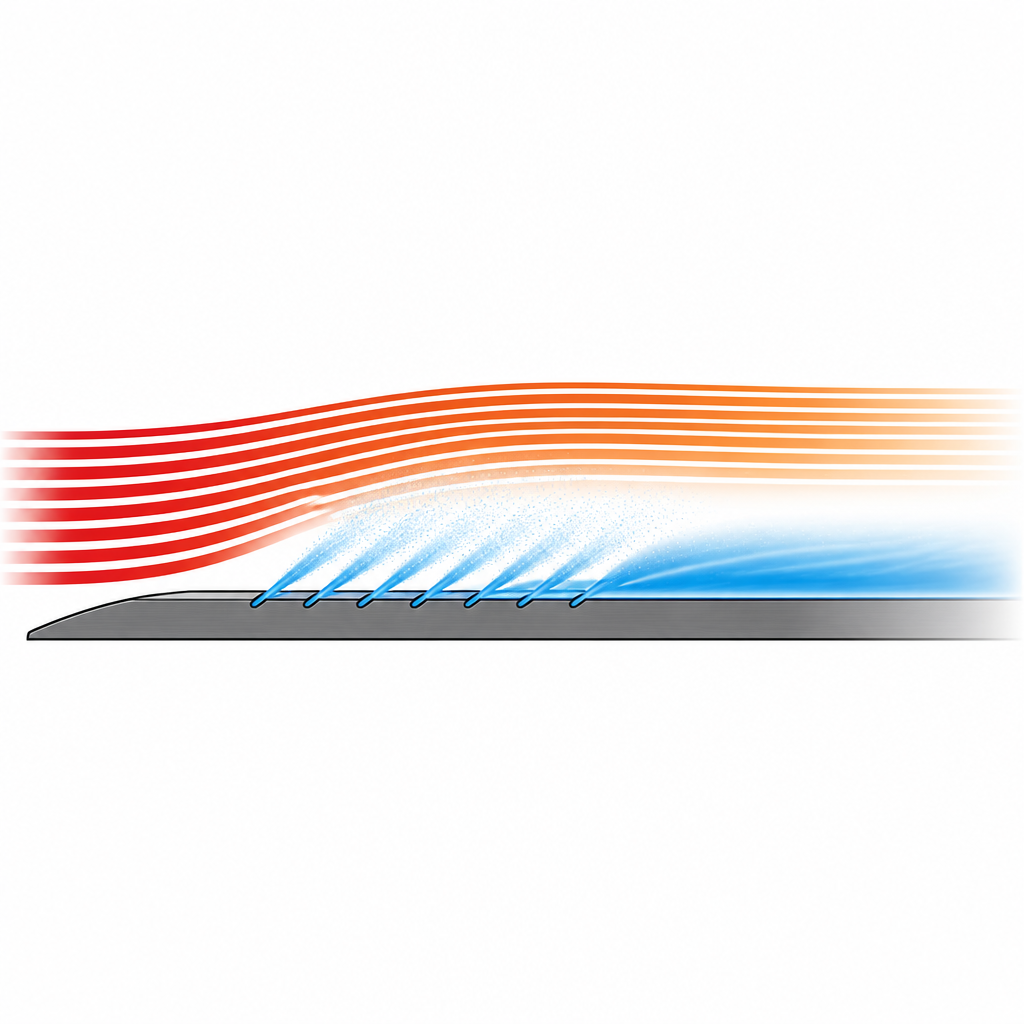
Modern jet engines push air to several times the speed of sound, bathing turbine parts in gas hot enough to melt most metals. To keep these parts intact, engineers blow cooler air through tiny holes to form a protective blanket along the surface. This study explores how adding a fine water mist to that cooling air can better shield engine parts when the surrounding flow is supersonic, a regime where traditional cooling methods struggle.
Why water droplets help cool hot metal
On its own, air can only carry away so much heat before warming up. Mixing in tiny water droplets changes that balance. As the droplets evaporate, they absorb large amounts of heat and increase the effective heat capacity of the cooling flow. The resulting water vapour can also puff up near the wall, gently pushing the hot gas away from the surface. Previous work in slower flows showed that this “mist assisted” approach can boost cooling by tens of percent, but how it behaves at supersonic speeds, with strong shock waves and intense shear layers, was largely unknown.
Simulating extreme speed cooling
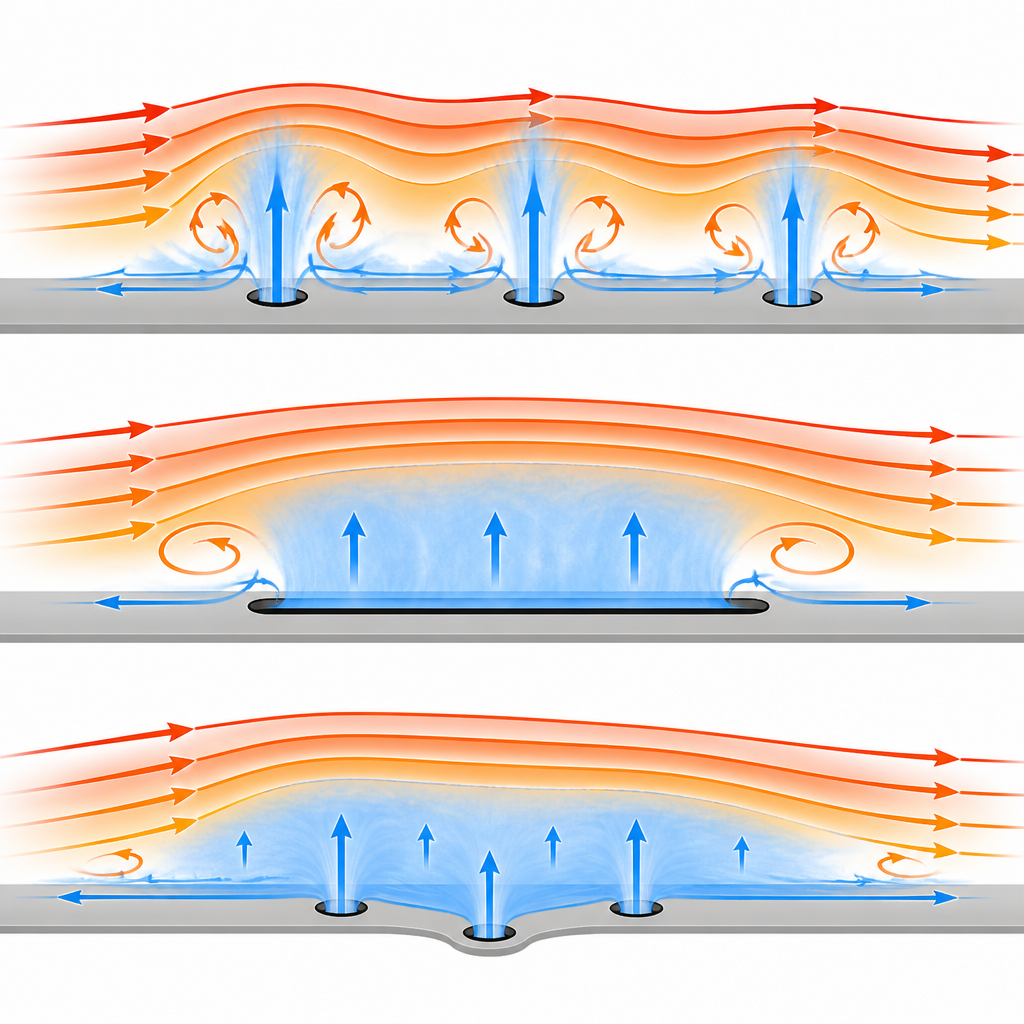
The researchers used high fidelity computer simulations to model a flat plate exposed to a supersonic main flow twice the speed of sound. Through the plate, three rows of angled holes injected cooler air that carried a fine mist of five micron water droplets at different concentrations. They examined three hole layouts: simple round holes, two overlapping holes forming a merged slot, and a more intricate “sister hole” pattern with one upstream hole feeding two offset downstream holes. For each layout, they varied the speed of the cooling jet and tracked both the air and the droplets, including how the droplets evaporated and exchanged heat and momentum with the gas.
How shocks and vortices fight the cooling film
Supersonic flow brings new challenges. As the cool jet meets the hot stream, it generates bow shaped shock waves and swirling “kidney” vortices that tend to lift the jet away from the wall. The simulations reveal a similar problem for the droplets: instead of staying near the surface, many are flung up into the main flow, where they evaporate too far from the wall to help cooling, a behaviour the authors call mist lift off. This effect becomes stronger as the cooling jet speed increases, cutting into the gains from mist injection near the holes, even though more droplets are present.
Designing holes that keep mist where it counts
The study shows that hole geometry can tame these disruptive structures. In the merged slot case, the jet spreads more sideways, keeping the cool layer closer to the wall than with simple round holes. The sister hole pattern goes further: by splitting the flow into three interacting jets, it weakens the kidney vortices and lowers the strength of the main shock. This combination helps both air and droplets to stay attached to the surface and return to it more quickly after being pushed away. As a result, the protective cool film extends farther downstream, where the pure air jet alone would have mostly lost its cooling power.
Where mist helps most in supersonic flows
The simulations indicate that water mist is particularly valuable far downstream of the holes, where the air only film has thinned and warmed. In this region, extra droplets can diffuse back to the wall and finish evaporating, significantly lowering the surface temperature. Raising the mist concentration within the tested range consistently improves overall cooling, although it does not fix the poor performance right next to the holes when jet and mist lift off are strong. Under the highest cooling jet speed studied, the sister hole layout with five percent mist increased average effectiveness by about 40 percent compared with the standard round holes, while the merged slot gave a 16 percent gain.
Practical message for hotter engines
For readers, the core conclusion is that simply blowing more cool air is not enough when engines run at extreme conditions. The way that air and added water mist are introduced, and how they interact with supersonic shocks and swirling motions, determines how well the metal surface is protected. Carefully designed multi hole patterns like the sister hole configuration can keep the cooling layer attached longer and help droplets do their job close to the wall. This insight can guide future turbine designs that rely on mist assisted cooling to safely handle higher gas temperatures without excessive air use.
Citation: Zhou, J., Zhang, J., Fu, J. et al. Numerical study on mist-assisted film cooling performance under supersonic condition with discrete coolant injection. Sci Rep 16, 15624 (2026). https://doi.org/10.1038/s41598-026-46042-7
Keywords: supersonic film cooling, water mist cooling, gas turbine blades, numerical simulation, coolant hole design