Clear Sky Science · en
Layered grouting reinforcement technology for coal–rock composite roof: A treatment system based on model experiments
Keeping tunnels safe underground
As coal mines go deeper, the tunnels that carry people, air, and equipment must pass under heavy layers of broken rock. When the rock roof above these tunnels sags or collapses, it threatens both safety and production. This study looks at a new way to “glue” those weak layers together in stages, so that the mine roof can once again carry its weight safely and keep roadways open for the long term.
Why deep mine roofs are hard to hold up
In the Chinese mine studied here, the tunnel roof is not a single solid slab but a stack of layers: soft, cracked coal at the bottom, weaker mudstone just above it, and stronger sandstone higher up. Over time and under great pressure, the lower layers break apart and can no longer pass the weight above them to the stronger rock. Conventional supports such as steel bolts and cables are then forced to work inside loose, crumbling rock, and the roof still sags, cracks, and sometimes drops pieces into the roadway.
A layered “injection and stitching” idea
The researchers propose a layered grouting method that treats the roof in two zones. First, a liquid mixture is injected around short bolts placed in the shallow, badly fractured coal and mudstone. As this mixture hardens, it binds the loose pieces together into a stronger band that acts like a primary beam above the tunnel. Next, longer cables reach up into the deeper, more solid sandstone, and grout is injected there as well. In this way, the newly strengthened shallow band is firmly stitched to the stable rock above, creating a stacked, cooperating structure rather than isolated patches of support. 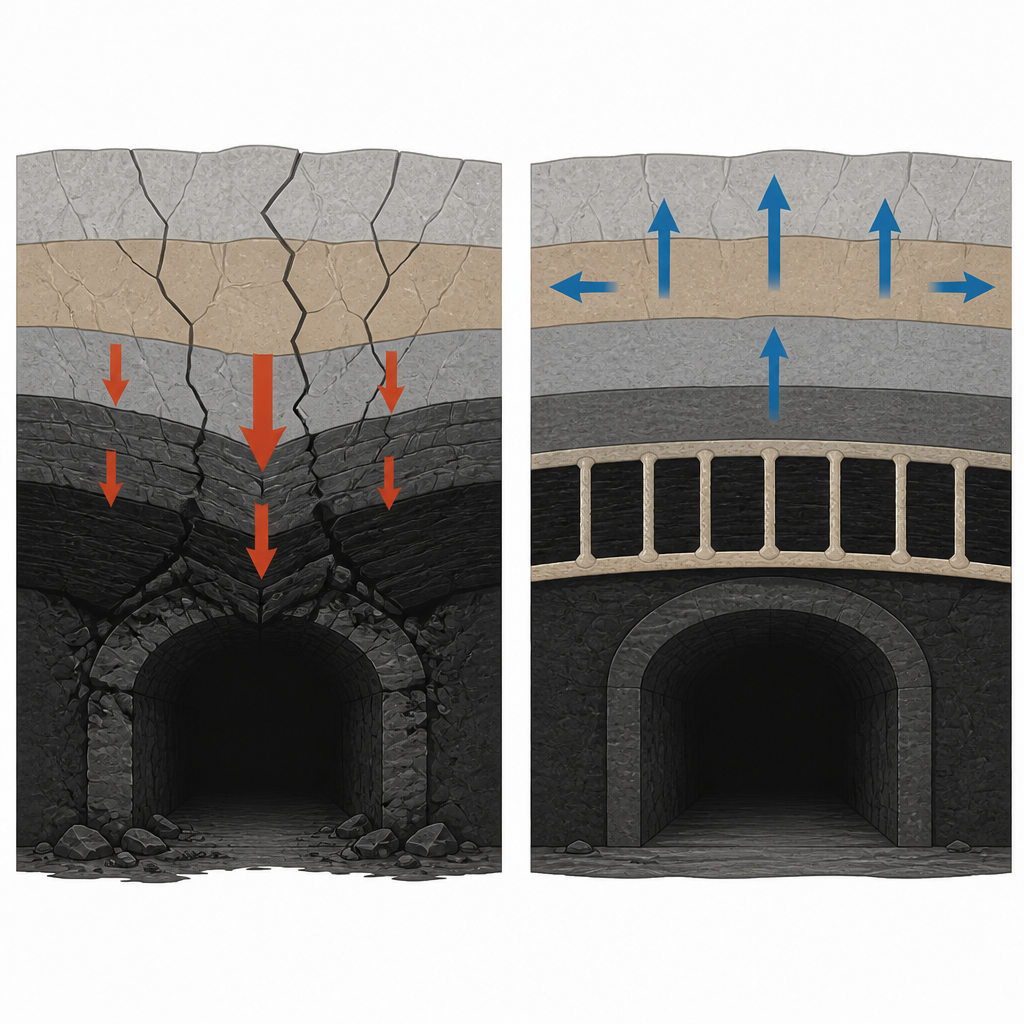
Testing the idea in a scaled-down model
To understand how this scheme changes roof behavior, the team built a physical model that shrinks the real geology and tunnel by a factor of fifty. They used sand, cement, and gypsum in carefully chosen mixes to mimic the strength of each rock layer, then cut two identical roadways into the model. One roadway used the original support design, while the other added the new layered grouting. Under controlled loading, cameras tracked roof and wall movement, sensors measured stress, and small vibration detectors listened for tiny cracking events inside the model as it was squeezed.
What changed inside the reinforced roof
The differences between the two roadways were striking. In the untreated case, most roof movement occurred in the shallow layers, cracks joined together, and the roof above the tunnel broke into blocks. Stresses shifted erratically upward, and many stronger cracking events were recorded. With layered grouting, roof settlement dropped from about eight and a half units in the model to just two, and cracking stayed scattered and fine instead of forming a broken band. Stresses became more even, with the grouted shallow layers now able to share load with the deeper sandstone, while the tunnel floor and walls stayed within acceptable movement limits. 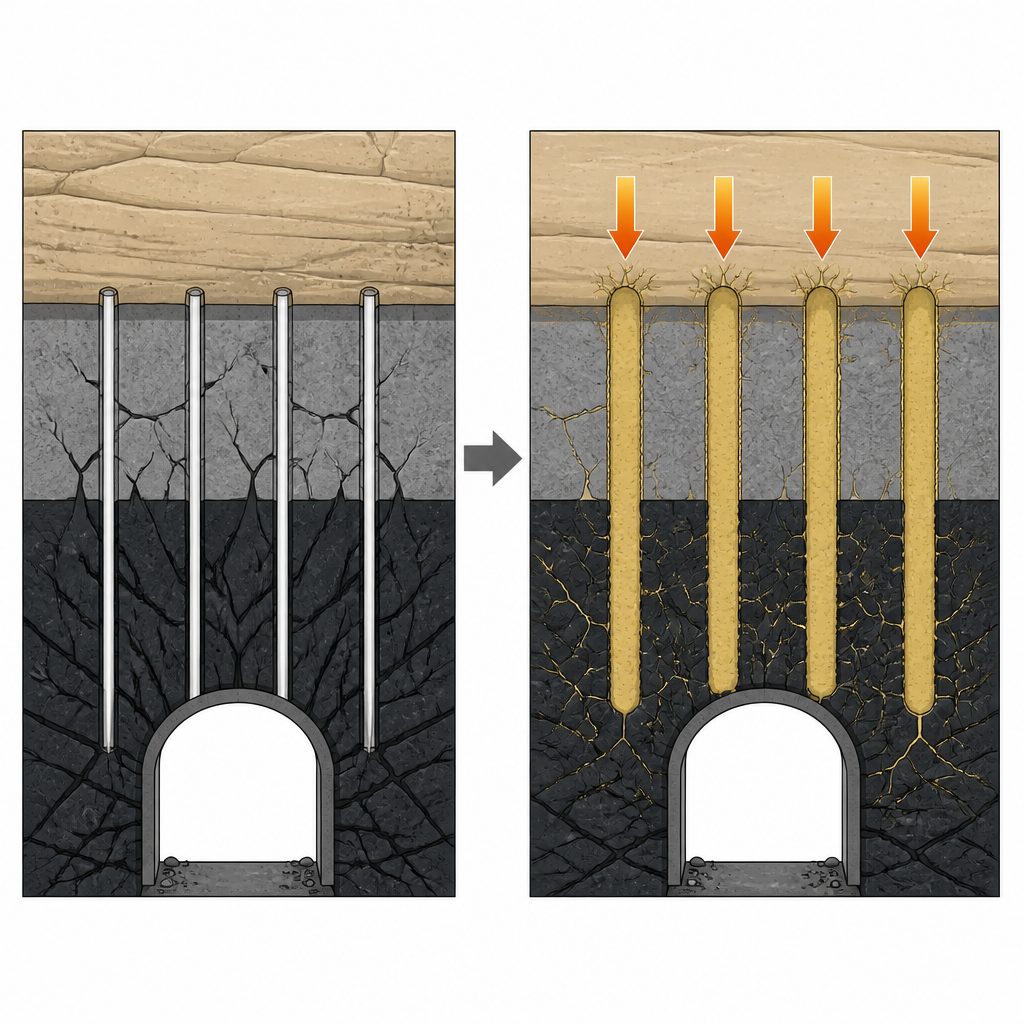
Proving it in a working mine
The team then applied the same support concept in a real roadway in the Shuiliandong Coal Mine. They compared a section using the original support with a nearby section that also received layered grouting. In the original section, the sidewalls squeezed inward by more than forty centimeters and the roof and floor moved toward each other by over fifty centimeters, with roof falls and broken bolts reported. In the grouted section, sidewall movement was cut about in half and roof–floor closure fell to only about twelve centimeters. The supported roof stayed intact, bolts and cables continued to work as intended, and ongoing maintenance became much lighter.
What this means for safer mining
For non-specialists, the key message is that the study shows how carefully targeted “injection” of hardening materials, done in layers, can turn a crumbling stack of rocks above a tunnel into a set of cooperating beams. Rather than simply adding more steel, the method repairs the way weight is passed from weak layers down to strong ones. In this case, it greatly reduced roof sag, cracking, and underground movement. That makes deep coal roadways safer to travel and cheaper to maintain, and offers a practical guide for stabilizing other tunnels driven through mixed, broken rock.
Citation: Liao, Z., Li, P., Zhao, X. et al. Layered grouting reinforcement technology for coal–rock composite roof: A treatment system based on model experiments. Sci Rep 16, 15002 (2026). https://doi.org/10.1038/s41598-026-46016-9
Keywords: coal mine roadway, roof reinforcement, grouting, underground stability, rock mechanics