Clear Sky Science · en
DeepSentRec: a deep learning-based sentiment-aware product recommendation system
Why Smarter Suggestions Matter
Every time you shop online, binge a series, or scroll through restaurant reviews, invisible algorithms decide what you see next. Yet these systems often miss something crucial: how you actually feel about what you buy or watch. This paper introduces DeepSentRec, a new recommendation framework that tries to read not just what you clicked, but the tone of your written reviews—your excitement, disappointment, or indifference—and then uses that emotional signal to tailor future suggestions in a more human way.
From Star Ratings to Real Feelings
Most existing recommendation engines lean heavily on numbers: star ratings, past clicks, and purchase history. They treat user reviews mainly as long, messy text that is hard to use at scale. As a result, they overlook rich clues such as whether a three-star rating was given with grudging acceptance or with mild praise. Earlier research has shown that incorporating sentiment—the positive, neutral, or negative feeling expressed in text—can improve personalization, but many systems still bolt this on as a shallow extra feature rather than making it central to how recommendations are formed and ranked.
Three Brains Working Together
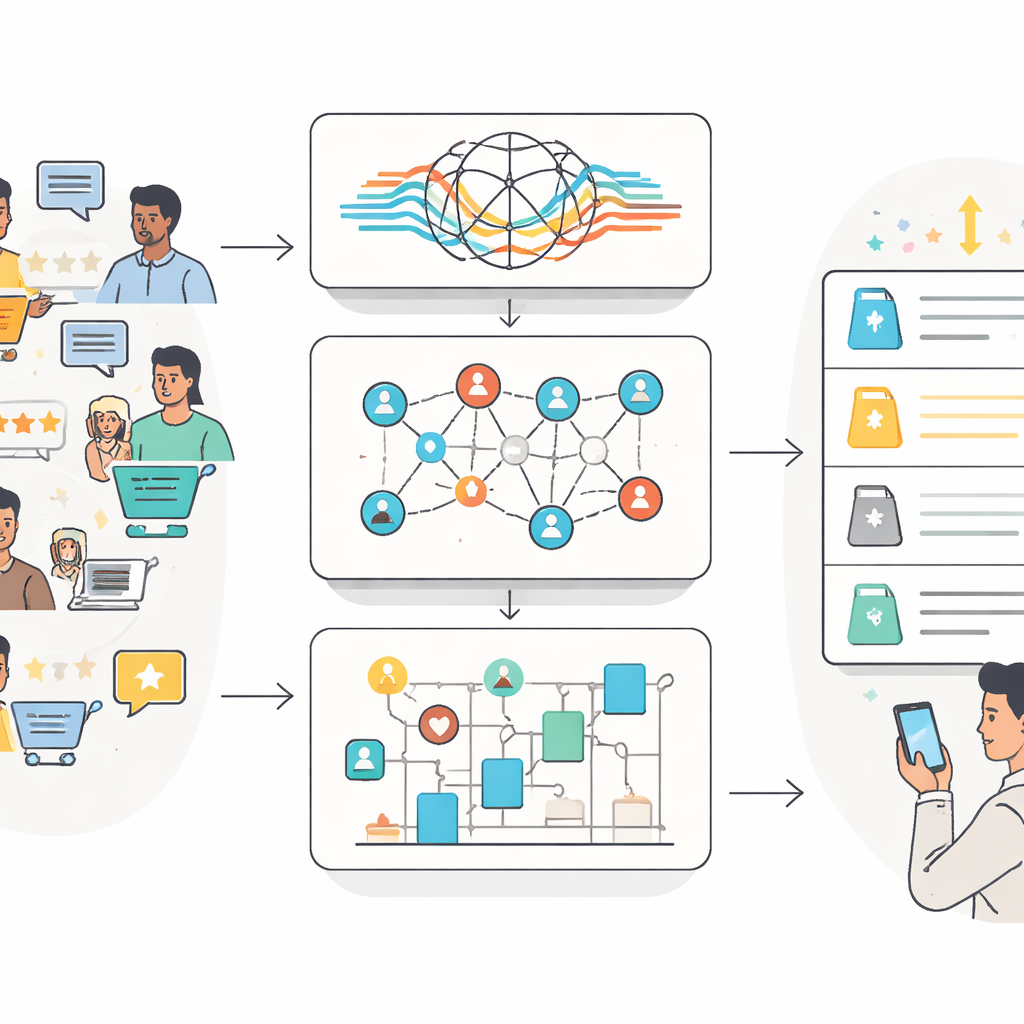
DeepSentRec is designed as a three-part pipeline that weaves emotions, behavior, and learning from feedback into one loop. First, a sentiment module called SentimentBERT reads review text and produces a fine-grained emotional fingerprint for each review, not just a simple thumbs-up or thumbs-down. Second, a hybrid recommendation module blends two views of the world: people who behaved like you (collaborative filtering) and products whose reviews carry similar meanings and feelings (semantic similarity). Third, a learning-to-rank module based on reinforcement learning continuously reshuffles the order of suggested products depending on how users respond—whether they click, buy, or ignore items.
Learning from Many Voices
To test whether this architecture actually helps people find more relevant items, the authors trained and evaluated DeepSentRec on four large, real-world datasets: Amazon product reviews, Yelp business reviews, IMDB movie reviews, and a Kaggle collection of e-commerce feedback. Before any learning happens, the text is carefully cleaned and broken into pieces suitable for modern language models. SentimentBERT is first trained on well-labeled movie reviews and then fine-tuned on Amazon and Yelp, so it can adapt to different writing styles and domains. The system also builds compact representations of how each user interacts with each product, then combines those with sentiment-aware text embeddings to create a richer picture of taste.
Turning Feedback into Better Rankings
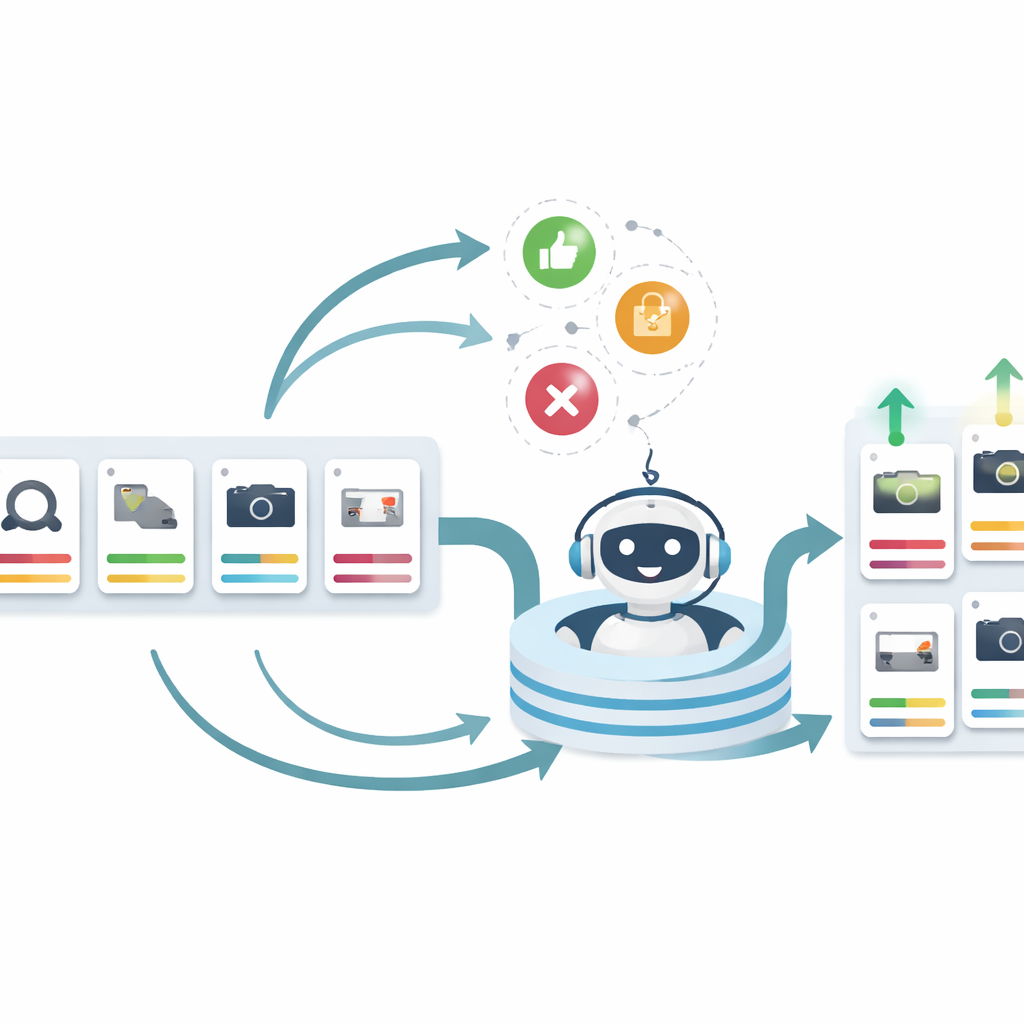
The most distinctive piece of DeepSentRec is how it treats ranking as an ongoing conversation rather than a static calculation. Using a reinforcement learning technique called Proximal Policy Optimization, the system treats each ranked list as a decision and each user reaction as a reward or penalty. Clicks, purchases, and skips are all folded into a score that encourages the model to highlight items that bring long-term engagement, not just quick clicks. Over time, the ranking policy improves by trying different orderings and keeping those that lead to more meaningful interactions, such as purchases or repeated use.
What the Results Show for Real Users
Across the Amazon and Kaggle e-commerce datasets, DeepSentRec consistently beats traditional methods based only on past behavior or simple text matching. It delivers higher precision (a larger share of the top suggestions are actually relevant), better recall (it finds more of the things users care about), and stronger ranking quality measures. Most importantly for real platforms, it raises click-through rates and an overall engagement score that combines multiple ways users react. Ablation studies—systematically removing components—show that each part matters: sentiment modeling improves accuracy, the hybrid text-plus-interaction model improves coverage, and the reinforcement learner further boosts how often users act on the recommendations.
What This Means for Everyday Recommendations
In plain terms, the study suggests that recommendation engines get noticeably better when they listen to what you say in reviews as carefully as they watch what you click, and when they keep learning from your latest behavior instead of relying solely on old patterns. DeepSentRec shows that combining emotional tone, context from text, and continuous feedback can produce recommendations that feel more timely, relevant, and personal. While the current work focuses on English-language reviews and offline experiments, it points toward a new generation of systems that adapt in near real time and can be extended to multiple languages and domains, potentially making digital experiences—from shopping to learning—more aligned with how people actually feel and behave.
Citation: Kollu, S.R.P., Garapati, Y. DeepSentRec: a deep learning-based sentiment-aware product recommendation system. Sci Rep 16, 10580 (2026). https://doi.org/10.1038/s41598-026-45953-9
Keywords: recommendation systems, sentiment analysis, e-commerce personalization, deep learning, reinforcement learning