Clear Sky Science · en
Experimental investigations on hybrid manufacturing: WEDM of WAAM-fabricated stainless-steel components using ANFIS modelling
Making Big Metal Parts More Precise
From aircraft wings to medical implants, many modern machines rely on large metal parts that must be both strong and extremely precise. A newer way to build such parts, called wire arc additive manufacturing, is good at quickly creating big stainless steel shapes but leaves rough surfaces and small geometric flaws. This study explores how a second process, wire electrical discharge machining, can carefully trim and smooth these additively made parts, while an intelligent computer model helps engineers find the best machine settings to balance speed and quality. 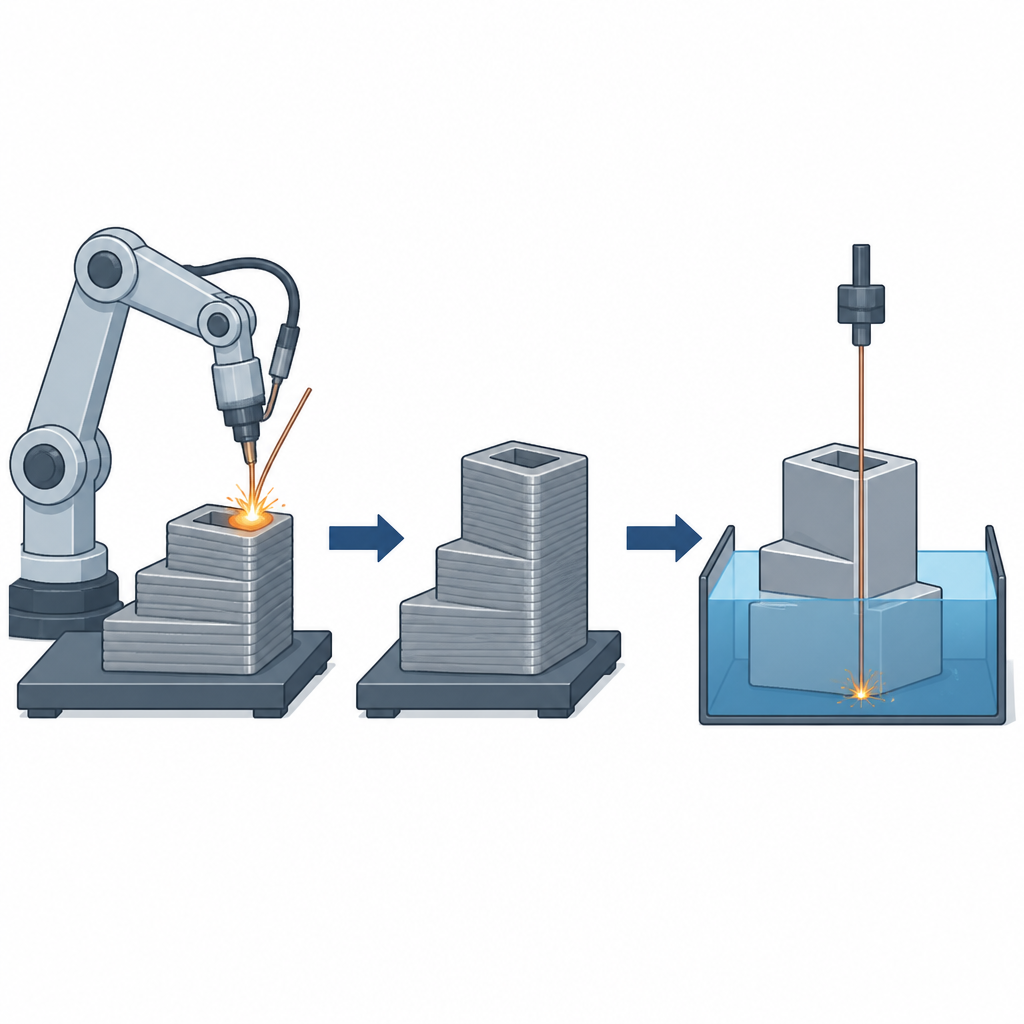
Why New Metal Building Methods Matter
Traditional machining starts with a solid block and cuts away material, which can be slow, wasteful, and limited in shape. Wire arc additive manufacturing instead builds metal components layer by layer using an electric arc and metal wire, almost like welding a part into existence. This approach is fast, cost effective, and well suited for large stainless steel pieces, making it attractive to aerospace, energy, and industrial designers. The downside is that the layered surfaces tend to be wavy and rough, and the heat involved can leave internal stresses and small dimensional errors, which are not acceptable where tight tolerances and smooth finishes are needed.
Finishing with Sparks Instead of Cutting
To correct these flaws, the authors turned to wire electrical discharge machining, a process that uses a thin wire and tiny electrical sparks to erode metal without physical contact. The stainless steel parts, made from a common alloy called SS316L using wire arc additive manufacturing, were then shaped and finished by this spark-based cutting method. Because the wire never touches the part, it can accurately cut hard and intricate shapes, and it is especially useful for reaching into complex geometries that might be difficult for regular cutting tools. The key challenge is that this spark process depends sensitively on how long each spark is turned on, how long it is turned off, and how strong the current is, so the team set out to measure how these settings affect material removal, surface smoothness, and geometric accuracy.
Testing Many Settings with Smart Statistics
Using a structured experimental plan, the researchers ran 27 different combinations of spark-on time, spark-off time, and electrical current on the additively made stainless steel. They measured how quickly metal was removed, how rough the final surface was, how far the size drifted from the target dimensions, and how well walls stayed straight and square. The results showed that spark-on time was the main driver of how fast metal was removed but also a major source of size errors and shape distortions when it was too high. Spark-off time, by contrast, was crucial for achieving a finer surface and stable geometry because it allowed the fluid between the wire and part to recover and flush away debris. 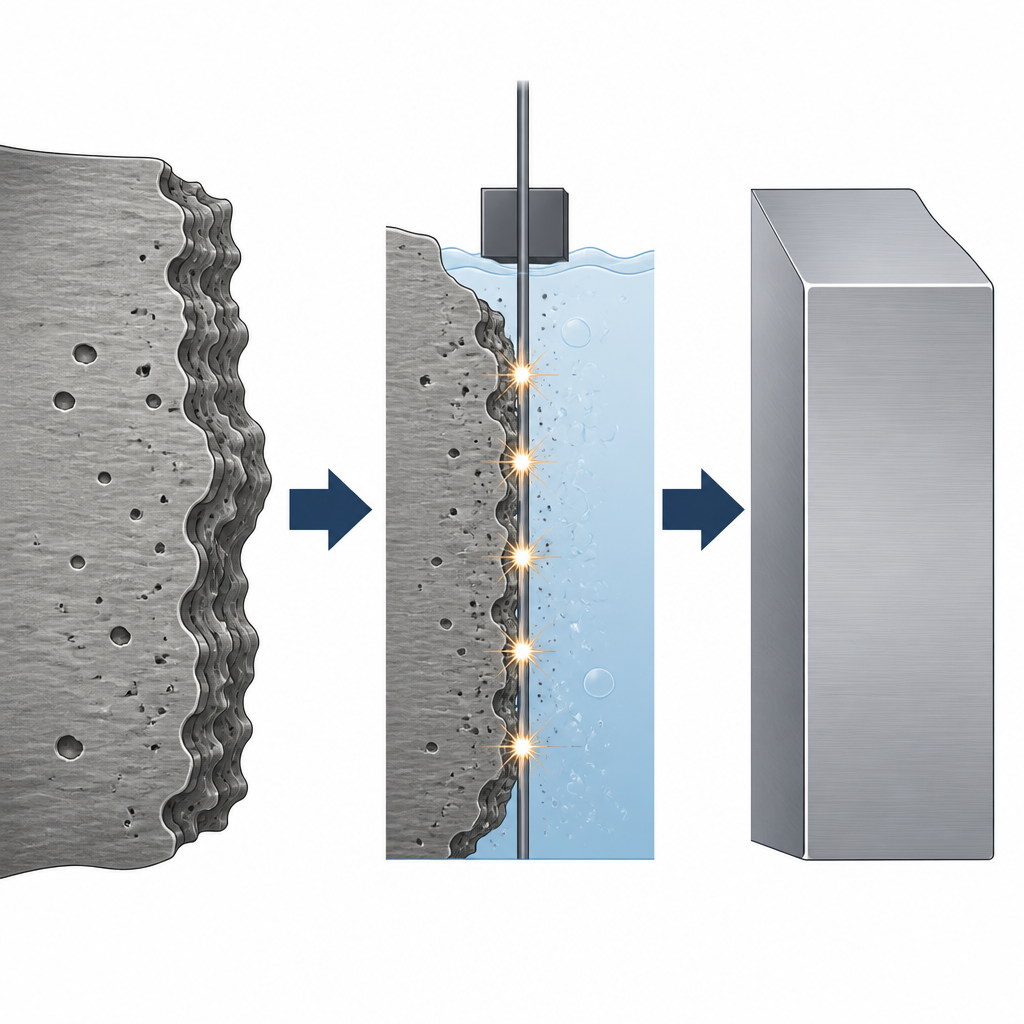
Teaching a Digital Assistant to Predict Quality
To handle the fact that several quality measures must be good at the same time, the team combined two methods: a ranking tool that merges all performance measures into a single score, and an adaptive neuro fuzzy inference system, a type of intelligent model that can learn complex patterns from data. They trained this model on the experimental results so that it could predict the combined performance score for new sets of machine settings. The predictions matched the experiments very closely, with small errors and an almost perfect correlation, showing that the model captured the relationships among speed, surface finish, and geometric precision in this hybrid process.
What This Means for Future Metal Parts
In simple terms, the study shows that building stainless steel parts quickly with wire arc methods and then finishing them with spark-based cutting can deliver smooth, accurate components suitable for demanding uses. It also shows that carefully tuning how long sparks are on and off can balance fast cutting with good surface quality and stable shapes. The intelligent model developed here can guide engineers toward the best combinations of settings without testing every possibility on real parts. Together, this hybrid manufacturing route and its digital helper point toward scalable production of large, precise metal components for fields such as aerospace, biomedical devices, and energy systems.
Citation: Thejasree, P., Manikandan, N., Marimuthu, S. et al. Experimental investigations on hybrid manufacturing: WEDM of WAAM-fabricated stainless-steel components using ANFIS modelling. Sci Rep 16, 15169 (2026). https://doi.org/10.1038/s41598-026-45952-w
Keywords: wire arc additive manufacturing, wire electrical discharge machining, stainless steel 316L, hybrid manufacturing, ANFIS modelling