Clear Sky Science · en
Design optimization and stiffness-equivalent method for an integrated starter generator in aerospace applications
Why smoother, lighter engines matter in the air
Modern aircraft are steadily replacing heavy, maintenance‑intensive hydraulic systems with cleaner and more efficient electrical ones. At the heart of this shift sits a hard‑working component called the integrated starter generator, which both spins the jet engine up to speed and then supplies electricity during flight. Making this unit lighter while keeping it quiet and stable at extremely high rotations is a major engineering challenge. This study introduces a faster way to design these machines so they stay safe, resist damaging vibrations, and shed unnecessary weight—key steps toward greener, more electric aircraft.
From old power plumbing to smart electric cores
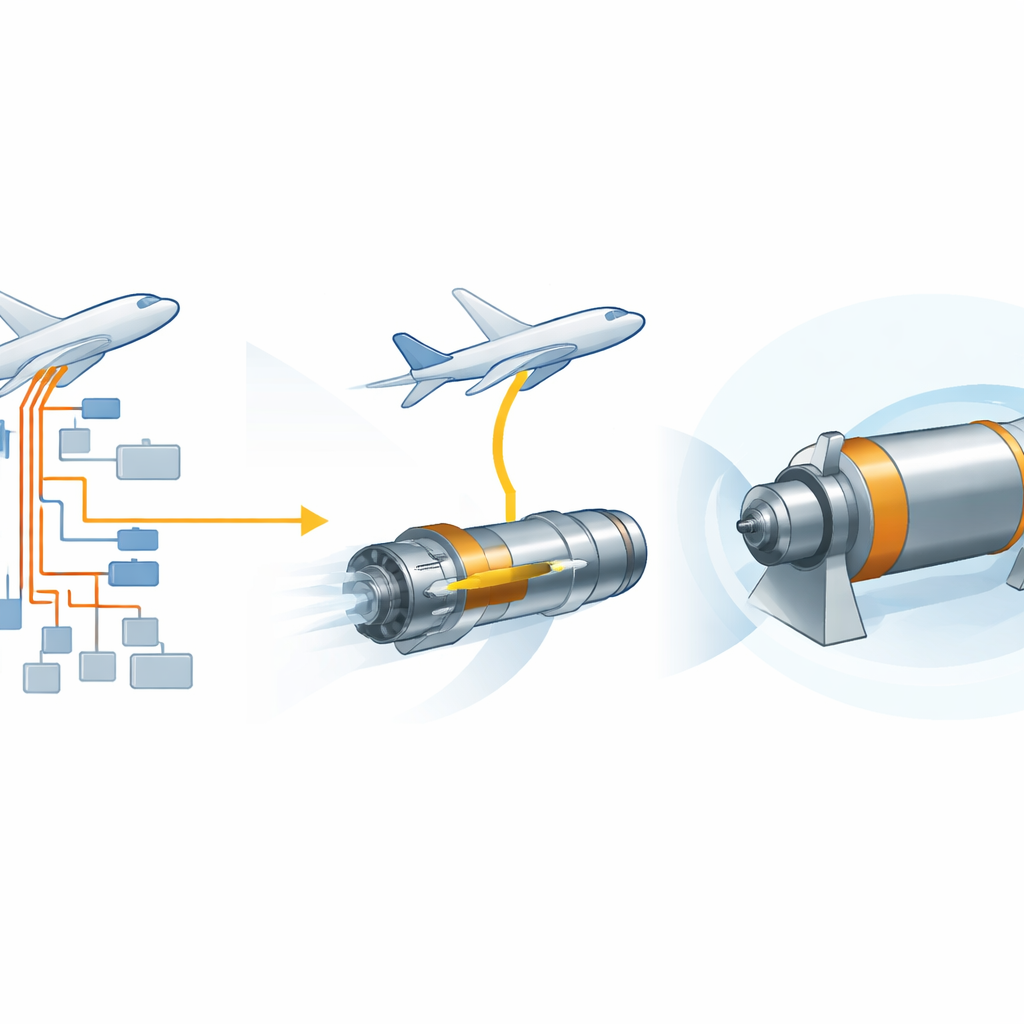
Traditional airliners route power around the airframe using a tangle of pipes, pumps, and mechanical drives. More‑electric aircraft simplify this maze by relying much more on electrical power drawn from the engines. The integrated starter generator (ISG) is central to that idea. It first acts as a powerful electric motor to spin the turbine up for ignition, and then switches roles to become a generator feeding the aircraft’s electrical systems. Because the ISG’s rotor spins at very high speeds, any mismatch between its natural vibration tendencies and its operating speeds can lead to resonance—shaking that can damage parts or shorten their life. Engineers therefore need tools that capture the rotor’s true behavior without bogging down design work in slow, extremely detailed simulations.
A shortcut that keeps the physics honest
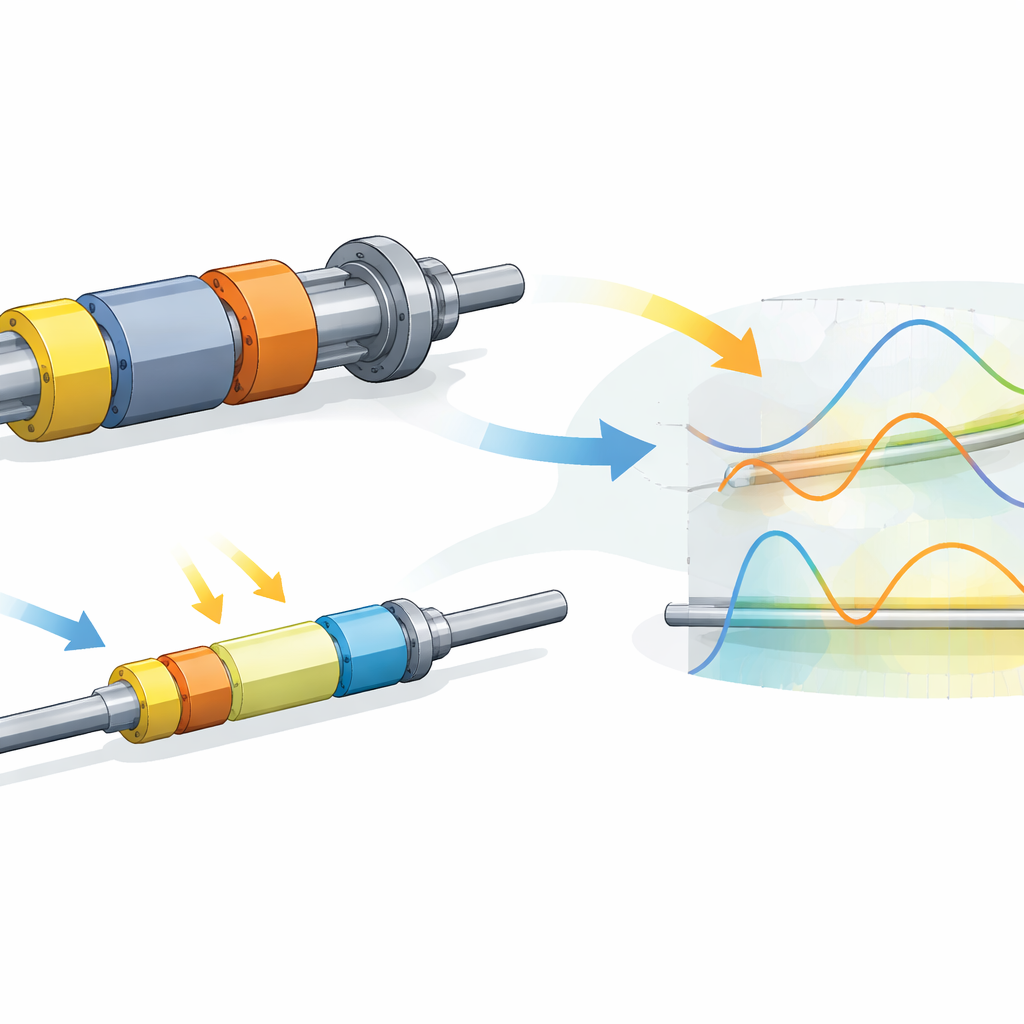
The authors focus on a clever modeling strategy they call a stiffness‑equivalent method. The ISG rotor is not just a simple shaft; it carries several bulky sections that represent the main generator, an exciter stage, and a small permanent‑magnet generator. In crude models, these sections are often treated as concentrated “dummy” masses, which makes the rotor appear too flexible and predicts the wrong vibration characteristics. Here, the team derives a way to mathematically “boost” the stiffness of these simplified regions so that the simplified model bends and vibrates like a much richer three‑dimensional model. This correction is built from energy principles: the simplified and detailed versions are forced to share the same natural vibration behavior, especially in the lowest bending shapes that matter most for safety.
Checking the shortcut against full 3D models
To see whether their shortcut is trustworthy, the researchers compare three versions of the ISG: a finely meshed three‑dimensional model, a very simple lumped‑mass model, and their new stiffness‑equivalent version. They compute how each one vibrates as the rotor speed changes, including the subtle effects of spinning motion itself. The fine and stiffness‑equivalent models show nearly identical vibration patterns, and their key “critical speeds” differ by less than about 9 percent across a range of material choices. By contrast, the crude lumped‑mass model can be off by more than 40 percent, which is unacceptable in early design. Just as important, the tuned equivalent model runs about seventeen times faster than the detailed one, making it practical for repeated use inside optimization loops.
Letting evolution search for a better shaft
With this fast, faithful model in hand, the team turns to automatic design optimization. They use a genetic algorithm—an approach inspired by natural selection—to vary the shaft’s length, thickness, spacing between internal components, and how stiffly the ends are held. For each candidate design, the code calls the stiffness‑equivalent model to check whether the rotor’s critical speeds stay comfortably away from operating speeds, and whether bending stresses from unbalanced forces remain within safe limits. Over many generations, the algorithm converges on a shaft weighing only about 0.3 kilograms while still meeting strength and speed‑margin targets. Follow‑up three‑dimensional structural and thermal analyses of this optimized design confirm that stresses in the shaft and attached components remain below allowable levels, even under maximum rotation and temperature.
What this means for future aircraft
For non‑specialists, the bottom line is that the authors have built a reliable shortcut for designing a key electric machine in jet engines. Their stiffness‑equivalent method captures the way the rotor bends and vibrates almost as accurately as a very detailed model, but in a fraction of the time. That speed makes it possible to systematically search for lighter, safer designs instead of relying on slow trial and error. As aircraft become more electric, such tools will help engineers trim weight, improve efficiency, and maintain comfortable safety margins, supporting cleaner and more economical air travel.
Citation: Han, B., Kwak, E., Lee, S. et al. Design optimization and stiffness-equivalent method for an integrated starter generator in aerospace applications. Sci Rep 16, 10943 (2026). https://doi.org/10.1038/s41598-026-45885-4
Keywords: more electric aircraft, integrated starter generator, rotor vibration, lightweight design, finite element modeling