Clear Sky Science · en
Energy storage-enabled fractional-order virtual synchronous generator for DC-link voltage regulation in DC microgrid under load and renewable disturbances
Keeping the Lights Steady in a Renewable World
As homes, offices, and electric vehicles plug into more solar panels and wind turbines, our power grids are becoming cleaner but also more fragile. When a cloud passes over a solar farm or the wind suddenly drops, the voltage in local power networks can wobble in ways that damage electronics or even trigger blackouts. This paper explores a new way to steady the voltage in small direct‑current (DC) power networks, called DC microgrids, by teaching battery systems to behave like the heavy spinning generators of old—only smarter and more flexible.
Why Small DC Grids Need Extra Help
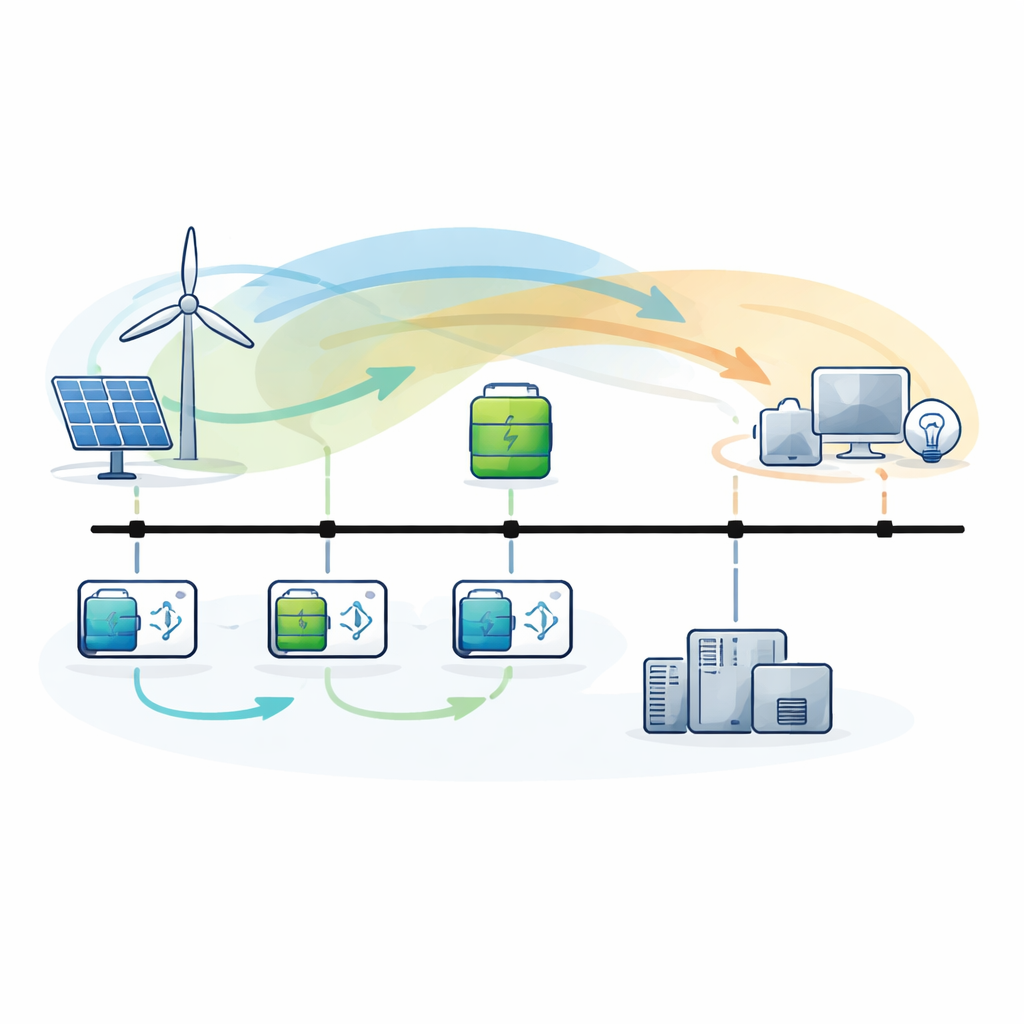
DC microgrids are compact networks that tie together rooftop solar panels, small wind turbines, batteries, and local DC loads such as LED lighting, electronics, and chargers. Because they avoid some conversion losses, they can be very efficient. But unlike traditional power plants, solar panels and wind turbines connect through lightweight power electronics, not big rotating machines. That means they contribute almost no physical "inertia"—the stabilizing effect that keeps voltage and frequency from lurching when demand or generation suddenly changes. In islanded or weakly connected microgrids, even modest swings in sunlight, wind, or load can cause sharp voltage jolts on the central DC link, threatening sensitive devices and forcing operators to oversize equipment.
Borrowing Stability from Virtual Machines
To compensate for this missing inertia, engineers have developed virtual synchronous generators, or VSGs. These are clever control programs inside power converters that mimic how a traditional spinning generator would respond to disturbances, adding virtual inertia and damping through software. Earlier work showed that VSGs can make DC bus voltage behave more smoothly, but most designs rely on simple, integer‑order derivatives—essentially, taking a hard numerical "slope" of the voltage signal. That approach is prone to amplifying high‑frequency noise, and it offers only limited freedom to fine‑tune how quickly the system settles or how much it overshoots when conditions change.
A Smarter, Memory‑Rich Control Strategy
This study proposes a more nuanced controller called a fractional‑order virtual synchronous generator (FOVSG). Instead of using a standard derivative, it uses a fractional‑order operator—a mathematical tool that behaves like a derivative with memory, blending present and past values of the DC‑link voltage. In practice, this lets engineers adjust not only how strongly the controller reacts but also how it spreads that reaction over time and frequency, smoothing out sharp edges without becoming sluggish. The FOVSG is built into the battery’s bidirectional converter, which already balances energy between the DC bus and the battery. A primary control layer shares power among parallel converters, while a secondary layer restores the DC voltage to its target level. Together, they make the battery act like a tunable stabilizing flywheel for the entire microgrid.
Letting Optimization Find the Sweet Spot
Because the FOVSG has more adjustable knobs than a traditional controller—covering virtual inertia, damping, and the fractional orders themselves—the authors turn to a metaheuristic search method known as the Grey Wolf Optimizer to select the best parameter set. This algorithm iteratively hunts for values that minimize the squared difference between actual and desired DC‑link voltage in simulated disturbance scenarios. The controller is tested in a detailed computer model of a 15‑kilowatt DC microgrid that includes solar, wind, a battery storage system, and realistic electronic converters. Three situations are examined: sudden load changes with steady renewables, renewable swings under constant load, and both changing at once.
Calmer Voltage, Gentler Battery Use
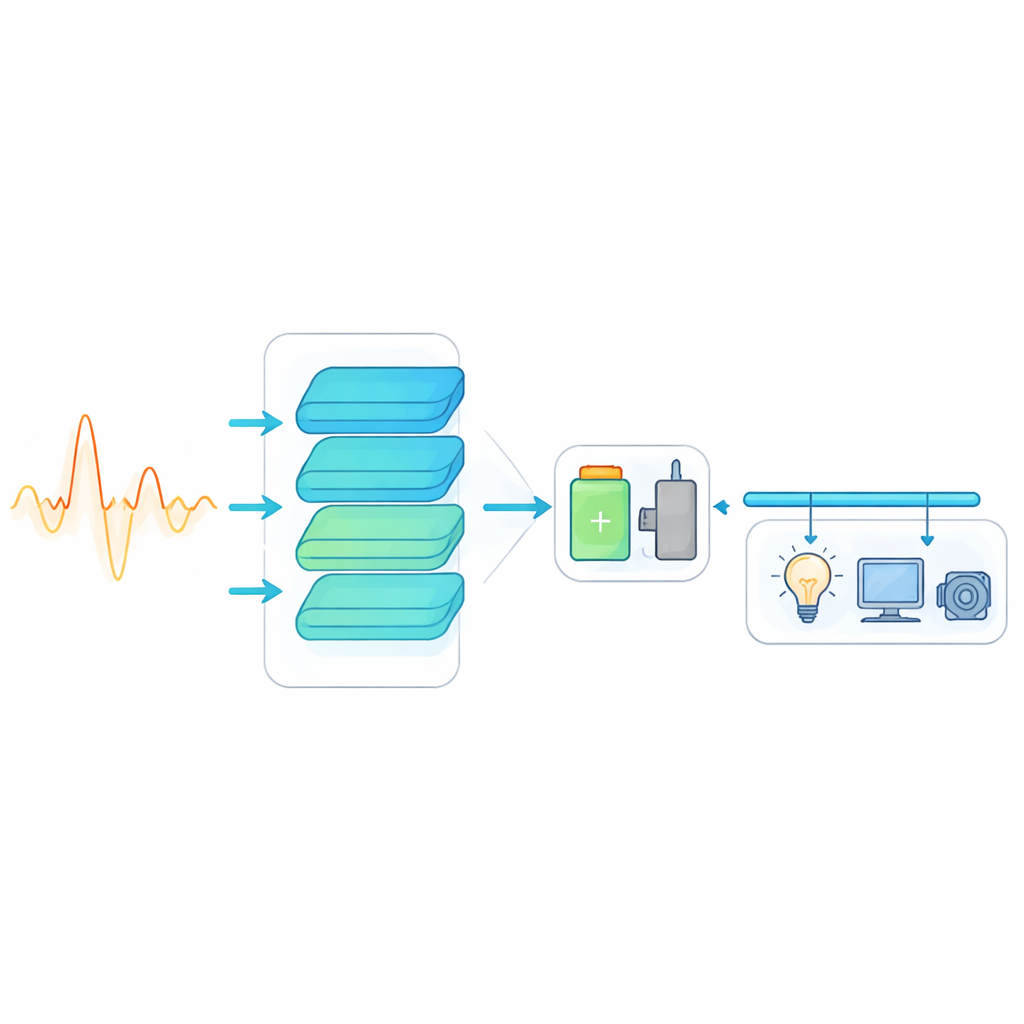
Across all scenarios, the fractional‑order approach clearly outperforms both a simple dual‑loop controller and a conventional VSG. The new method cuts DC‑link voltage spikes by up to 80 percent in some tests and consistently removes the steady voltage offsets that the traditional VSG leaves behind. At the same time, the battery’s state of charge drifts less, showing that the system is not trading stability for excessive battery wear. Voltage disturbances are smaller, settle faster, and show less ringing, even when load and renewable power fluctuate together. In plain terms, the FOVSG makes the DC bus behave as if it were supported by a smarter, more adaptable spinning generator, but implemented entirely in software.
What This Means for Future Power Systems
For non‑specialists, the key message is that clean energy does not have to mean a fragile grid. By combining battery storage with advanced, memory‑aware control laws, engineers can build DC microgrids that ride through everyday ups and downs in sun, wind, and demand while keeping voltage nearly constant. The proposed fractional‑order virtual synchronous generator is a step toward such resilient, renewable‑heavy local grids, hinting at future neighborhoods and campuses where stable, high‑quality power is delivered by quiet electronics instead of massive spinning machines.
Citation: Bakeer, A., Hussain, S., Chub, A. et al. Energy storage-enabled fractional-order virtual synchronous generator for DC-link voltage regulation in DC microgrid under load and renewable disturbances. Sci Rep 16, 12355 (2026). https://doi.org/10.1038/s41598-026-45850-1
Keywords: DC microgrid, virtual synchronous generator, fractional-order control, battery energy storage, renewable integration