Clear Sky Science · en
Soil health improvement and climate change mitigation in soybean agroecosystems
Why the way we treat soil matters
For many of us, soybeans are just tofu, miso, or animal feed. Yet the fields that grow them can either leak climate-warming gases into the air or quietly lock carbon away underground. This study from Japan explores how everyday farming choices—how much we disturb the soil, whether we keep it covered with plants, and whether we add biochar—can turn soybean fields into healthier soils that also help slow climate change.
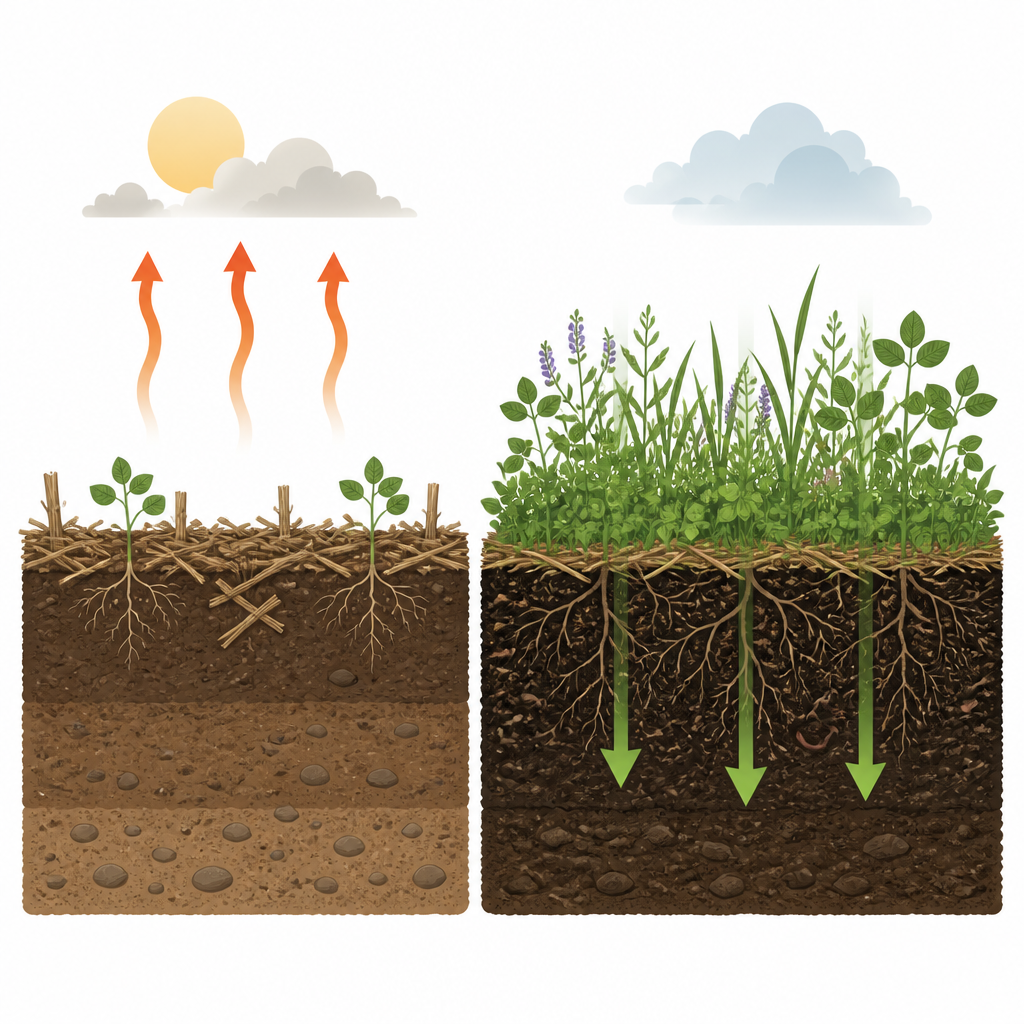
Two ways to grow soybeans
The researchers compared long-term organic soybean fields managed in two broad styles. One resembles conventional organic farming, where soil is regularly tilled with plows and rotary tools and crop residues are often buried. The other follows a regenerative approach that avoids turning the soil, keeps living cover crops such as rye and hairy vetch on the surface, and sometimes adds biochar made from rice husks. Over 19 years on volcanic ash soils known as Andosols, they tested combinations of three tillage methods, three cover crop options, and fertilizer or biochar additions, then tracked how these choices shaped soil condition and climate impact.
Building a local soil health score
Most soil health tests were designed for soils in North America and may not suit Japan’s carbon-rich Andosols. To solve this, the team built a site-specific scoring system using nearly two decades of measurements. They combined physical traits like how dense and hard the soil is, biological traits such as soil organic carbon and microbial activity, and chemical traits including nutrients and acidity. Using a statistical method that converts raw measurements into 0–100 scores, they created a local “report card” for soil health, tailored to the unusually high carbon levels and low bulk density of these volcanic soils.
What farming practices did to the soil
The new scorecard revealed clear patterns. Over recent years, intensive moldboard plowing consistently lowered overall soil health compared with no-tillage. No-tillage paired with cover crops and biochar helped keep soil organic carbon in the topsoil around 3.8–4.8 percent and preserved the loose, well-aggregated structure of Andosols. Biological scores, which reflect soil life, were generally highest where the soil was not turned and where cover crops added extra plant matter. Biochar further boosted biological and chemical scores, especially by 2022. In contrast, some tilled systems slipped from “medium” to “low” soil health over only a few years, even when cover crops were used.
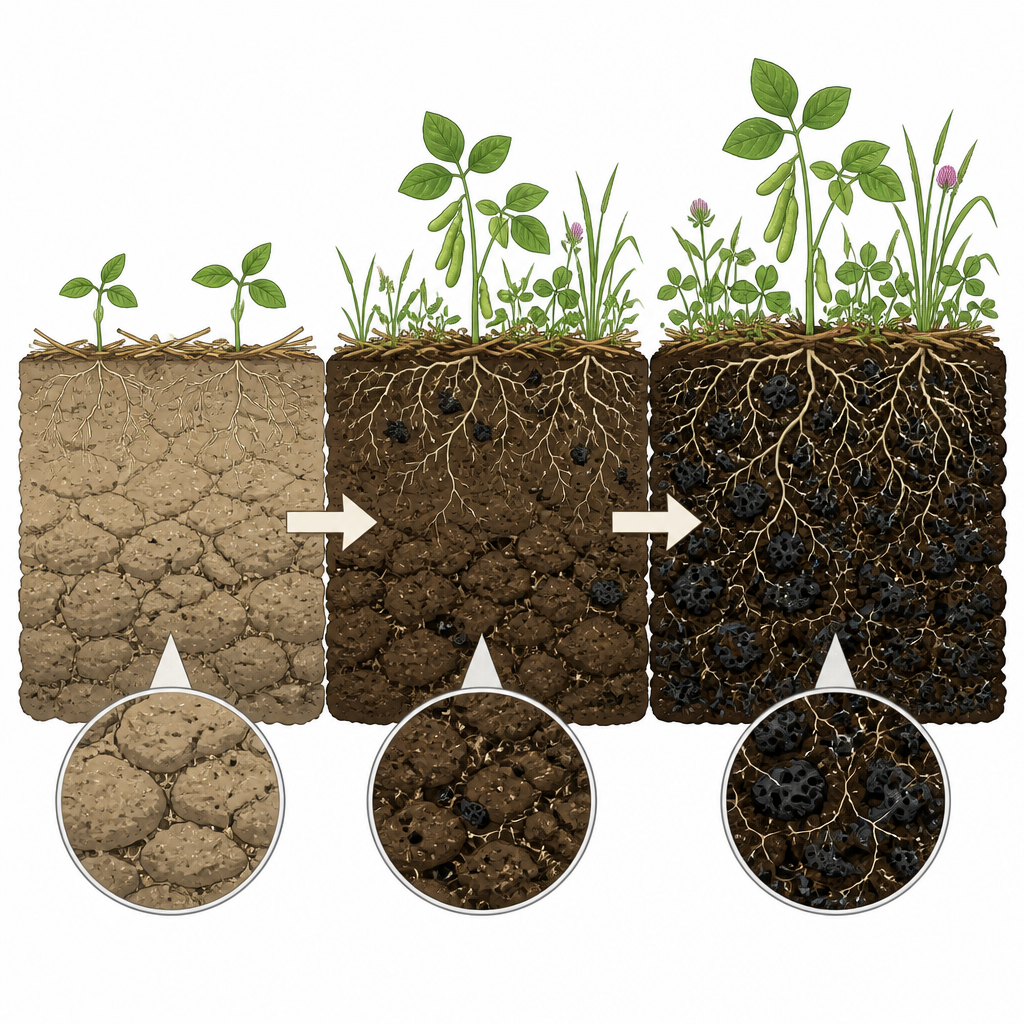
Soil carbon, microbes, and climate links
Soil organic carbon emerged as the central player connecting many aspects of soil function. Higher carbon levels were tied to more active soil enzymes, greater microbial respiration, better nutrient availability, and improved overall soil health scores. Statistical pathway analyses showed that in these Andosols, carbon strongly influenced both biological and chemical components of soil health. Crucially, fields with higher soil health scores tended to have lower net global warming potential, meaning their extra stored carbon more than offset greenhouse gas emissions in some management combinations. While soybean yields did not always rise with soil health—and no-tillage sometimes produced lower yields in certain years—the environmental benefits were clear.
What this means for farmers and the climate
For a lay reader, the take-home message is that soil is not just dirt underfoot; it is a living system that can store carbon, filter water, and support crops when treated gently. In these Japanese soybean fields, avoiding deep tillage, keeping the soil covered with plants, and adding biochar generally improved the soil’s physical structure, fed its microbial life, and helped trap more carbon. The authors conclude that even if no-tillage systems do not always deliver the highest short-term yields, they can play a valuable role in climate change mitigation while supporting long-term, sustainable production on fragile volcanic soils.
Citation: Dewi, R.K., Huang, Q., Hashimi, R. et al. Soil health improvement and climate change mitigation in soybean agroecosystems. Sci Rep 16, 15811 (2026). https://doi.org/10.1038/s41598-026-45849-8
Keywords: soil health, soybean farming, no-tillage, cover crops, biochar