Clear Sky Science · en
Strain release of substoichiometric (Zr,Y)O $$_{2-x}$$ phases formed by electrochemical reduction in single crystalline YSZ
Why darkening ceramics matters
Many high‑temperature devices, from solid oxide fuel cells in clean energy systems to components in microelectronics, rely on a ceramic called yttria‑stabilized zirconia (YSZ). Under strong electric fields, YSZ can suddenly turn black, become highly conductive, and mechanically fragile. This study peeks inside that transformation at the nanoscale, uncovering new, extremely oxygen‑poor forms of zirconia and showing how their formation builds up internal strain that may ultimately crack or weaken devices.
How a white crystal turns black
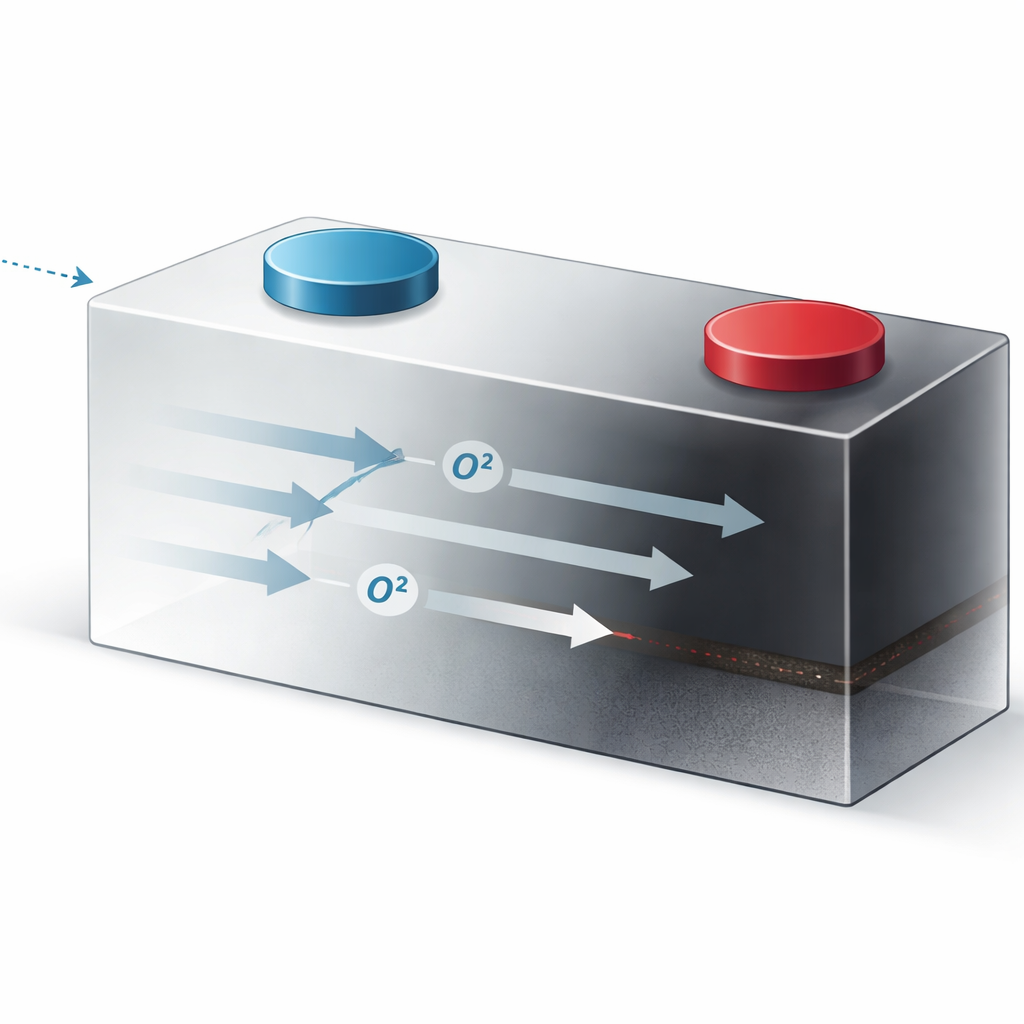
YSZ is normally an excellent oxygen ion conductor but a poor electronic conductor, which is why it serves so well as a solid electrolyte. When a strong direct current is driven through a single crystal of YSZ under low oxygen pressure, oxygen ions are pulled out near the negative electrode (the cathode). This local loss of oxygen atoms chemically “reduces” the material, turning it dark and dramatically boosting electronic conductivity. The authors reproduced this blackening in a carefully controlled setup: a thin YSZ crystal with two small platinum electrodes on its surface, heated to 400 °C in vacuum and subjected to a high voltage for many hours.
New hidden layers inside the crystal
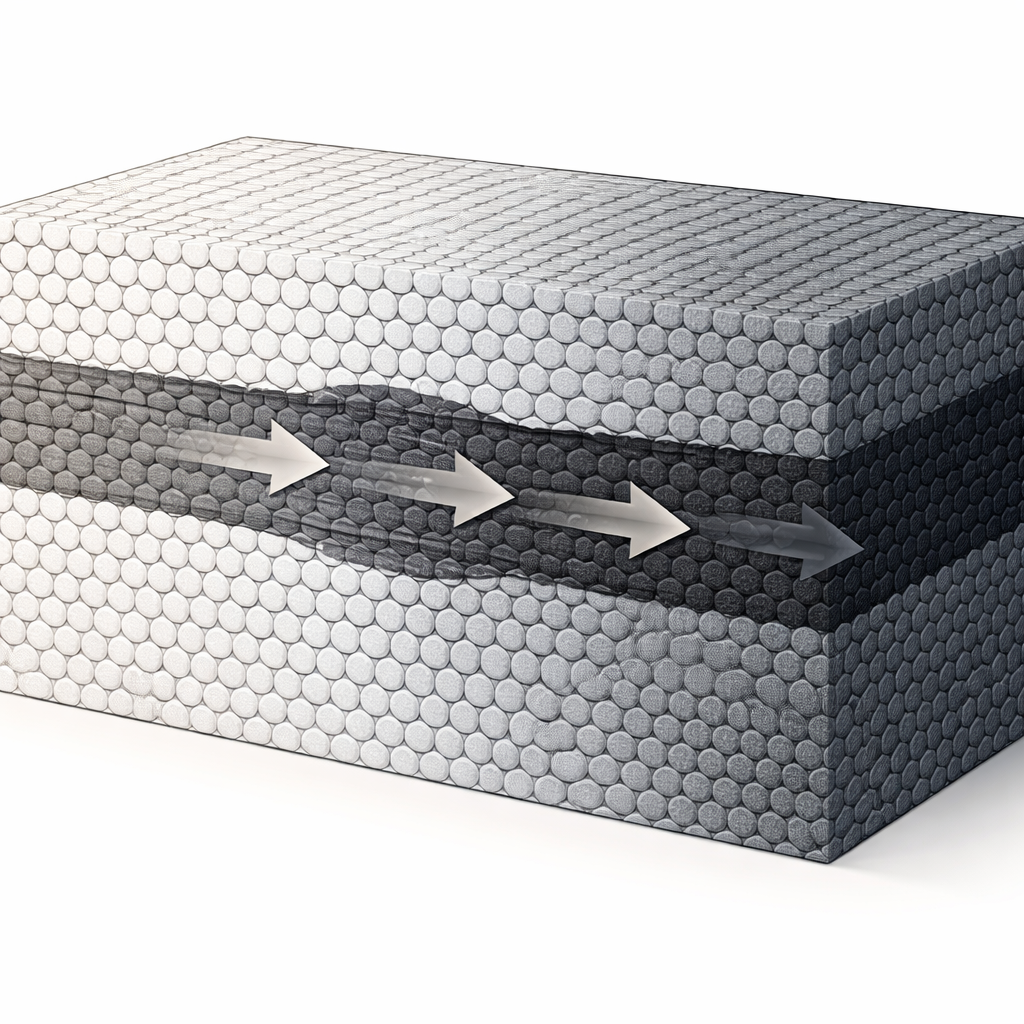
Viewed under an optical microscope, the area near the cathode shows a striking checkerboard pattern on the surface, hinting at strong internal distortion. To see what was happening in the bulk, the team prepared cross‑section samples and examined them with high‑resolution scanning transmission electron microscopy. Just tens of nanometers below the surface, they discovered a thin, belt‑shaped layer only about 20–30 nm thick that looks distinctly different from the surrounding material. Chemical analysis with X‑ray spectroscopy revealed that both this belt and the neighboring region have lost a huge fraction of their oxygen compared with normal YSZ.
Exotic oxygen‑starved phases
By quantifying the local composition, the researchers found two previously unreported, highly metal‑rich phases. The “outer” reduced region surrounding the belt corresponds roughly to a composition written as (Zr,Y)₂O, meaning that for every two metal atoms there is only one oxygen atom—far fewer oxygen atoms than in regular zirconia. Inside the belt, the oxygen content is even lower, close to (Zr,Y)₈.₆O, an extreme case where metals are almost in a metallic state. Spectroscopic measurements of the electronic structure support the idea that zirconium and yttrium in these regions have unusually low oxidation states, between neutral metal and +2. These phases are probably metastable, meaning they do not appear in standard phase diagrams but can form under the nonequilibrium conditions of electrochemical reduction.
Built‑in strain and hidden defects
The formation of these dense, oxygen‑poor phases does not just change chemistry and conductivity—it also shrinks the local crystal lattice. The authors measured that the reduced phases have a noticeably smaller unit‑cell volume than unreduced YSZ, with the belt layer contracting most strongly. Where the belt meets the surrounding phase, the mismatch in lattice spacing forces the crystal to accommodate strain by creating misfit dislocations—line‑like defects where extra half‑planes of atoms terminate. Advanced image analysis of the electron micrographs maps out the resulting strain fields and reveals arrays of dislocations at the interfaces, along with stacking faults inside the belt. The authors propose that the checkerboard pattern observed on the macroscopic surface is the visible fingerprint of this strain relief as dislocations glide outward from the buried reduced layer.
What this means for real devices
Putting the pieces together, the study shows that strong electrochemical reduction of YSZ can drive the material into exotic, extremely oxygen‑deficient states that are likely metallic in conductivity and much denser than the starting crystal. As a reduction front moves through the electrolyte under current, these phases can form near the cathode, bringing with them internal strain, dislocations, and surface patterning. For engineers, this helps explain why blackened YSZ, though highly conducting, often suffers from degraded mechanical properties and potential failure. Understanding these hidden phases and the strain they create is a key step toward designing operating conditions and materials compositions that harness YSZ’s useful properties without triggering damaging structural transformations.
Citation: Rodenbücher, C., Wrana, D., Jany, B.R. et al. Strain release of substoichiometric (Zr,Y)O\(_{2-x}\) phases formed by electrochemical reduction in single crystalline YSZ. Sci Rep 16, 12064 (2026). https://doi.org/10.1038/s41598-026-45838-x
Keywords: yttria-stabilized zirconia, electrochemical reduction, oxygen deficiency, ceramic strain, solid oxide cells