Clear Sky Science · en
Enhanced trajectory tracking for autonomous navigation of wheeled mobile robots using an adaptive fuzzy PID controller
Smarter Robot Drivers
As robots roll into warehouses, farms, and even disaster zones, they must be able to follow planned paths smoothly and safely, even when the ground is slippery or their motors misbehave. This paper explores a new way to help wheeled robots stay on track, cutting down on wobble and drift so that they can navigate busy, unpredictable places with much greater confidence.
Why Staying on Track Is Hard
Many unmanned ground vehicles, such as warehouse carts or survey robots, move on wheels because they are efficient, fast, and relatively simple to build. Yet keeping such a robot exactly on a planned path is surprisingly difficult. Real floors are dusty or uneven, wheels slip, sensors are noisy, and the robot’s true physical properties often differ from its ideal mathematical model. Traditional control methods, such as standard PID controllers that rely on fixed tuning, work well only when conditions match their design assumptions and can lose precision or even become unstable when the robot is heavily loaded or disturbed.
A Two-Layer Control Brain
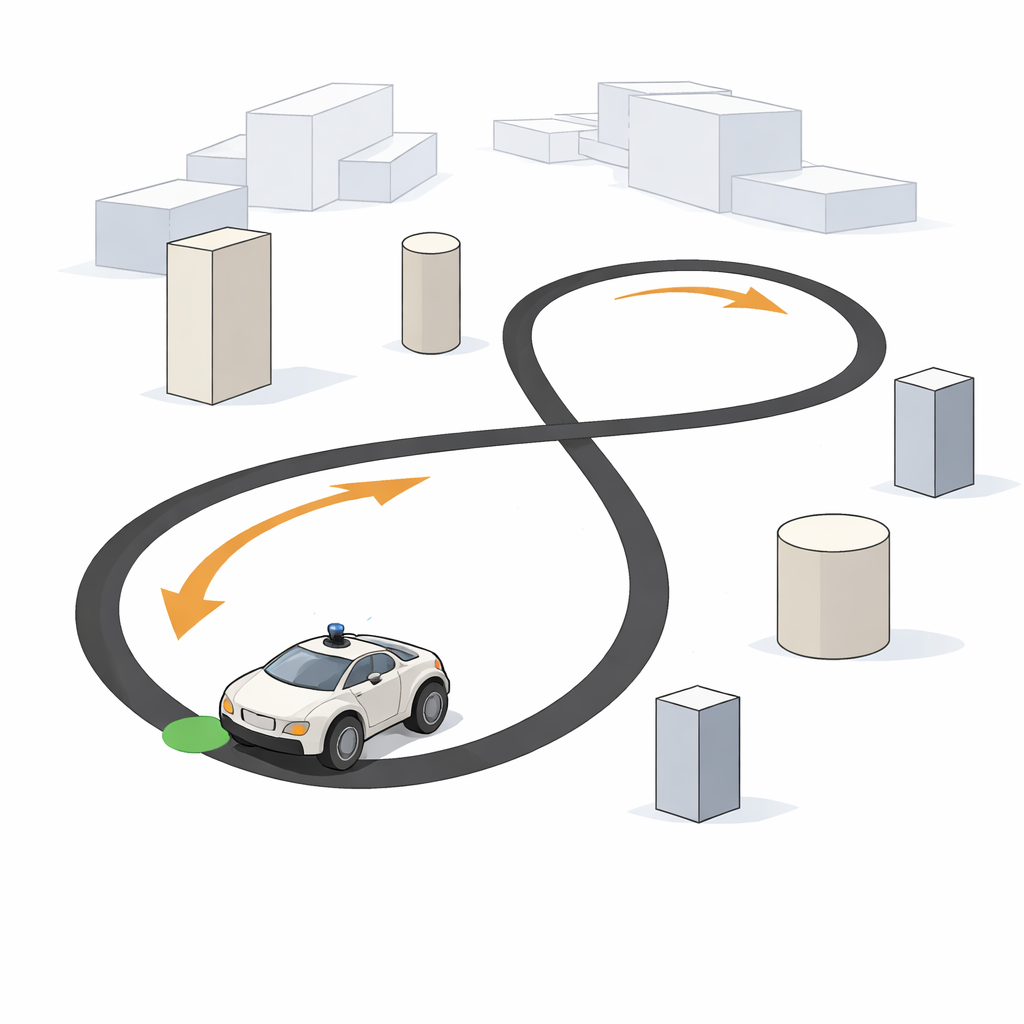
To overcome these limits, the authors design a two-layer “brain” for a common type of wheeled robot that has two drive wheels on either side. The top layer looks only at the robot’s position in the plane and computes how fast it should move forward and how fast it should turn to follow a planned path, such as a smooth figure-eight curve. The lower layer is responsible for making the motors actually produce those speeds. Here the paper introduces an adaptive fuzzy PID controller: a standard PID controller whose three main gains are continuously adjusted by a fuzzy-logic system that watches how far the robot’s behavior deviates from what is desired.
Letting the Controller Learn on the Fly
Fuzzy logic allows the controller to use simple “if–then” style rules, such as reacting differently to small versus large errors or to increasing versus decreasing errors, without needing an exact mathematical model of every disturbance. In this design, two input signals—how big the tracking error is and how quickly it is changing—are fed into a compact fuzzy system that outputs updated values for the PID gains. In effect, the controller can stiffen or relax its response in real time as the robot speeds up, slows down, or encounters slips and noise. A mathematical stability analysis shows that, even with these continual adjustments and with unmodeled effects present, the tracking error will always shrink into a small, guaranteed region and stay there.
Putting the System Through Tough Trials
The researchers then subject their controller to a battery of simulated trials using a well-known mobile robot platform model. First, under ideal conditions with no outside disturbances, the adaptive fuzzy PID controller already tracks the figure-eight path more accurately than a conventional PID and another advanced dynamic controller, showing smoother speed profiles and smaller average errors. Next, they deliberately introduce mismatches between the robot’s true physical parameters and the values assumed by the controller, starting with a 20% error and pushing all the way to a full 100% mismatch. At the same time, they add random noise to the robot’s motion and periodic forces that mimic bumpy ground or jerky actuators.
Results That Survive Extreme Abuse
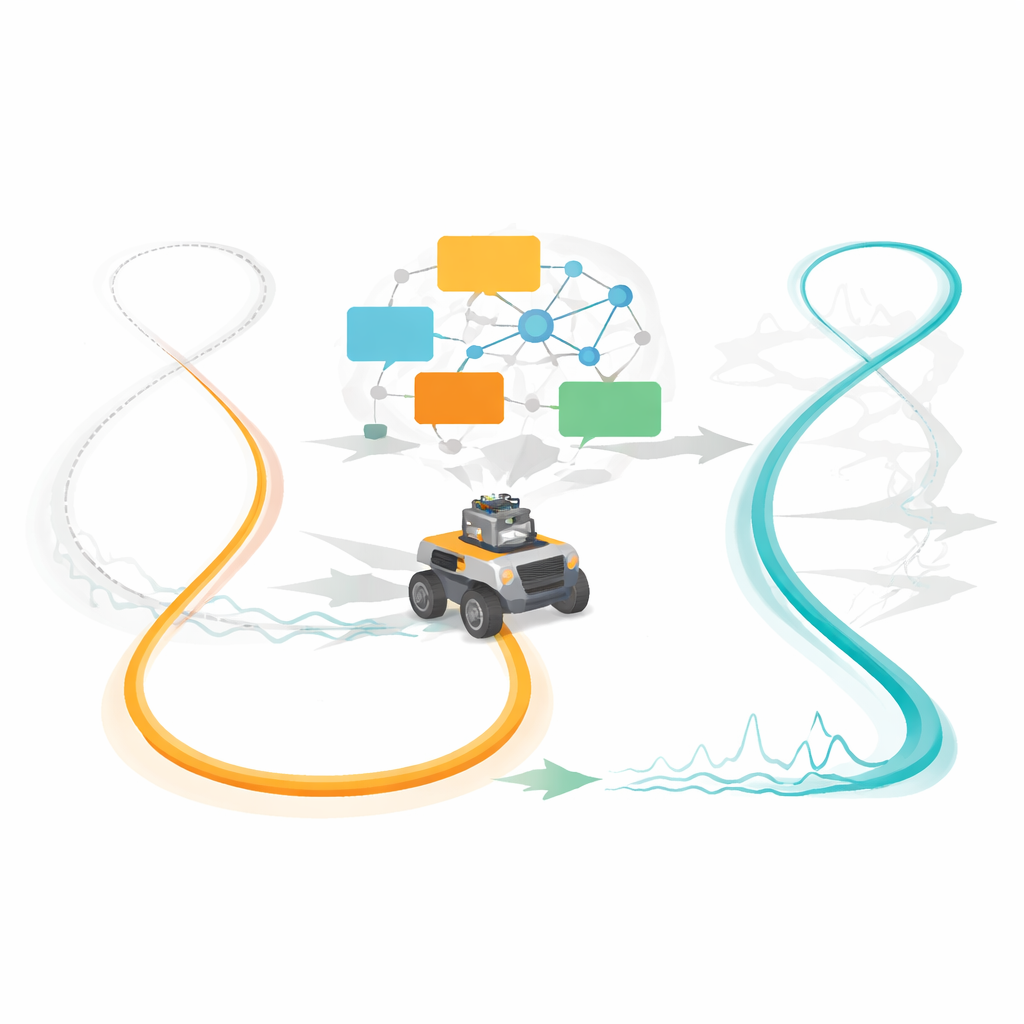
Across all these increasingly harsh scenarios, the adaptive fuzzy PID controller maintains tight tracking of the figure-eight path, while the conventional PID begins to oscillate, lag, and deviate, especially where the path curves sharply. Key error measures, including the root-mean-square tracking error, are consistently cut roughly in half or better by the new method, even when every model parameter is wrong and the robot is bombarded by noise. The motion remains smooth and well behaved, indicating that the controller is not just accurate but also robust and practical for real-time use.
What This Means for Everyday Robots
For a non-specialist, the takeaway is that this work provides a more forgiving and self-adjusting “autopilot” for wheeled robots. Instead of relying on a perfect understanding of the robot and its environment, the controller learns from the ongoing difference between where the robot is and where it should be, and gently retunes itself as conditions change. That means mobile robots in factories, warehouses, or hazardous sites can follow planned routes more safely and precisely, even when their wheels slip, their loads change, or their motors age—bringing us closer to reliable, everyday autonomous machines.
Citation: El Zoghby, H.M., Sharaf, S.M., Bendary, A.F. et al. Enhanced trajectory tracking for autonomous navigation of wheeled mobile robots using an adaptive fuzzy PID controller. Sci Rep 16, 12736 (2026). https://doi.org/10.1038/s41598-026-45772-y
Keywords: autonomous mobile robots, trajectory tracking, fuzzy PID control, robot navigation, disturbance rejection