Clear Sky Science · en
Context-aware sequential course recommendation via conditional variational autoencoders and transformer architectures in IoT-enabled E-learning systems
Smarter Help Choosing Online Classes
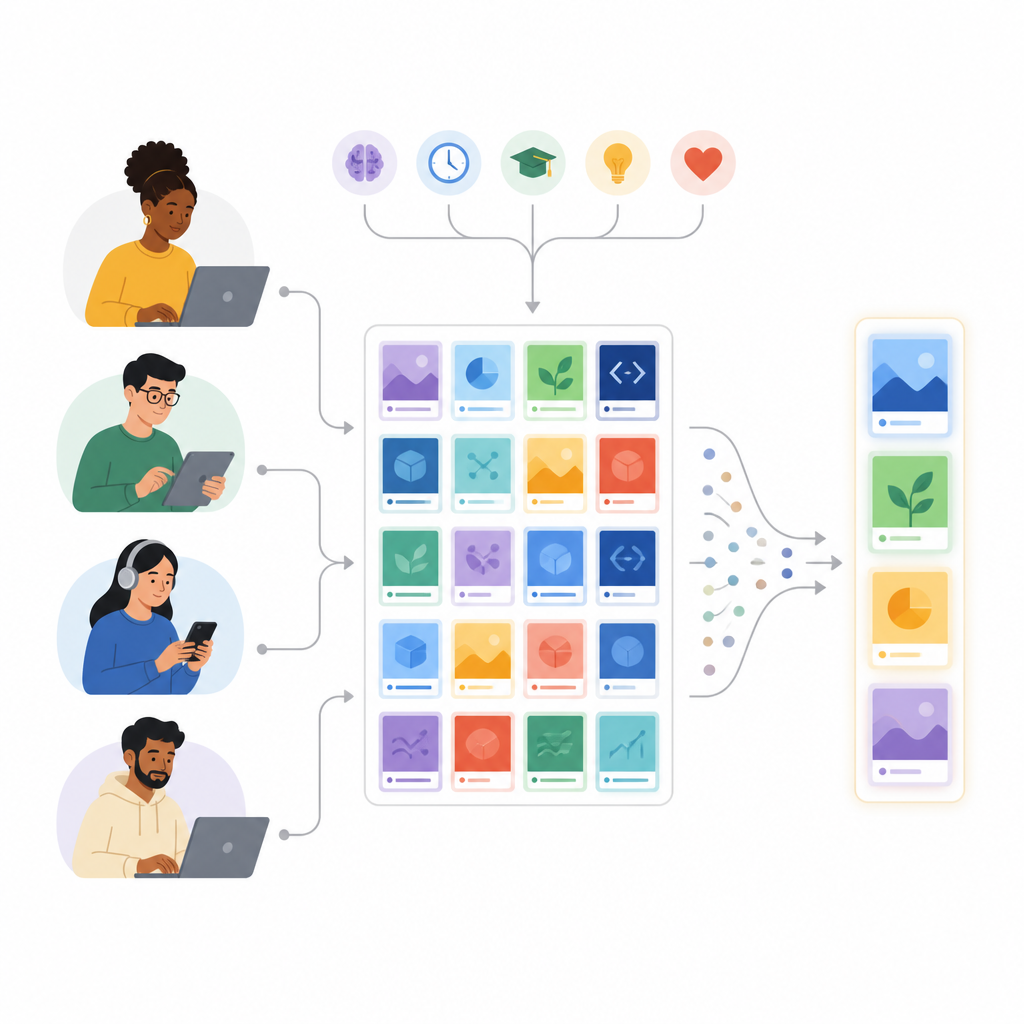
As online learning platforms grow, many students face a new problem: too many courses and not enough guidance. This study explores a smarter way for platforms to suggest classes that fit not only what a learner has done before, but also when, where, and how they are studying, using signals from connected devices and learning apps.
Why Course Suggestions Often Miss the Mark
Most recommendation tools treat students as if their tastes are fixed and their situation rarely changes. Early systems mainly compared users with similar histories or matched course descriptions to profile data. These methods struggle when a learner is new, when there is little data, or when many people follow similar paths and receive nearly identical suggestions. They also do not handle the fast-changing nature of online study, where someone might watch a video at night on a laptop, then skim material on a phone during a commute. This gap becomes larger in settings enriched by connected devices, where time of day, device type, and activity patterns can all influence what kind of course or lesson would be most helpful at a given moment.
Using Signals from Connected Learning
The authors focus on e-learning environments that are linked to the Internet of Things, such as platforms accessed through wearables, smartphones, and smart classrooms. From real course platforms, they gather not only which classes students picked or clicked, but also simple context clues: what device they used, how often they log in, and when they tend to study. These clues act as stand-ins for richer sensor data that future systems could access. After cleaning and organizing these records, the system builds compact numerical portraits of each learner, each course, and each context. Even though the raw platforms do not provide live sensor streams, these proxy signals are enough to test how much context-aware suggestions can help.

How the New Recommendation Engine Works
The proposed engine combines two advanced ideas from modern artificial intelligence. The first is a component that learns hidden patterns behind students and courses while also accounting for uncertainty, which is important when information is missing or noisy. The second is a sequence module that looks at the order of past choices to understand how interests change over time, instead of treating each click or enrollment in isolation. Context from devices and study habits is mixed into this process at every step, so the system can adjust its internal picture of a learner as their situation shifts. A special training strategy teaches the engine to keep its hidden representations stable while still ranking courses accurately, balancing the need to explore options with the need to make sharp distinctions among them.
What the Experiments Show on Real Platforms
The researchers test their framework on three large collections of data from major online course providers. They compare it with several strong existing methods that already model sequences or work well with course content. Across many measures, including how often the top suggestions match what students actually pick and how well the system orders relevant courses, the new method consistently performs better. It also makes fewer prediction errors and remains effective when user histories are short, a common situation for newcomers. When the authors remove pieces of the design in controlled tests, the quality drops, showing that each part, from context handling to the joint training objective, plays a meaningful role.
What This Means for Online Learners
In simple terms, the study suggests that course recommendation should be treated as a moving target shaped by both past behavior and present circumstances. By blending knowledge of what a learner has done, how their interests evolve, and what their current study setting looks like, platforms can deliver suggestions that feel more timely and personal. While questions about data protection and computing cost remain, this work outlines a path toward online learning systems that guide students through long term learning journeys in a way that adapts to their everyday lives.
Citation: Chen, G., Han, G. & Liu, S. Context-aware sequential course recommendation via conditional variational autoencoders and transformer architectures in IoT-enabled E-learning systems. Sci Rep 16, 15370 (2026). https://doi.org/10.1038/s41598-026-45764-y
Keywords: online course recommendation, e-learning personalization, sequential recommendation, IoT learning context, MOOC platforms