Clear Sky Science · en
Cascaded adaptive model predictive and PID control for integrated LFC–AVR enhancement
Keeping the Lights Steady
Every time you plug in a device or switch on a light, power plants silently adjust to keep the grid’s frequency and voltage within tight limits. If either one swings too far, equipment can fail or large blackouts can follow. This paper explores a smarter way to control both frequency and voltage together, using an adaptive, layered control strategy that reacts in real time as the grid’s conditions change.
Why Frequency and Voltage Must Work Together
In large power systems, frequency tells us if the balance between generated power and demand is off, while voltage indicates how healthy the electrical pressure is across the network. Although they are often controlled by separate mechanisms, the two are physically linked inside generators and their excitation systems. A sudden jump in demand, or a shift in generator parameters, can disturb both at once. Traditional controllers, tuned for one typical operating point, may respond too slowly or overshoot, causing unnecessary swings before the system settles.
A Smarter Two-Layer Control Strategy
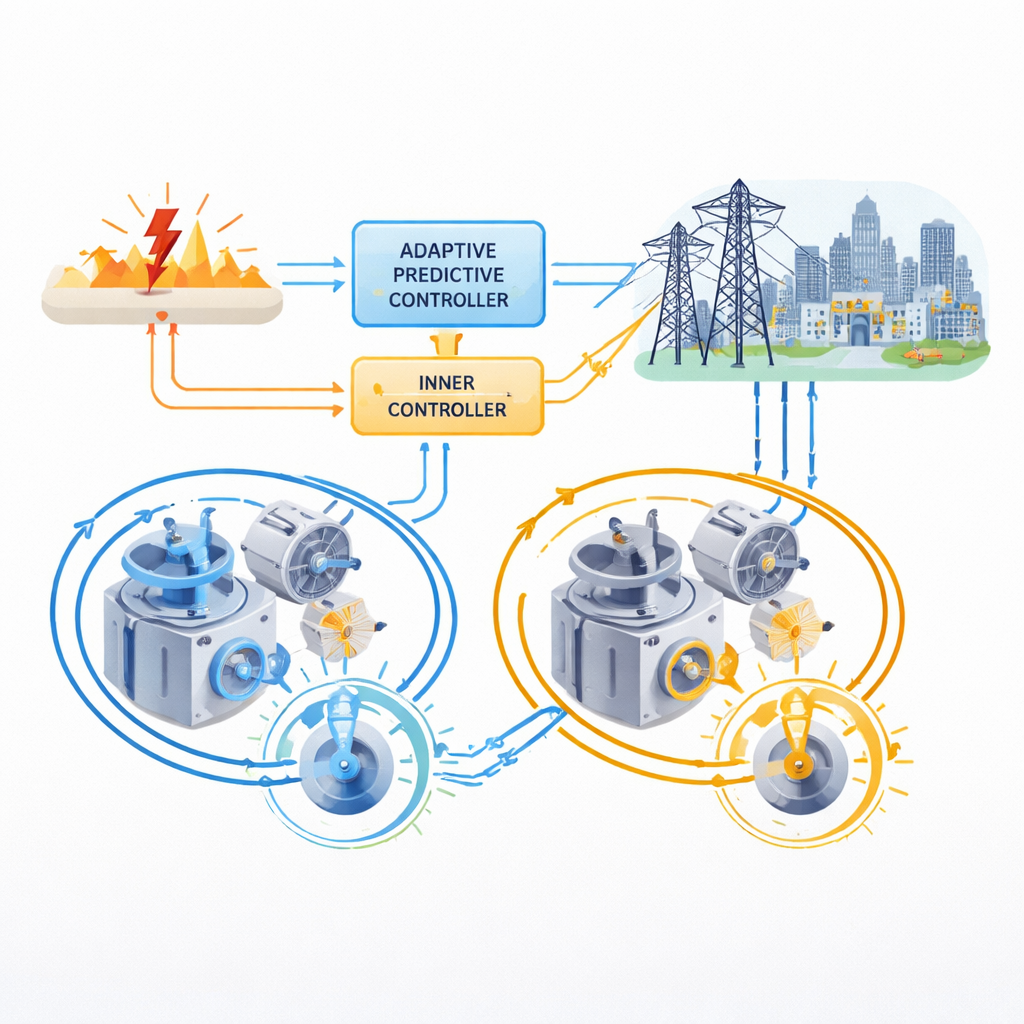
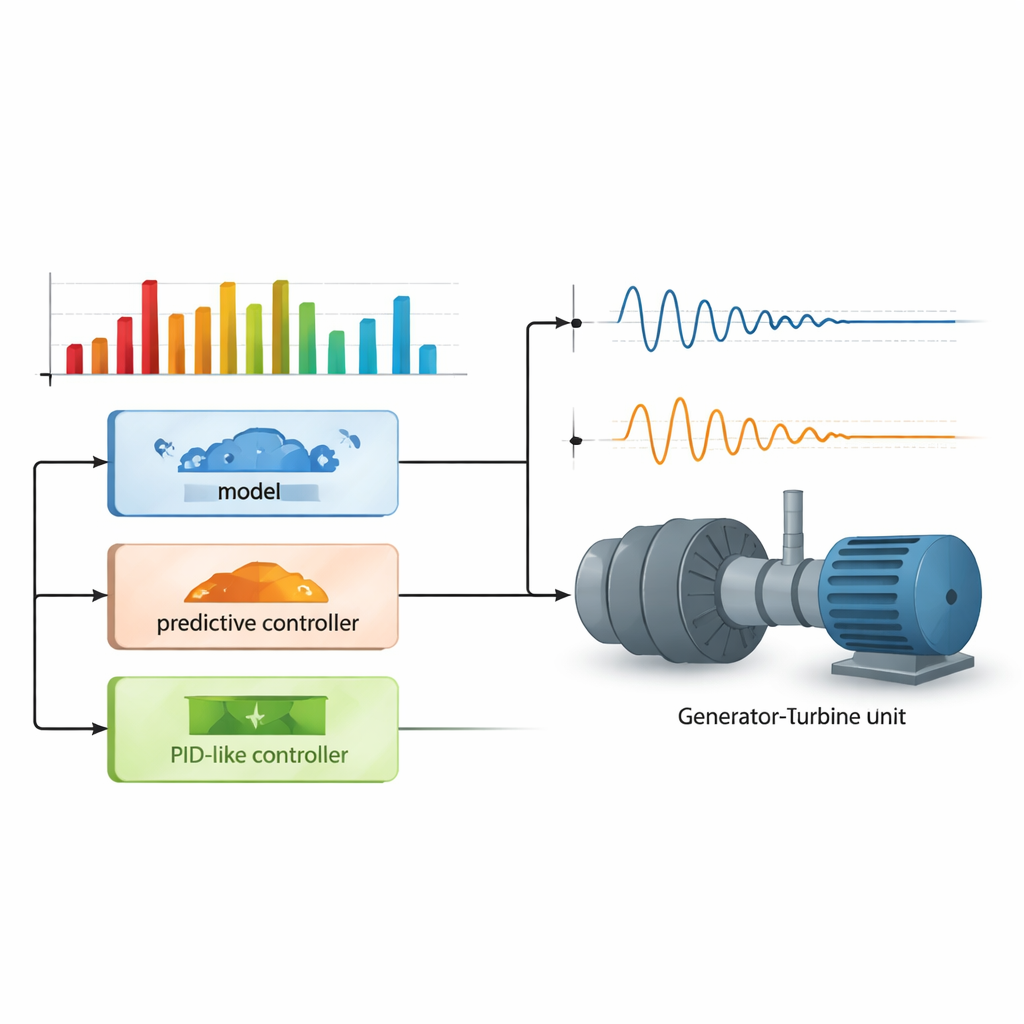
To tackle this, the authors propose a cascaded control scheme that marries an advanced predictive controller with a familiar, fast-acting controller. In the outer layer sits an adaptive model predictive controller that constantly updates its internal picture of how the power system behaves. In the inner layer, a standard PID controller executes quick, smooth adjustments to the generator’s actuators. The outer layer looks ahead in time and decides the best trajectory for frequency and voltage, while the inner layer makes sure the generator closely follows those targets with minimal delay.
How the Controller Learns on the Fly
Rather than assuming the power system never changes, the outer controller continuously re-identifies the system’s behavior during operation. It uses running measurements to estimate key parameters and rebuild a compact mathematical model at each instant. A time-varying filter then reconstructs important internal signals that are not directly measured. With this refreshed model, the predictive layer solves a short-term optimization problem: it chooses future control actions that will minimize deviations in frequency and voltage while keeping adjustments within safe limits. Only the first action in this sequence is applied, and the process repeats, allowing the controller to adapt as loads and system characteristics drift.
Testing on Simple and Interconnected Grids
The researchers tested their approach on two standard setups: a single power area and a two-area system linked by tie lines. They compared the new cascaded controller against advanced versions of the traditional PID design whose settings were tuned offline using modern search algorithms. When the authors applied sudden load changes or altered system parameters, the adaptive scheme consistently showed smaller dips and peaks in frequency, quicker settling times, and smoother voltage behavior. In both simple and interconnected grids, the new approach restored normal conditions several seconds faster than the best tuned conventional methods.
Robust Performance Under Stress
The study also pushed the system far from its comfort zone to test robustness. Load disturbances of varying sizes and sizeable changes in model time constants were imposed. Even when the system was stressed with larger steps or significant parameter shifts, the adaptive cascaded controller held frequency and voltage within tight bounds, with only modest overshoot and rapid recovery. In contrast, the conventional controllers responded more sluggishly and exhibited deeper excursions, especially in the interconnected two-area case where disturbances in one region affect the other.
What This Means for Future Power Grids
For a general reader, the main message is that a grid can be made more resilient by giving its controllers the ability to learn continuously and coordinate multiple tasks at once. By combining an adaptive predictive layer with a fast inner controller, this work shows how frequency and voltage can be stabilized more quickly and reliably than with even carefully tuned traditional schemes. As power systems become more complex with renewable sources and fluctuating loads, such adaptive, layered control strategies could be key to keeping the lights on without wasteful overdesign or constant manual retuning.
Citation: Ayman, M., Attia, M.A. & Asim, A.M. Cascaded adaptive model predictive and PID control for integrated LFC–AVR enhancement. Sci Rep 16, 12734 (2026). https://doi.org/10.1038/s41598-026-45726-4
Keywords: power system stability, load frequency control, voltage regulation, adaptive model predictive control, PID controllers