Clear Sky Science · en
Stress-mediated multi-fault rupture dynamics of the 2023 Kahramanmaraş earthquake sequence, Türkiye
Why this double earthquake matters
In February 2023, two huge earthquakes struck southeastern Türkiye just hours apart, killing tens of thousands of people and devastating whole cities. This study asks a deceptively simple question with big implications for public safety: why did two neighboring faults break in such quick succession, and could the second disaster have been made more likely by the first? By tracing how stress slowly built up over two centuries and then suddenly shifted during the 2023 events, the authors show how one earthquake can prepare and then unlock another, turning a single catastrophe into a cascading sequence.
Long memories hidden in the rocks
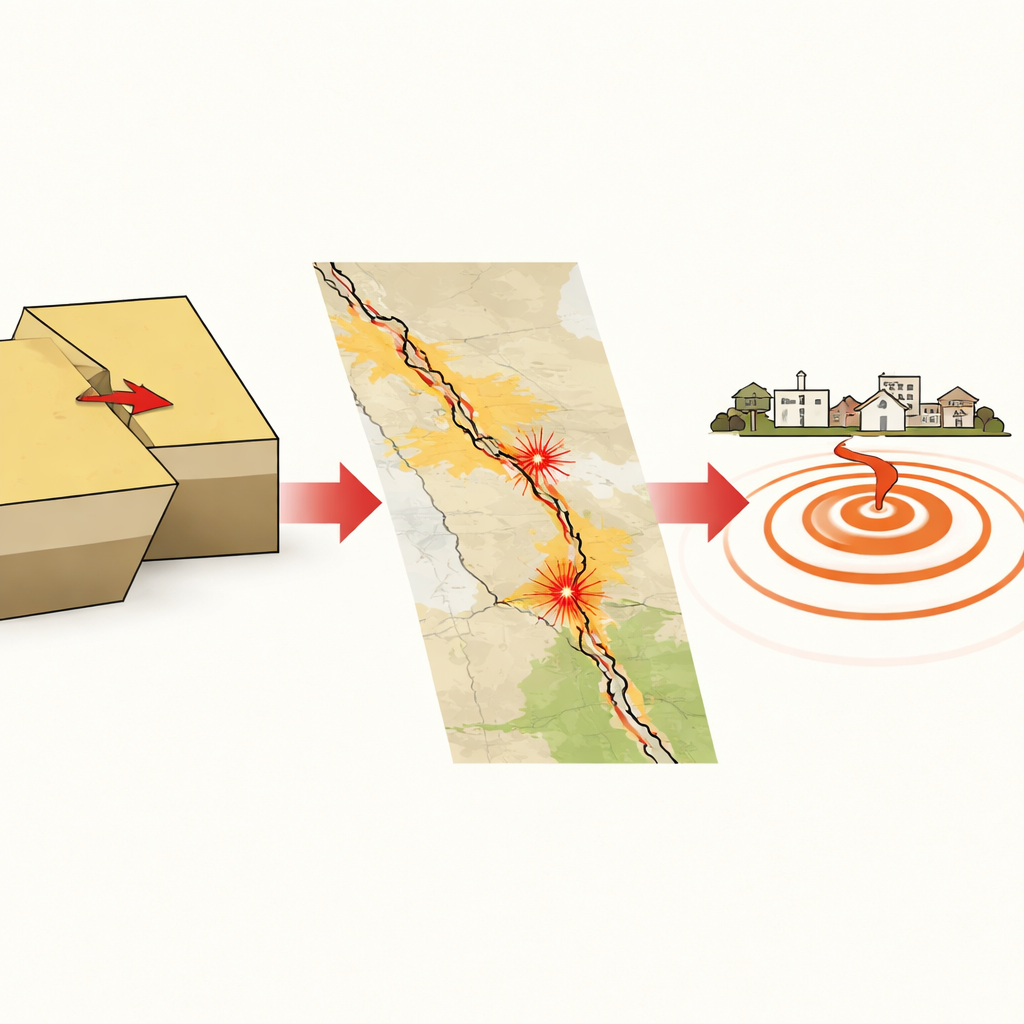
Earthquakes do not come out of nowhere. Each one slightly reshapes the stress field in the crust, loading some faults and relaxing others. The team revisited an earlier model of these stress changes for eastern Türkiye, updating it with new historical records, fault maps, and modern seismology. They tracked how stress accumulated from a series of large quakes beginning in 1822, including both the sudden jolts during each event and the slow, creeping adjustments that followed deep in the crust. This allowed them to estimate how “primed” different fault segments were on the eve of the 2023 disaster, long before the ground actually began to shake.
The first shock: a fault ready to go
The initial magnitude 7.8 Kahramanmaraş earthquake did not start on the main well-known fault, but on a smaller nearby segment called the Narlı fault. Their calculations show that this fault had been steadily loaded for two centuries, especially by the great 1822 earthquake. When it finally broke, stress along the adjacent Pazarcık segment of the main East Anatolian Fault had already reached high levels. The Narlı rupture added another push, raising stress still further and helping the break jump onto Pazarcık just seconds later. Along part of this segment, stresses were high and relatively uniform, conditions that laboratory and computer models suggest are ideal for extremely fast, “super-shear” rupture that outruns its own seismic waves, as was observed to the northeast. In contrast, to the southwest, where the stress pattern was more patchy and even locally negative, rupture moved more slowly.
Barriers, shadows, and the second big quake
Not every nearby fault was ready to fail. The Amanos segment, which ruptured after Pazarcık, initially lay in what the authors describe as a stress “shadow,” with parts of it experiencing reduced stress from earlier events. Yet the combined effect of the Narlı and Pazarcık ruptures reversed this picture, leaving most of Amanos strongly loaded and allowing a slower, sub-shear rupture to proceed. The truly surprising story, however, concerns the magnitude 7.6 Elbistan earthquake that followed nine hours later on a different, roughly east–west fault. Before 2023, most of this fault sat in an unfavourable state, with stress changes that would have tended to inhibit failure rather than promote it.
How one quake unclamped another
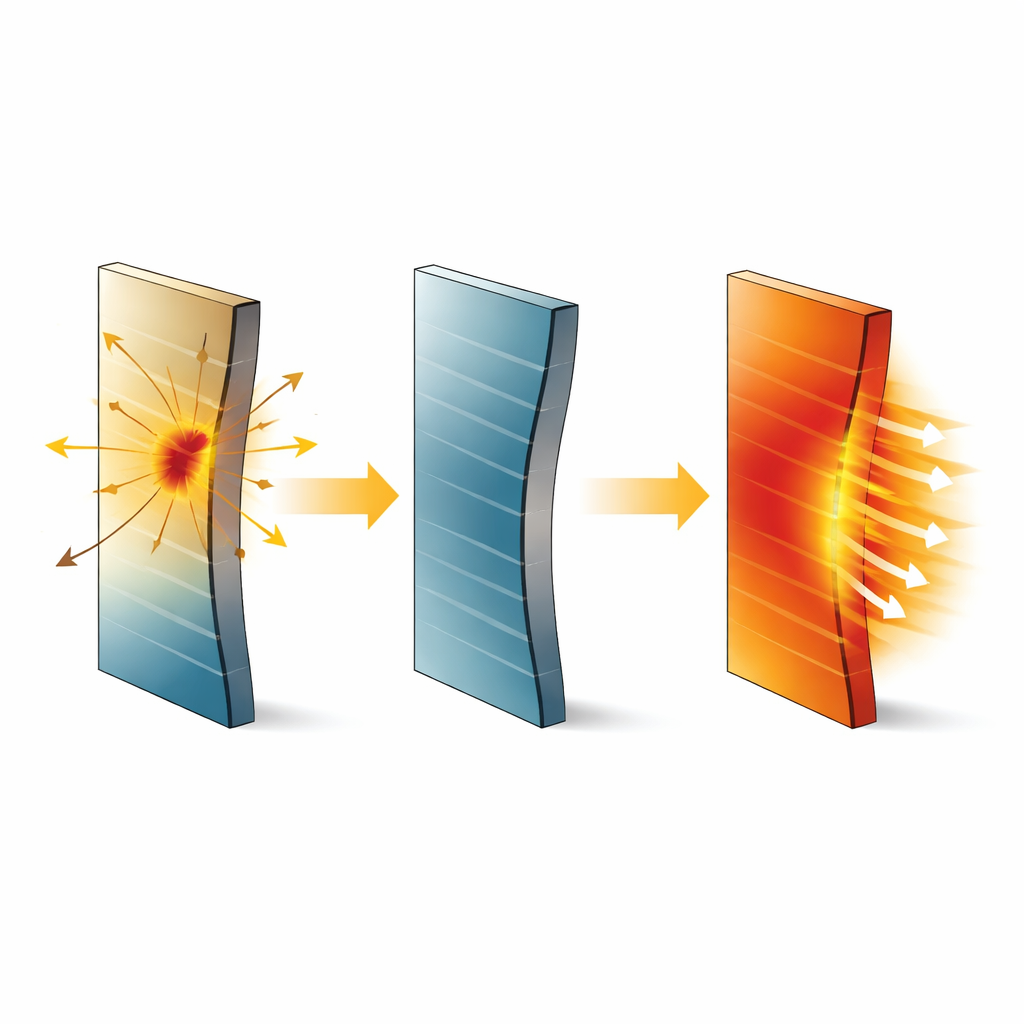
The models reveal that the Kahramanmaraş mainshock dramatically reshaped conditions on the Elbistan fault. Instead of mainly pushing it sideways, the first quake effectively “unclamped” the second fault by reducing the squeezing force that held it shut by more than ten bars of pressure over a wide area. Even though the increase in sideways shearing force was modest, this release of clamping stress, combined with subtle changes in the average stress that controls fluid pressure in rocks, tipped the balance. The authors suggest that pore fluids may have migrated towards zones where the crust was slightly stretched, further weakening the fault. As a result, a previously unfavourable fault was transformed into one with positive overall stress change, allowing it to rupture rapidly, again with segments moving at super-shear speeds.
What this means for future risk
The study concludes that the 2023 disaster cannot be understood by looking only at simple “seismic gaps” or by considering each fault in isolation. Instead, both long-term loading from historical earthquakes and short-term changes from a major shock can combine to create complex, cascading failures across multiple faults. For non-specialists, the key message is that one big earthquake can quietly prepare the ground for another by shifting stresses and loosening neighboring faults, even if those faults previously appeared relatively safe. Recognizing and modeling these hidden connections is essential if we are to improve earthquake forecasts and better anticipate when a single large event might become a deadly double or even a chain reaction.
Citation: Nalbant, S.S., Uzunca, F., Main, I.G. et al. Stress-mediated multi-fault rupture dynamics of the 2023 Kahramanmaraş earthquake sequence, Türkiye. Sci Rep 16, 10705 (2026). https://doi.org/10.1038/s41598-026-45723-7
Keywords: earthquake triggering, fault interactions, Coulomb stress, Kahramanmaraş sequence, seismic hazard