Clear Sky Science · en
Study the behaviour of Ti-Mo-xZr alloys during thermomechanical treatment
Why new metals matter for our bodies
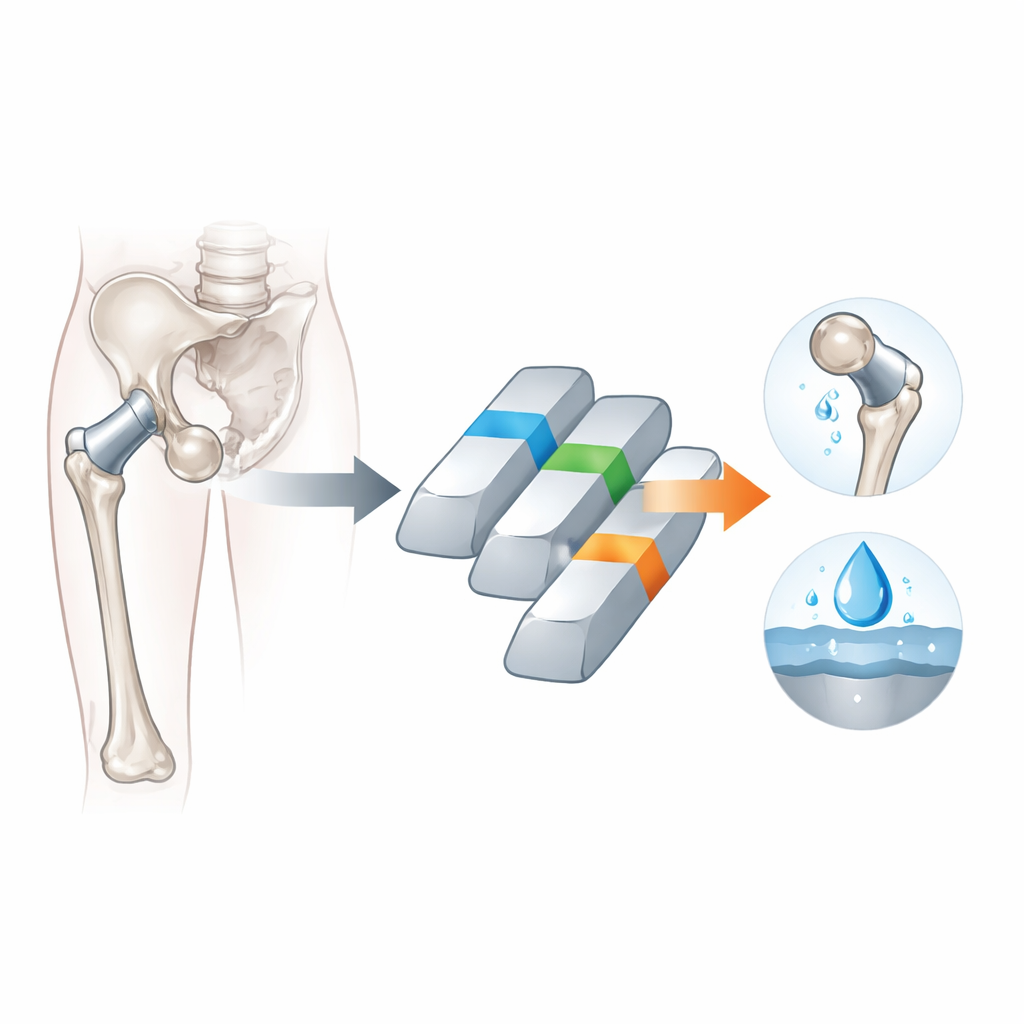
Hip joints, dental screws, and bone plates all depend on metals that can live quietly inside the body for decades. Titanium has long been a favorite because it is light, strong, and resists rusting in blood and tissue. Yet the most widely used titanium alloy, known as Ti‑6Al‑4V, contains elements that may release ions over time and do not perfectly match the stiffness of bone, which can weaken the surrounding skeleton. This study explores a new family of titanium‑based alloys that aim to be safer for the body while better imitating the way real bone bends and bears weight.
Building safer metal for implants
The researchers focused on alloys made from titanium, molybdenum, and zirconium—elements chosen for their good biocompatibility and reasonable cost. Starting from a known implant alloy containing 10 percent molybdenum, they created three versions by adding either 0, 3, or 6 percent zirconium by weight. Before melting any metal, they used computer tools, including electronic structure diagrams and thermodynamic software, to predict which internal crystal phases would form and how stable they would be as the alloys were heated and cooled. These predictions guided the design so that the material would favor phases associated with lower stiffness and good mechanical behavior in the body.
Forging and probing the new alloys
After casting the alloys in an inert atmosphere, the team homogenized and hot‑forged them to break up casting defects and refine the grain structure, mimicking industrial thermomechanical processing. They then mapped the internal phases using X‑ray diffraction, electron microscopy, and thermal analysis. Both the models and experiments showed that adding zirconium lowers the temperature at which the high‑temperature beta phase transforms to the alpha phase, confirming zirconium acts as a beta‑stabilizing element in these titanium systems. Interestingly, the combination of forging and zirconium content produced a non‑linear outcome: the alloy with 3 percent zirconium developed the highest fraction of alpha phase, while the alloys with 0 and 6 percent zirconium remained strongly beta‑rich.
Strength, flexibility, and how the metal “feels” to bone
Because bone can gradually dissolve away if a nearby implant is much stiffer and carries too much of the load, a key goal was to keep the elastic modulus—the measure of how much a material springs back under stress—as low as possible while maintaining high strength. All three alloys showed high compressive strength and large plastic deformation, meaning they can withstand heavy loads without brittle failure. Their hardness was roughly three times that of commercially pure titanium, suggesting good wear resistance. At the same time, their elastic moduli fell between about 109 and 120 gigapascals, slightly below or comparable to the workhorse Ti‑6Al‑4V alloy and below those of stainless steel and cobalt‑chromium implants. The 3‑percent zirconium alloy, which contained the most alpha phase, achieved the lowest modulus in this group, coming close to that of pure titanium while retaining the strength benefits of the alloyed system.
Surviving in simulated body fluid
To understand how these materials would behave inside the body, the team immersed them in a laboratory solution that mimics blood plasma and measured their electrochemical response. All samples quickly formed passive oxide films that protected the underlying metal, but their corrosion resistance varied with composition and phase balance. The beta‑rich alloys—those with 0 and 6 percent zirconium—showed the lowest corrosion currents and highest polarization resistance, indicating very slow, steady material loss. In contrast, the 3‑percent zirconium alloy, with its mixed microstructure, suffered from micro‑galvanic effects between neighboring regions, which accelerated local corrosion despite its favorable stiffness.

What this means for future implants
Taken together, the results suggest that carefully tuned titanium–molybdenum–zirconium alloys can offer an appealing combination of high strength, moderate stiffness, and strong resistance to body‑fluid corrosion, without relying on aluminum or vanadium. The study highlights how subtle changes in composition and forging conditions can swing the internal structure between different phase balances, changing both how the alloy carries load and how it resists attack in a salty, oxygen‑rich environment. Beta‑rich versions stand out as especially corrosion‑resistant, while the 3‑percent zirconium variant offers the lowest stiffness. In the long run, such design strategies may enable orthopedic and dental implants that are kinder to surrounding bone and longer‑lasting inside the body.
Citation: Keshtta, A., Aly, H.A., ELnaser, G.A. et al. Study the behaviour of Ti-Mo-xZr alloys during thermomechanical treatment. Sci Rep 16, 12349 (2026). https://doi.org/10.1038/s41598-026-45667-y
Keywords: titanium implants, biocompatible alloys, zirconium addition, elastic modulus, corrosion resistance