Clear Sky Science · en
Development of a high-precision evaluation system for radial pulse wave applanation tonometry devices
Why a wrist pulse matters at home
Checking your pulse at the wrist is no longer limited to the doctor’s office. Smartwatches and other wearables now track heart rhythms around the clock. But before these gadgets can be trusted with our health, engineers need a way to test them under realistic, repeatable conditions. This study introduces a lab-built “artificial wrist” that can precisely mimic human pulse waves so that pulse-measuring devices can be judged fairly and tuned carefully.
Building a realistic fake wrist
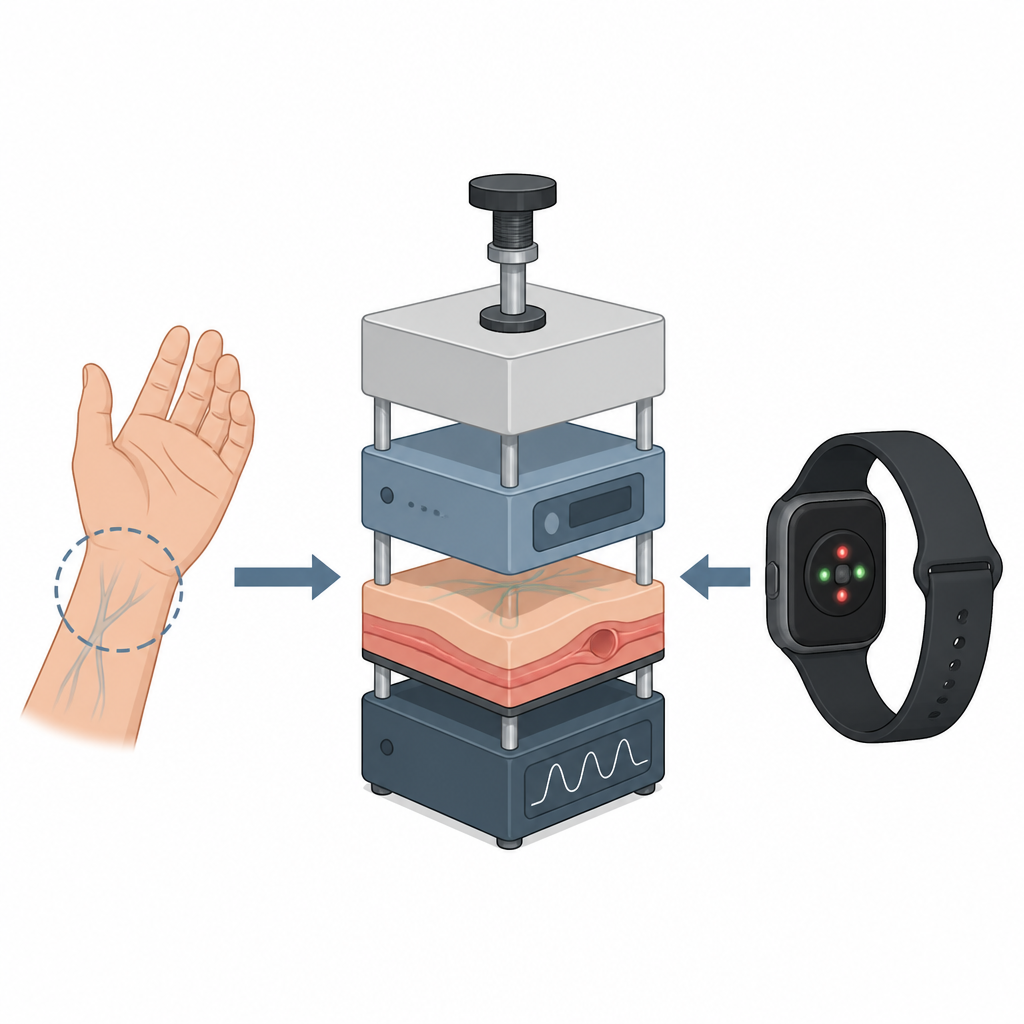
The researchers set out to close a gap between growing wearable technology and the lack of solid testing tools. International rules already describe how accurate electronic radial pulse devices should be, including how well they measure blood pressure changes and heart rate. Yet there was no single test platform able to reproduce lifelike wrist pulses while checking all of these performance targets. To solve this, the team designed a high-precision evaluation system that brings together four main parts: a pressing unit that imitates how a device pushes on the skin, a central control box, a wrist model with artificial skin and artery, and a pulse generator that drives the fake blood vessel.
How the pulse simulator works
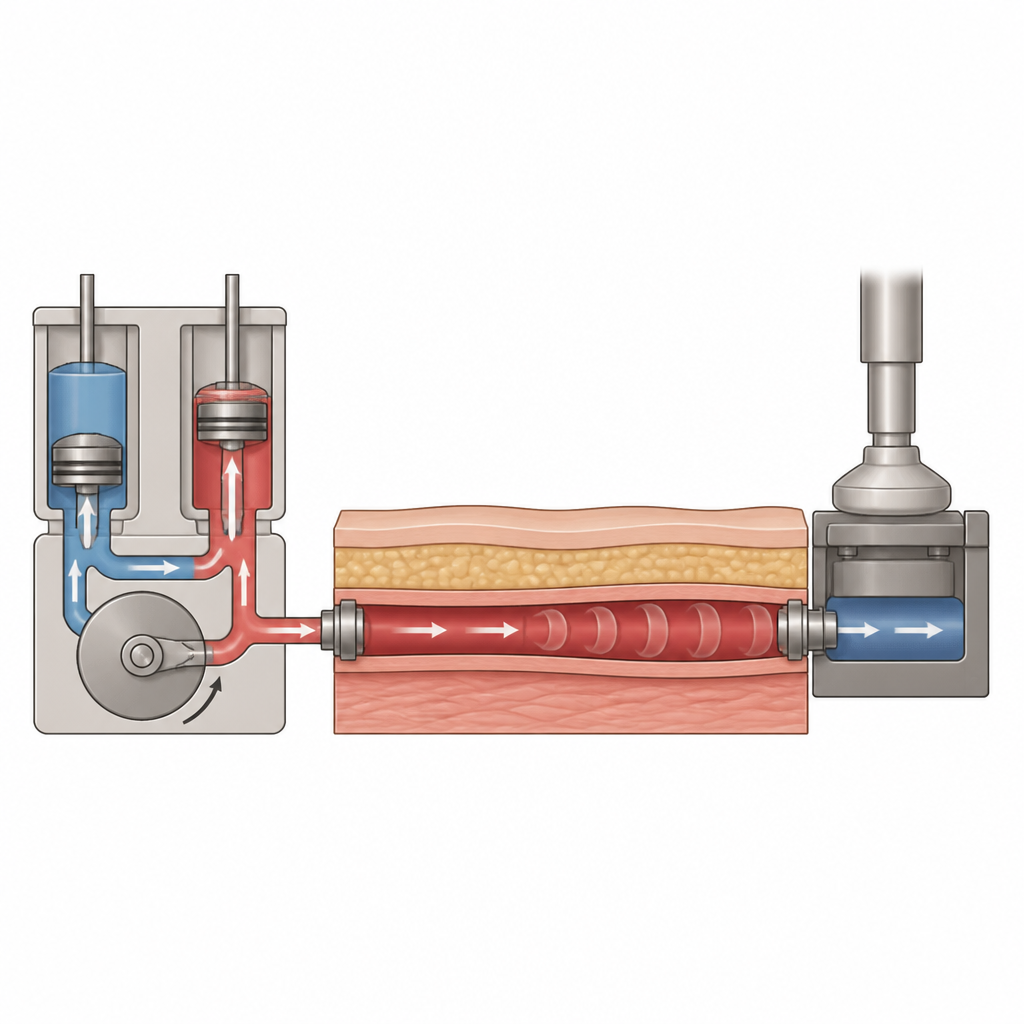
At the heart of the system is a three-dimensional cam, a rotating part whose shape controls how pressure rises and falls with each beat. By moving this cam sideways and changing its speed, the machine can adjust both the strength and the timing of the pulse wave, just as different hearts and blood pressures would in real life. A clever “dual-volume” design separates slow background pressure, like the steady blood pressure between beats, from the sharp pressure peaks that form each pulse. Large fluid chambers set the base pressure, while a smaller chamber tightly linked to the cam fine-tunes the pulse peaks. This setup allows the machine to cover a wide range of conditions while still responding quickly and smoothly.
Mimicking bones, skin, and vessels
To test real devices, the team needed more than just moving fluid; they needed an arm-like structure. Their wrist unit includes a rigid piece that represents bone, a soft silicone layer that imitates skin and tissue, and elastic tubes that stand in for the radial artery. Swappable artificial arteries with different diameters and stiffness levels let the researchers study how vessel size and hardness affect the signals seen by sensors. A force sensor buried under the “bone” measures how hard a device presses on the skin, while pressure sensors inside the fluid track the true base pressure and pulse peaks. Together, these elements create a controlled but surprisingly lifelike stand-in for a human wrist.
Putting the system to the test
The authors rigorously checked whether their artificial wrist could hold steady settings and repeat them over and over. They varied pulse strength, background pressure, heart rate, and the downward force applied by a mock device, then repeated each test many times. Across these trials, the system kept applied pressure, pulse size, and pulse rate within fractions of a percent of their target values. It could generate heart rates from about 20 to over 200 beats per minute and base pressures spanning low to high physiological ranges. The shapes of the pulse waves also stayed highly consistent, an important feature for devices that analyze subtle details in the waveform rather than just counting beats.
What this means for future wearables
In simple terms, the researchers have built a precise “test bench” for wrist-based pulse sensors that behaves much more like a real human wrist than older simulators. Because it can reproduce lifelike pulse waves with tightly controlled settings and low variability, the platform offers a trustworthy way to compare devices, calibrate them, and explore how different vessel or tissue properties might confuse their readings. This kind of standardized testing is a key step toward making everyday wearable monitors more reliable for tracking cardiovascular health.
Citation: Jun, MH., Choy, S. & Kim, YM. Development of a high-precision evaluation system for radial pulse wave applanation tonometry devices. Sci Rep 16, 15598 (2026). https://doi.org/10.1038/s41598-026-45661-4
Keywords: radial pulse, wearable sensors, applanation tonometry, pulse wave simulator, cardiovascular monitoring