Clear Sky Science · en
Cultivation system and plant health influence root-associated bacterial community structure and interaction networks in strawberry
Why the Dirt Around Strawberries Matters
Strawberries may look simple on the surface, but their roots host bustling communities of bacteria that can help plants stay healthy or tip them toward disease. As growers increasingly shift between traditional soil fields and high-tech hydroponic systems, understanding how these tiny partners change with the growing method could improve yields while reducing chemical use. This study explores how different cultivation systems and plant health conditions shape the root‑associated bacteria of strawberries—and what that might mean for more sustainable disease management.
Two Ways to Grow the Same Berry
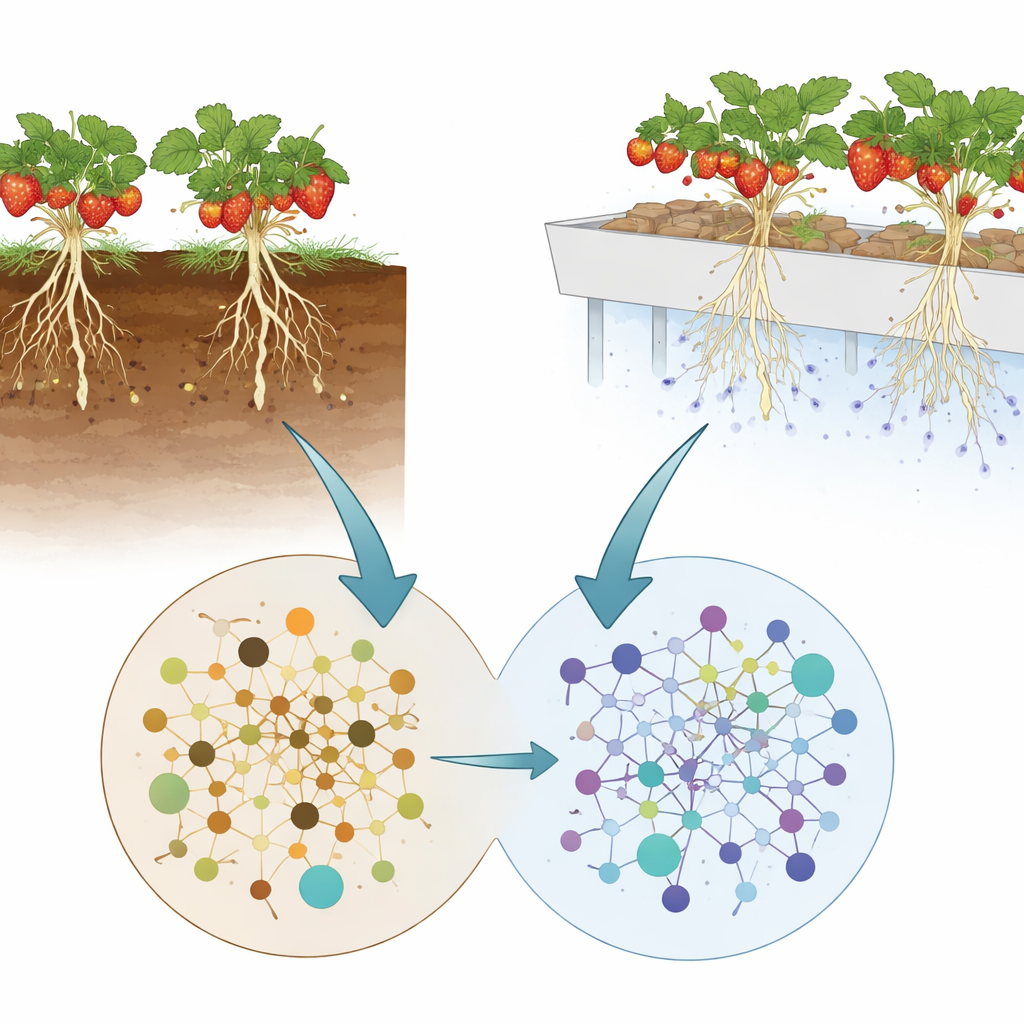
The researchers compared strawberries grown in a soil field with those raised in a soilless hydroponic setup using cocopeat and perlite. In both places, they sampled material clinging to the roots—soil in the field and substrate in hydroponics—from plants that looked healthy and plants showing decline symptoms such as wilting or yellowing leaves. By sequencing bacterial DNA from 40 root‑associated samples, they could see which kinds of bacteria were present and how these communities differed between field healthy (FH), field diseased (FD), hydroponic healthy (HH), and hydroponic diseased (HD) plants. This approach let them ask whether the growing system or the plant’s visible health had the bigger influence on its microscopic partners.
Different Underground Neighborhoods
The study found that the cultivation system was the main force shaping which bacteria lived near strawberry roots. Field plants were dominated by groups commonly found in soils, especially Firmicutes and Actinobacteria, including many relatives of Bacillus, a genus often linked with natural disease control. Hydroponic plants, by contrast, hosted more Proteobacteria, Bacteroidetes, Planctomycetes, and Verrucomicrobia, with families such as Chitinophagaceae and Sphingomonadaceae standing out. These system‑specific fingerprints appeared in both healthy and diseased plants, showing that where the plant grows matters more than whether it currently looks sick.
Richness, Shifts, and Stress
Surprisingly, bacterial diversity was higher in the hydroponic system than in the field, across several measures of richness and variety. This runs counter to the common assumption that complex soils always host more diverse life, and suggests that long‑term soil practices, like continuous strawberry cropping and tillage, may have reduced diversity in the field site. When the researchers looked at which exact bacterial types were more common under each condition, they saw that field plants—healthy or diseased—consistently favored Bacillus and related groups, indicating a relatively stable community. In hydroponics, however, healthy plants had distinctive bacteria such as Ferruginibacter, Luteolibacter, and Mesorhizobium, while diseased hydroponic plants showed a broader reshuffling and loss of these helpful lineages rather than the clear rise of a single new group. This suggests that stress in hydroponics may be linked to a breakdown of a supportive bacterial cast rather than takeover by one obvious culprit.
Hidden Networks of Microbial Partners
Bacteria do not act alone; they form interaction networks, where some types are more connected and influential than others. The team built such networks for each of the four plant groups to see how tightly knit these invisible communities were. Hydroponic roots contained more bacterial types and more potential interactions overall, yet their networks were less densely clustered and showed lower cohesion than those in soil. Field networks, though smaller, were more compact and locally connected, hinting at a tighter, perhaps more stable web of relationships. Disease influenced these patterns differently depending on the system: in the field, symptomatic plants showed more fragmented networks with extra modules, while in hydroponics, disease coincided with greater centralization, where a subset of bacteria became more highly connected and influential. Importantly, the bacteria that changed most in abundance were usually not the same ones occupying central positions in the network, showing that “most common” and “most structurally important” are not always the same players.
What This Means for Growers
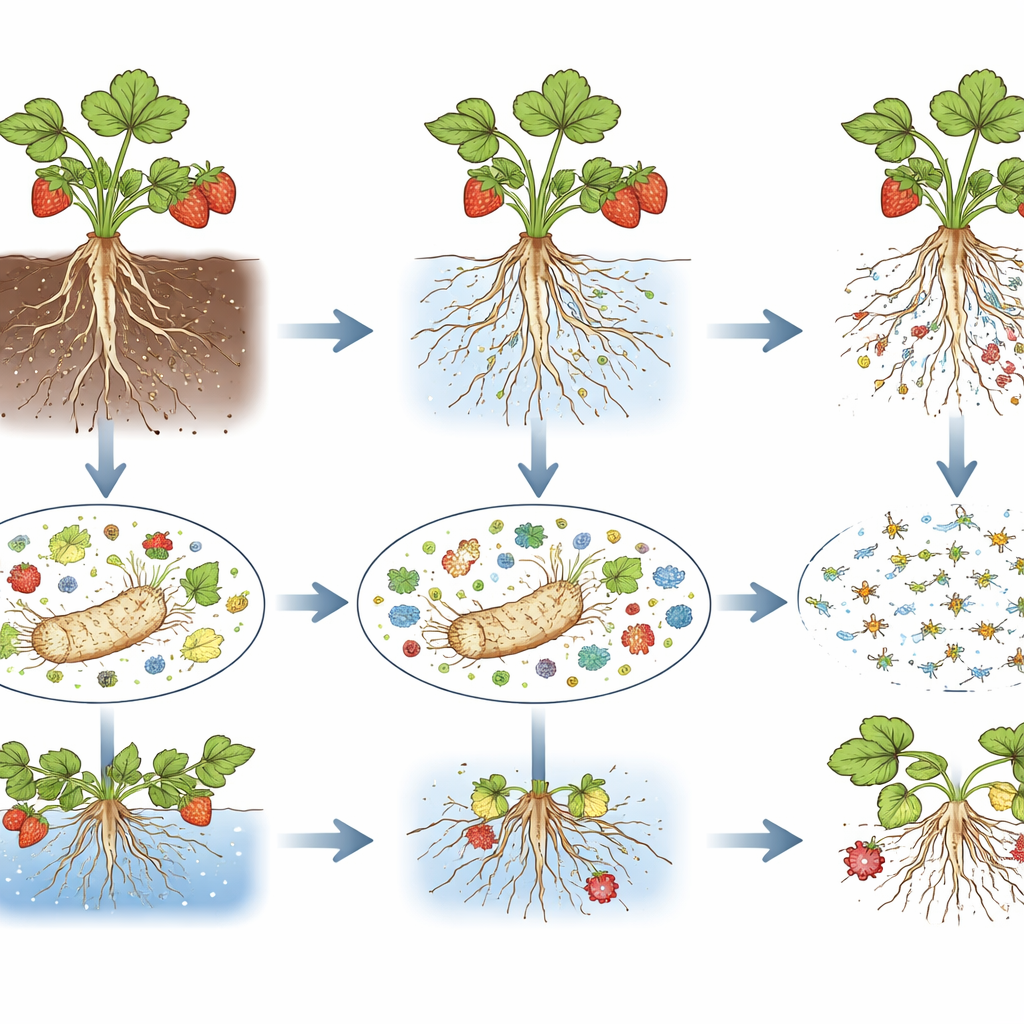
In simple terms, this work shows that the way strawberries are grown—traditional soil beds versus soilless hydroponic troughs—largely determines which bacteria gather around their roots and how those bacteria interact. Field systems support more tightly woven bacterial networks, while hydroponic systems host richer but more loosely organized communities that reorganize strongly when plants show stress. Because the study links these patterns to plant health, it suggests that future disease‑management strategies will need to be tailored to each cultivation system, using an understanding of both community makeup and network structure to maintain or restore beneficial microbiomes around strawberry roots.
Citation: Roy, M., Han, D., Lee, D. et al. Cultivation system and plant health influence root-associated bacterial community structure and interaction networks in strawberry. Sci Rep 16, 13270 (2026). https://doi.org/10.1038/s41598-026-45642-7
Keywords: strawberry microbiome, hydroponic cultivation, root-associated bacteria, plant disease suppression, soil vs soilless systems