Clear Sky Science · en
A low-complexity compact dual-polarized patch antenna with high isolation and low cross-polarization for in-band full-duplex applications
Why better antennas matter for everyday wireless
Smartphones, home Wi‑Fi routers, and future 6G gadgets all compete for the same limited airwaves. One promising way to squeeze more data out of the spectrum is to let a device transmit and receive on the same frequency at the same time, a mode called in‑band full‑duplex. But to make that work in practice, the tiny antenna inside the device must keep its outgoing signal from drowning out the incoming one. This paper presents a new compact antenna design that tackles this challenge using a simple structure that could fit inside modern wireless products.

Making room in a crowded airwave world
Traditional wireless systems avoid self‑interference by separating transmit and receive signals in time or in frequency, which effectively halves the potential data rate. Full‑duplex systems aim to double efficiency by letting both directions share the same channel. The catch is that the transmitter’s powerful signal can leak into the receiver path, overwhelming the much weaker signal arriving from the other end of the link. Part of the solution lies in clever electronics and signal processing, but the antenna itself also has to keep the two signal paths as independent as possible while staying small and easy to manufacture.
Two signals, one tiny radiator
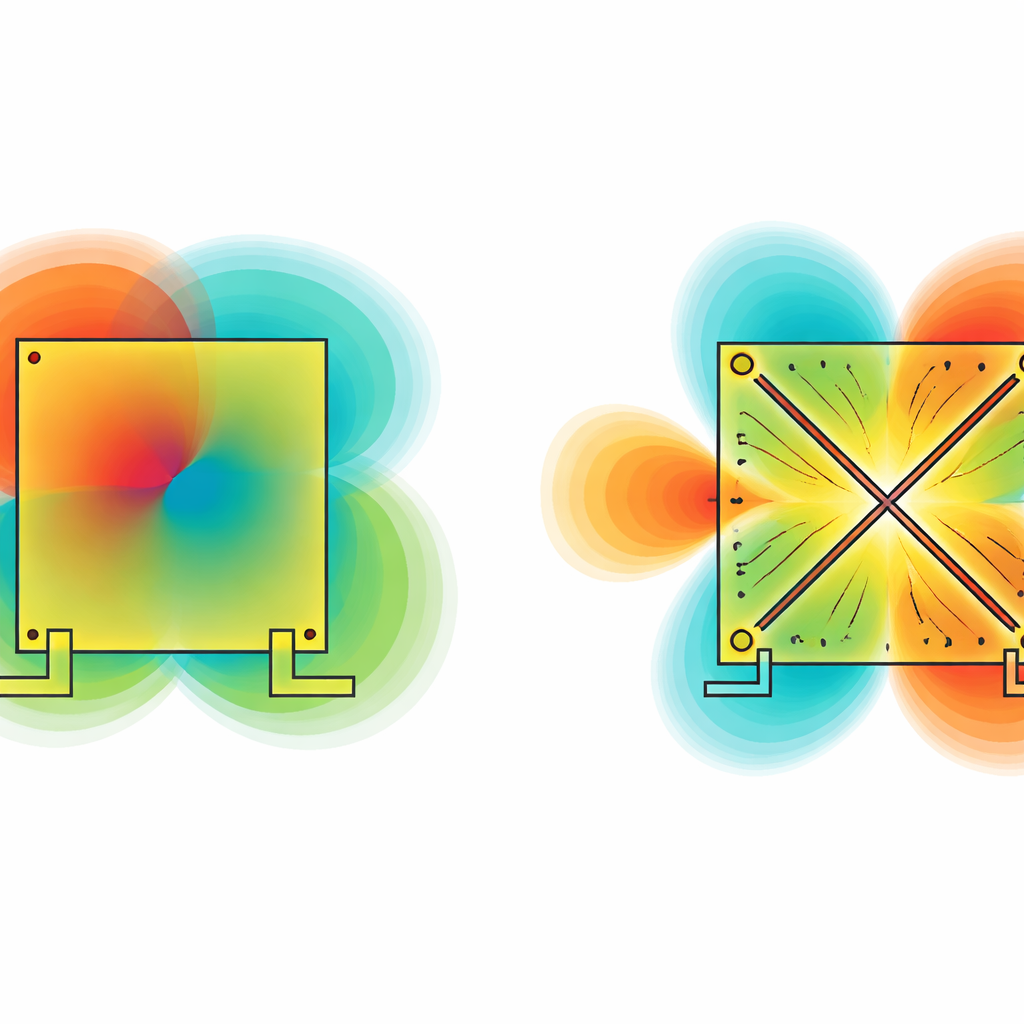
The authors build on a common component known as a microstrip patch antenna, essentially a thin metal rectangle printed on a circuit board. They first introduce a single‑polarized “miniaturized” version that uses narrow gaps and metal pins (vias) to add extra electric storage, or capacitance, inside the patch. This internal loading lets the antenna resonate at a lower frequency without increasing its size, shrinking it to only 0.18 wavelengths on a side at 5.6 GHz—small enough for compact devices. Importantly, the way the antenna is fed and shaped also keeps unwanted polarization—the part of the wave vibrating in the wrong direction—more than 40 decibels weaker than the main signal, far better than a conventional patch.
How the new structure tames interference
To turn the miniaturized patch into a dual‑polarized radiator that can handle two independent signal paths, the team feeds the same square patch from two perpendicular directions and cuts diagonal slots into its surface. These slots, together with the earlier gaps and pins, introduce additional capacitance and sculpt how currents flow across the metal. Simulations and lab measurements show that this carefully shaped current pattern keeps the two polarizations strongly separated. In the operating band from 5.53 to 5.62 GHz, the energy leaking from one port into the other stays better than 38–40 decibels below the main signal, meaning the transmit and receive paths hardly “see” each other even though they share the same radiator.
Performance in real‑world bands
The antenna was fabricated on a single standard substrate and tested with a network analyzer and an over‑the‑air measurement setup. It covers a 90 MHz band around 5.6 GHz, fitting comfortably within the 5 GHz Wi‑Fi spectrum and wide enough to host typical 20–80 MHz Wi‑Fi channels. Within this range, both ports are well matched, the broadside gain peaks around 4.3 dBi, and the radiation efficiency stays above 70%, all respectable figures for such a compact design. A metric called envelope correlation coefficient, which gauges how independent the two ports are, remains below 0.05 across the band, indicating that the two polarizations can serve as high‑quality diversity or MIMO channels.
What this means for future wireless gear
By combining compact size, simple single‑layer construction, very low unwanted polarization, and exceptionally high isolation between its two ports, this antenna strikes a practical balance between performance and manufacturability. Compared with other compact dual‑polarized designs in the literature, it achieves better isolation and cleaner polarization without resorting to stacked layers, bulky decoupling networks, or elaborate feeds. For a lay reader, the takeaway is that this type of radiator could help future Wi‑Fi and other wireless devices send and receive simultaneously on the same channel, boosting speeds and reliability without demanding more spectrum or more space inside the gadget.
Citation: Tran-Huy, H., Hoang-Thu, T., Le-Tuan, T. et al. A low-complexity compact dual-polarized patch antenna with high isolation and low cross-polarization for in-band full-duplex applications. Sci Rep 16, 10761 (2026). https://doi.org/10.1038/s41598-026-45635-6
Keywords: full-duplex wireless, dual-polarized antenna, compact patch antenna, Wi-Fi 5 GHz, self-interference suppression