Clear Sky Science · en
Wideband patch antenna with enhanced gain stability for sub-6 GHz 5G applications
Why this small part matters for your phone
As our phones and gadgets race to support faster 5G connections, a quiet struggle is happening inside their tiny circuit boards. The antennas that send and receive signals must fit into tight spaces yet still work reliably across many channels. This study introduces a compact antenna design for sub-6 GHz 5G that keeps its signal strength remarkably steady, helping future devices stay connected even as they move between different parts of the network. 
Signals that stay strong across the band
Most 5G phones rely on the sub-6 GHz range because it balances wide coverage with decent data speeds. However, many small antennas behave like temperamental performers: they do very well at one frequency but lose power at others. The team behind this work set out to build an antenna that does the opposite, delivering nearly the same gain, or signal strength, across a broad span of frequencies from 3.2 to 6.6 GHz. Their prototype keeps gain variation within about plus or minus 0.8 decibels, far steadier than many existing designs that swing by more than twice that amount.
Building a better shape step by step
To reach that performance, the researchers did not start from scratch each time. Instead, they followed a six-step evolutionary process. They began with a simple rectangular patch fed by a straight metal line on a common circuit-board material. This first version worked only at higher frequencies and produced uneven gain. With each new step they added or reshaped features, carefully simulating how electric currents flowed and how the antenna radiated. By the final version, they had shifted the main operating region down toward the key 3.5 GHz 5G band without making the antenna physically larger. 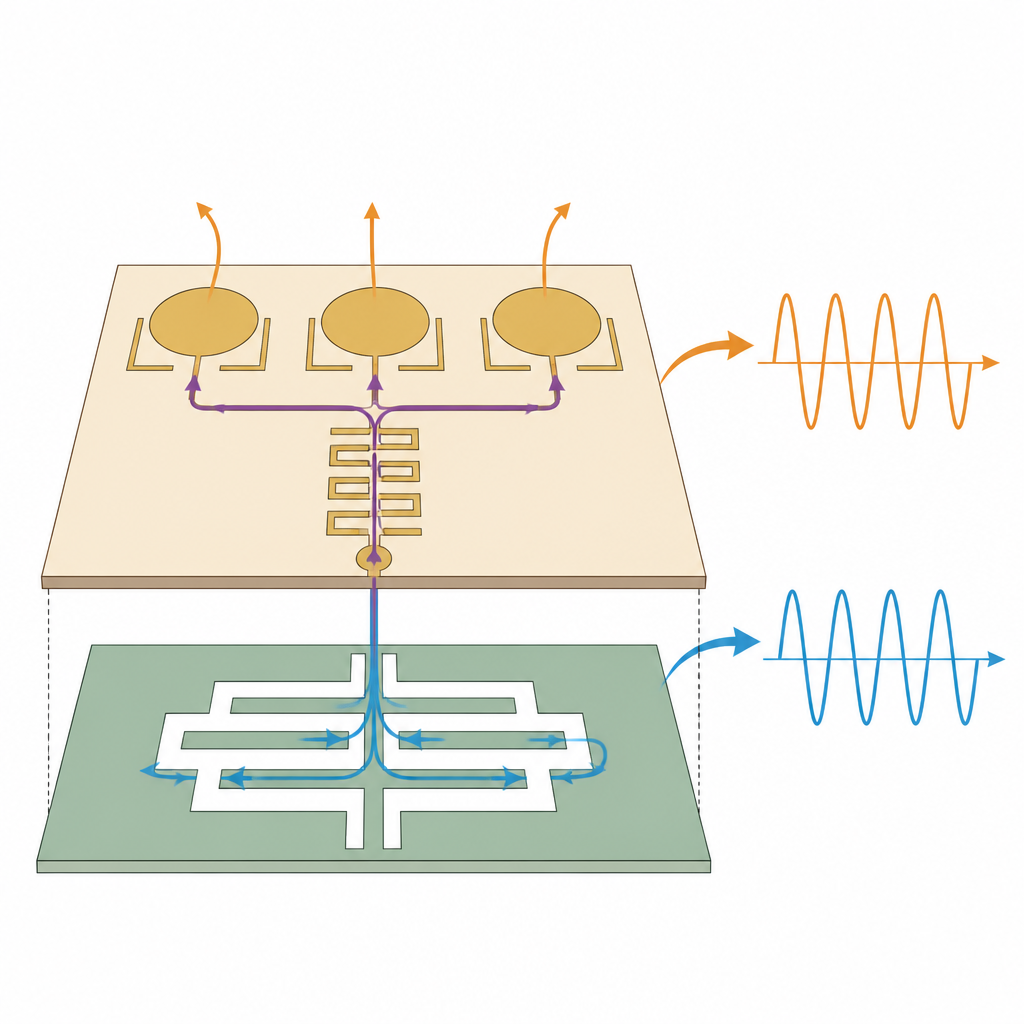
Smart details in a tiny footprint
The finished antenna fits in a rectangle just 36 by 20 millimeters, small enough for a smartphone or other handheld device. On the top side sit three circular metal patches acting as supporting elements that help the main radiator handle more than one frequency at once. Two L-shaped cuts in the metal guide surface currents along a longer path, which lowers the working frequency without stretching the hardware. The feeding line is bent into a meandering path, further lengthening the journey the current must take. On the underside, a deliberately broken ground plane pattern introduces additional electric effects that broaden the usable frequency range and smooth out unwanted resonances.
From computer model to real hardware
All of these tweaks were first explored using specialized simulation software, which let the team adjust dimensions such as stub size, slot length and ground cutout shape while watching how the antenna responded. They examined not only gain and bandwidth, but also how evenly the antenna radiated in different directions. Once the best combination was found, they fabricated a physical sample on a standard FR-4 circuit board and tested it with lab instruments. The measured results closely matched the simulations: the antenna showed two strong working points around 3.6 and 6.1 GHz, more than 3 GHz of continuous bandwidth, over 90 percent of input power converted to radiation, and very small timing distortion as signals passed through.
What this means for future 5G devices
In everyday terms, this design shows that a very small, flat antenna can serve a wide slice of the 5G sub-6 GHz spectrum while keeping its signal strength nearly constant. That steadiness can make wireless links more reliable as phones and other devices roam between channels and need to maintain stable connections. The work also offers a clear recipe other engineers can follow, combining shaped patches, clever cuts, a folded feed line and a patterned ground to tame the usual trade-offs between size, bandwidth and stability.
Citation: Vijayadheeswar Reddy, S., Kumar, J. Wideband patch antenna with enhanced gain stability for sub-6 GHz 5G applications. Sci Rep 16, 15891 (2026). https://doi.org/10.1038/s41598-026-45574-2
Keywords: 5G antenna, sub-6 GHz, wideband, patch antenna, gain stability