Clear Sky Science · en
Experimental study on portable multi-parameter intelligent wind measurement sensor
Why measuring mine winds matters
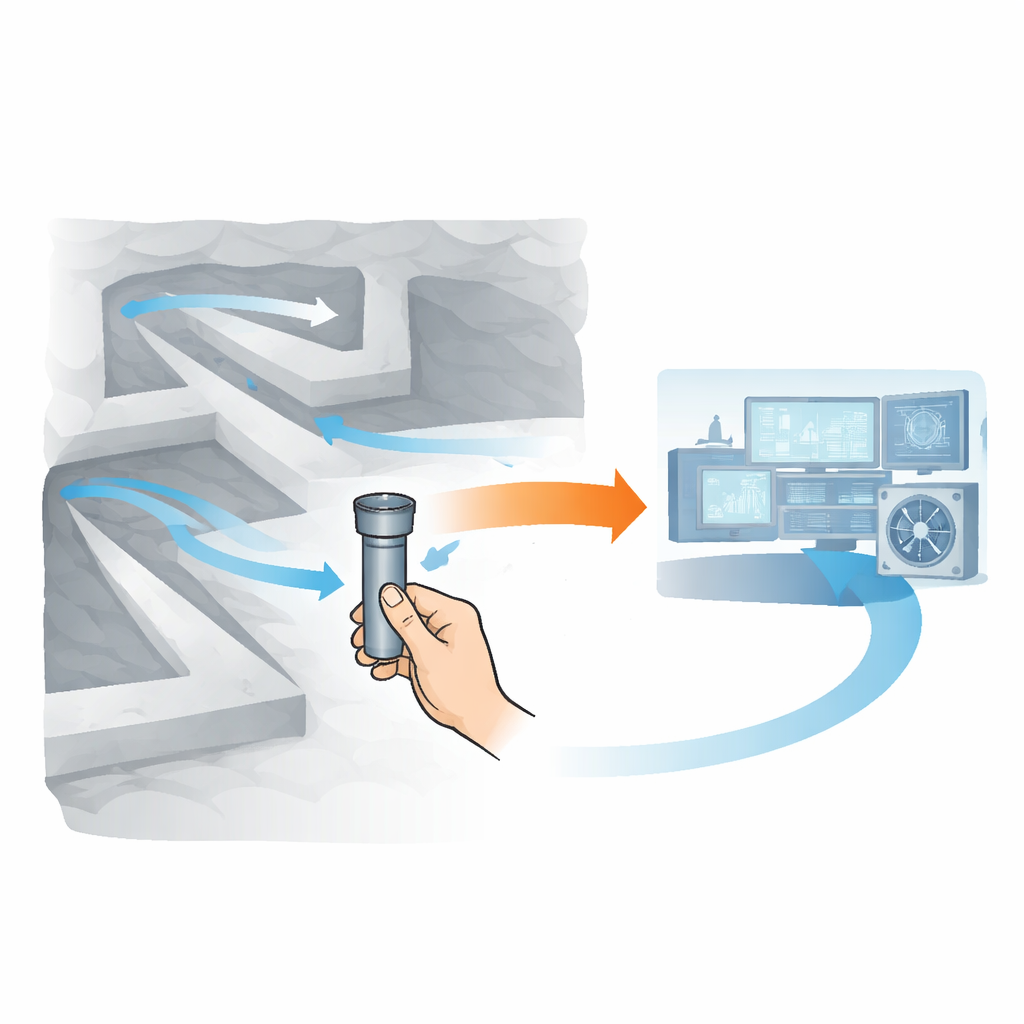
Deep underground mines depend on moving fresh air through long tunnels to keep workers safe from dust, heat, and toxic gases. Knowing exactly how fast that air is moving is as critical as knowing a person’s blood pressure: too low, and dangers can build up; too high, and energy is wasted. Traditional spinning wind meters struggle in harsh, dusty mine air. This study presents a new handheld ultrasonic sensor that can measure wind speed and direction more accurately and reliably, helping modern “smart” mines keep their air flowing safely and efficiently.
From spinning cups to sound waves
For decades, mines have relied on contact tools like cup and vane anemometers, hot wires, and pressure tubes. These devices touch the air directly and must keep moving parts or delicate wires working in a hostile environment filled with dust, moisture, and vibration. They wear out, clog, and often need workers to read dials by eye, which introduces human error. Newer non-contact tools use light or sound, but in cramped, rough tunnels their signals can weaken and lose accuracy. The authors argue that a better solution must balance precision, toughness, and the ability to keep working in dirty, humid air—something current tools do not fully achieve.
Listening to the wind with echoes
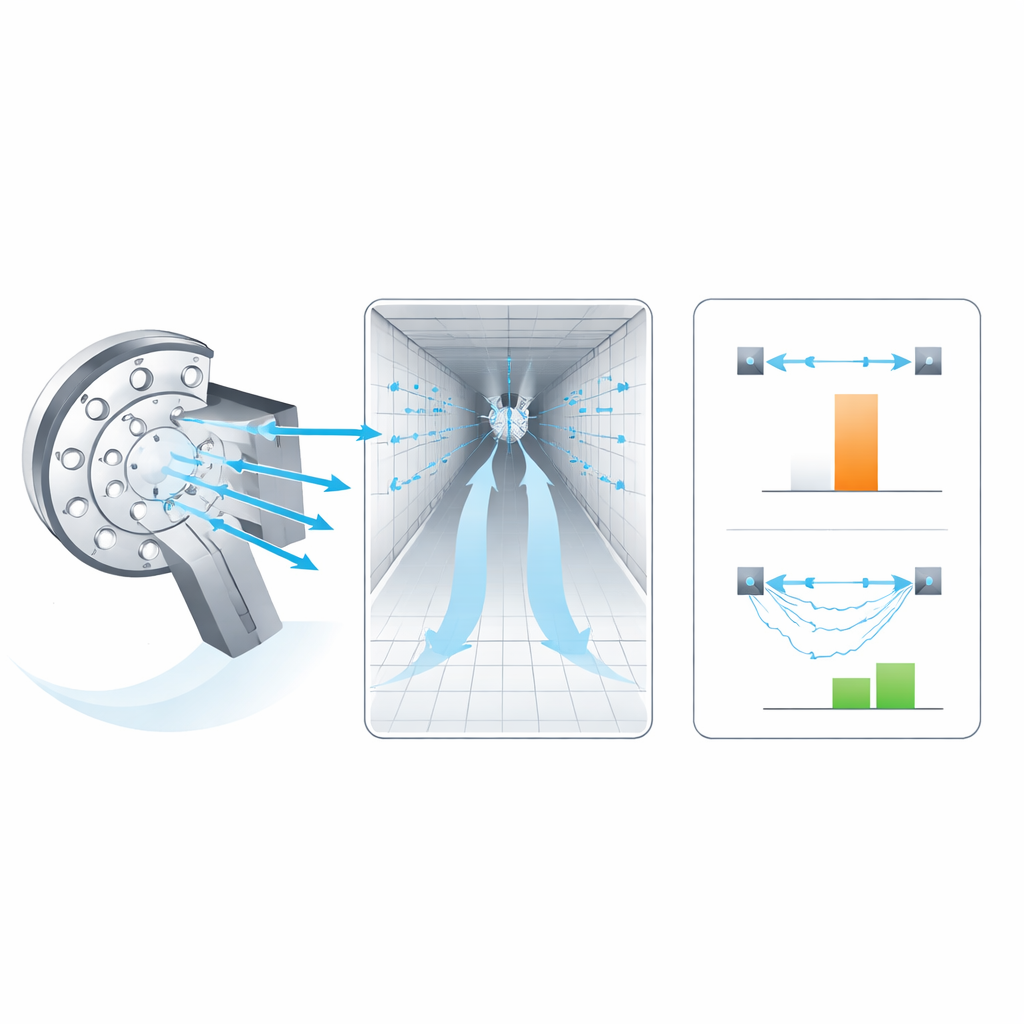
The new sensor listens to the wind instead of being pushed by it. It sends brief ultrasonic pulses—sound too high for humans to hear—between small transmitters. When air stands still, sound takes the same time to travel in opposite directions. When air moves, sound going with the flow speeds up, while sound going against it slows down. By comparing these tiny time differences, the device can calculate both wind speed and direction. The researchers tested two setups: a direct “face-to-face” layout and a “reflection” layout, where sound bounces off a small reflector before returning. In controlled tests at low wind speeds, the reflective layout cut average measurement error by about three quarters and made the readings far more stable.
Putting the handheld sensor to the test
To see how the device behaves in realistic flow, the team built a closed-loop wind tunnel that produces steady, low-speed air similar to that in mine tunnels. They placed the new sensor in the center and changed both wind speed and the angle at which the instrument faced the airflow. When the screen side of the sensor pointed directly into the oncoming air, its readings matched the tunnel’s true speed most closely; turning it sideways increased the gap. They then mapped wind speed across a grid of points in the tunnel cross-section at different inlet speeds. The pattern was physically sensible—faster in the middle, slower near the walls—and throughout the useful region the sensor’s average error stayed within about plus or minus 0.1 meters per second, a tighter tolerance than many mine standards require.
Checking real tunnels underground
Laboratory success alone is not enough for safety-critical equipment, so the researchers carried the calibrated sensor into a working coal mine. There they divided real tunnel cross-sections into dozens of small zones and measured wind speed in each one using the portable ultrasonic tool, while also taking standard readings with a mechanical anemometer. Using a simple model for average wind speed across the whole opening, they compared the two methods. In two different return airways, the differences between traditional and ultrasonic measurements were mostly smaller than 0.1 meters per second, even though the real tunnels had irregular shapes and more complex air patterns than the wind tunnel.
What this means for safer, smarter mines
In everyday terms, the study shows that a handheld ultrasonic sensor using reflected sound can “feel” mine winds with high precision, even when the air moves slowly and conditions are dusty and damp. By carefully choosing the internal layout, correcting for temperature and humidity, and aligning the sensor with the airflow, the team achieved reliable readings that agree closely with both controlled tests and traditional field instruments. This kind of robust, accurate wind sensing is a key piece of the puzzle for intelligent ventilation systems, which aim to adjust fans and airflow in real time—keeping miners safer while using less energy.
Citation: Wang, Z., Wang, Y., Ni, Y. et al. Experimental study on portable multi-parameter intelligent wind measurement sensor. Sci Rep 16, 10934 (2026). https://doi.org/10.1038/s41598-026-45567-1
Keywords: mine ventilation, ultrasonic anemometer, airflow monitoring, coal mine safety, wind tunnel experiments