Clear Sky Science · en
Rock layer deformation analysis and mitigation at fault-crossing mining sites in RCRM operations
Why underground rock movement matters
Deep beneath our feet, coal mines thread through layered rock that is far from solid and still. Cracks in the Earth’s crust, known as faults, can suddenly shift when mining changes the balance of forces underground. These movements can crush tunnels, damage equipment, and endanger workers. This study looks at a modern mining method that tries to keep tunnels open by letting broken rock support the roof, and asks a tough question: what happens when that method has to cross a major fault? By blending theory, computer models, and real mine tests, the authors show how to tame dangerous rock movements in such tricky zones.
A new way to keep tunnels open
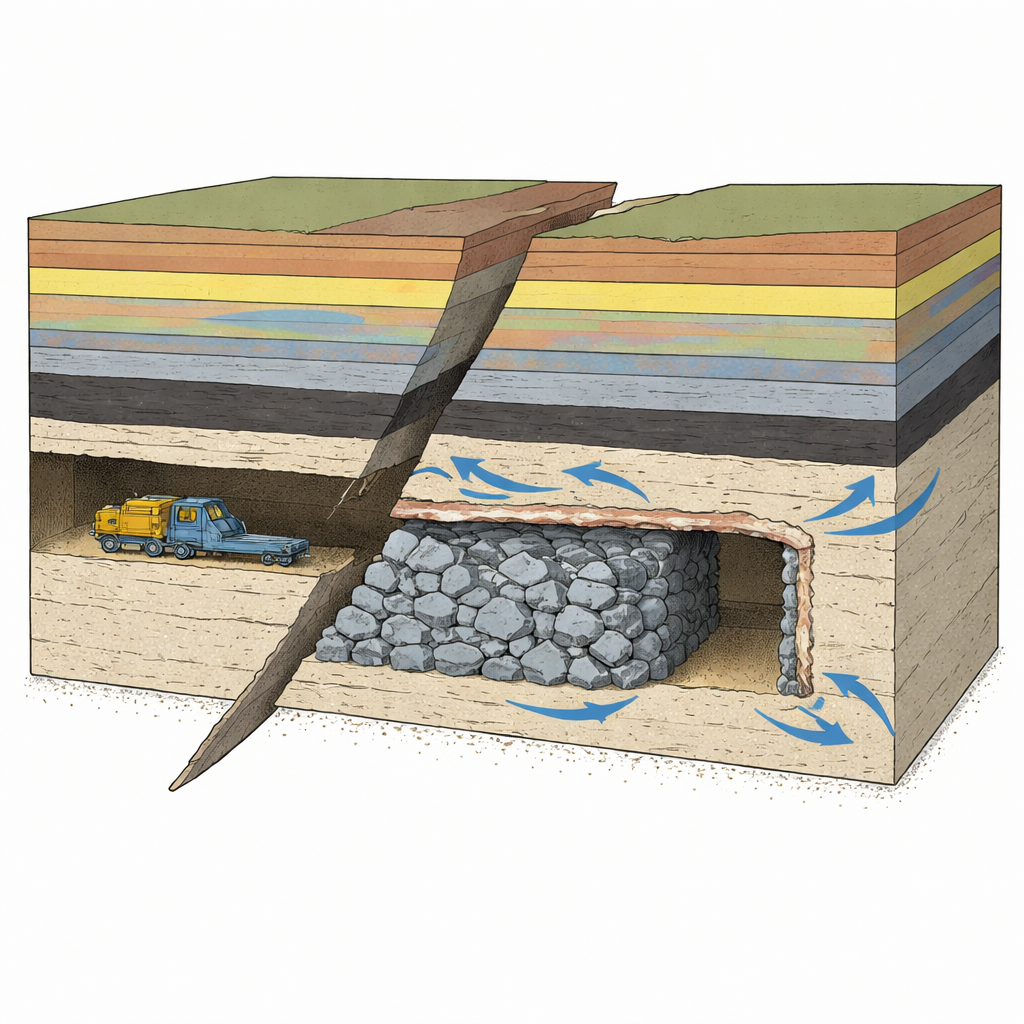
Traditional coal mining often leaves thick coal pillars behind to hold up the roof, sacrificing valuable reserves and still risking sudden rock failures. Roof Cutting and Retaining by Mining (RCRM) turns this idea on its head. Instead of pillars, miners pre-cut the roof and allow waste rock, called gangue, to cave in and naturally bulk up, forming a self-supporting wall that shapes and protects the roadway needed for the next mining panel. This simple idea—using the mine’s own broken rock as a support material—can improve resource recovery, spread out stress in the surrounding rock, and cut the costs and risks of maintaining long tunnels.
When faults block the way
Faults complicate this otherwise elegant system. Because rock layers on either side of a fault behave differently, stresses concentrate unevenly, and the ground can deform or slip suddenly. The authors focus on the 11,101 working face of the Qipanjing Coal Mine in China, where a steep fault slices across the mining direction. Using established rock-structure concepts, they build a three-stage picture of what happens as the mining front approaches the fault from above, passes through it, and then moves away below it. Their model shows that the stress ahead of the mining front does not simply rise and fall smoothly. Instead, when the coal above the fault is removed, the fault acts like a barrier, causing a sharp drop in forward stress, followed by a gradual build-up again as the front moves onto and beyond the lower block of rock.
Peering inside the rock with simulations
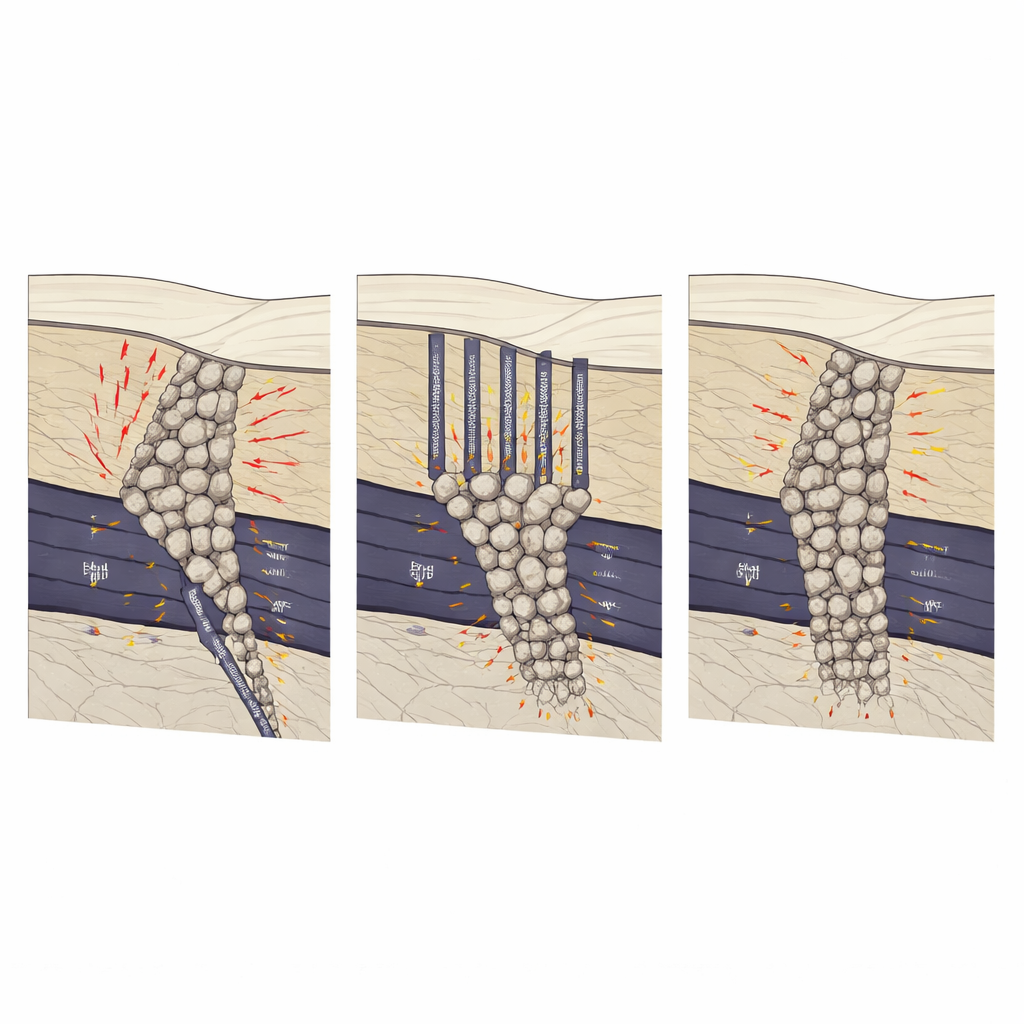
To move beyond theory, the team builds a detailed three-dimensional computer model of the mine section, including the fault and the goaf, or empty space left after coal removal. They pay particular attention to how the collapsed gangue compacts under pressure. Broken rock does not behave like a solid block: it starts loose, with many voids, and then stiffens as grains crush and rearrange. The researchers mimic this behavior with a specialized “double-yield” numerical model and test several scenarios that change how high the roof is cut above the seam. In simple terms, higher cuts create more falling rock, which can fill the space more fully and compact more tightly.
Finding the sweet spot in broken rock
The team evaluates each scenario by tracking how much the overlying rock sags, how much the fault itself slips, and how strongly the surrounding rock is distorted and squeezed. They find that increasing the cutting height reduces both the stored “twisting” energy in the coal ahead of the face and the crushing strain near the fault. A cutting height of around 10 meters emerges as a practical optimum: it significantly lowers the intensity of stress and movement—cutting key stress measures by notable margins and shrinking roof and fault displacements—while avoiding the extra cost and limited added benefit of even taller cuts. Based on this, they design a combined treatment of taller slot cuts in the roof plus additional “loose blasting” to further break up and compact the gangue so that it acts as a stronger support.
From computer to coalface
These ideas were not left on the drawing board. In the Qipanjing mine, the researchers implemented the 10-meter cutting and loose-blasting scheme as the RCRM panel crossed the fault. Field measurements showed that the hydraulic supports at the mining face had to carry notably less load, and the broken rock behind the face compacted more tightly, as reflected in a lower bulking factor. In practical terms, the fault slipped less, the roof sagged less, and the retained roadway alongside the goaf remained stable as the mining front moved more than 200 meters away. The observed improvements matched most of the predicted targets, giving confidence in the combined theoretical and numerical approach.
Safer mining through smarter rock control
For non-specialists, the central message is that rock in and around faults is not just a passive backdrop to mining—it is an active, shifting system that can be guided, within limits, by careful design. By understanding how stresses are blocked, redirected, and released as a mining face crosses a fault, and by deliberately managing how broken rock compacts to support the roof, engineers can both recover more coal and keep underground passages safe. The proposed “cut higher and crush finer” strategy for the waste rock behind the face offers a practical recipe for mines in faulted ground that wish to use RCRM, turning a geologic hazard into a manageable engineering challenge.
Citation: Dongshan, Y., Bo, L., Xiaohui, K. et al. Rock layer deformation analysis and mitigation at fault-crossing mining sites in RCRM operations. Sci Rep 16, 11723 (2026). https://doi.org/10.1038/s41598-026-45552-8
Keywords: fault-crossing mining, roof cutting and retaining, coal mine safety, rock mass deformation, gangue backfill