Clear Sky Science · en
Novel design of an airplane split wheel based on the hybrid topology and shape optimisation
Why lighter airplane wheels matter
Every time an aircraft lands, its wheels absorb tremendous forces as rubber meets runway. The wheels used to test aircraft tyres must be even tougher, since they face loads that exceed normal service conditions. That extra strength often comes with a hidden cost: extra metal, extra weight, and extra expense. This study explores how engineers can redesign a special split airplane wheel so that it stays strong under extreme loads while shedding nearly half of its material.
How a test wheel works
The work focuses on a two-piece aluminum wheel used in a laboratory to test aircraft tyres. The wheel is made from a high-strength aluminum alloy and split into inboard and outboard halves that bolt together, making it easier to forge, assemble, and change tyres. In the testing rig, the tyre and wheel are pressed and pushed in different directions to mimic the heavy vertical loads of landing and the sideways forces that occur when an aircraft turns or lands in a crosswind. To keep test results precise, the wheel must deform very little, even when the tyre is pushed far beyond typical service conditions.
Understanding the forces at play
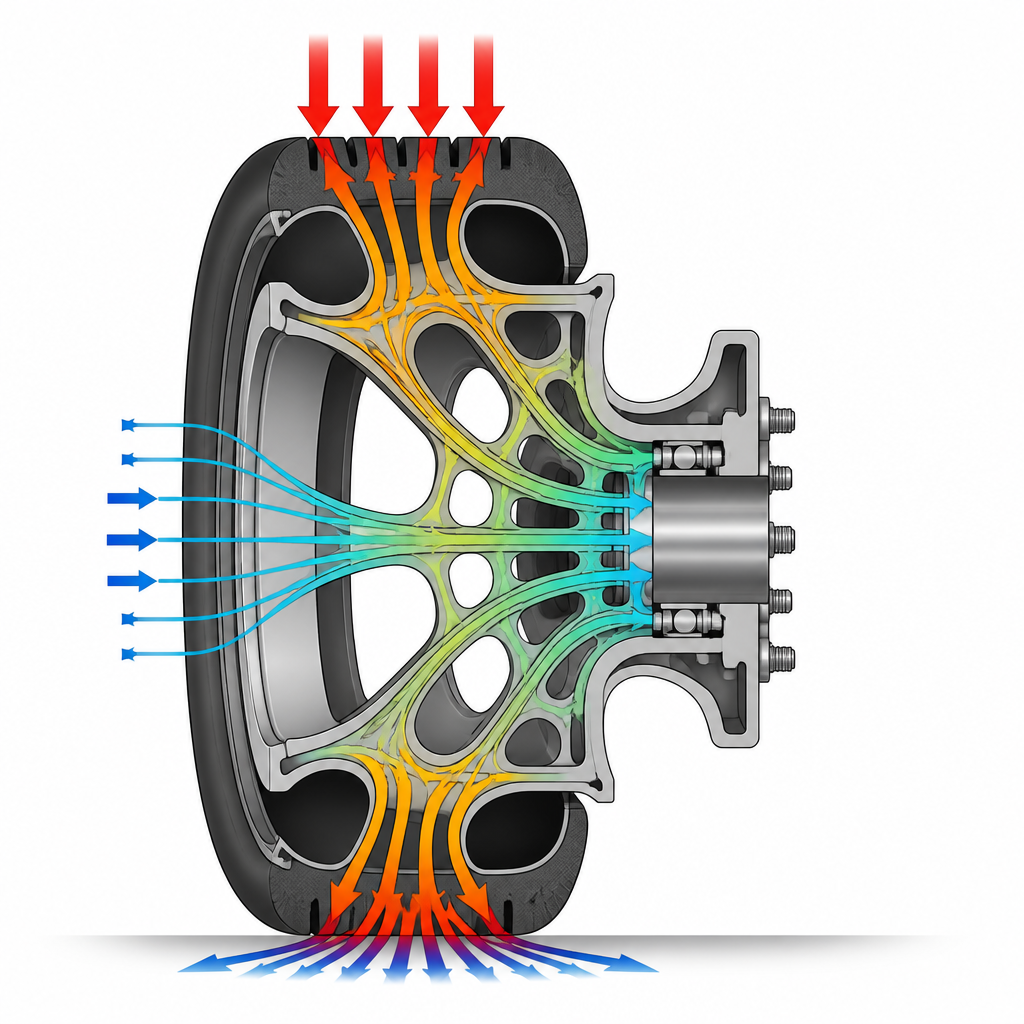
Before changing the design, the authors first mapped how forces travel from tyre to wheel. They studied two extreme cases: one with only vertical force, and another that added a strong sideways load. Using earlier experimental work on how tyres press against rims, they described how contact pressures spread around the bead seat and flange of the wheel. They then built detailed computer models of the wheel and simulated how it responds under these extreme loads. These models revealed where stresses are highest and how much the wheel flanges bend, confirming that the combined vertical and sideways loading is the more critical situation.
Carving out the right shape
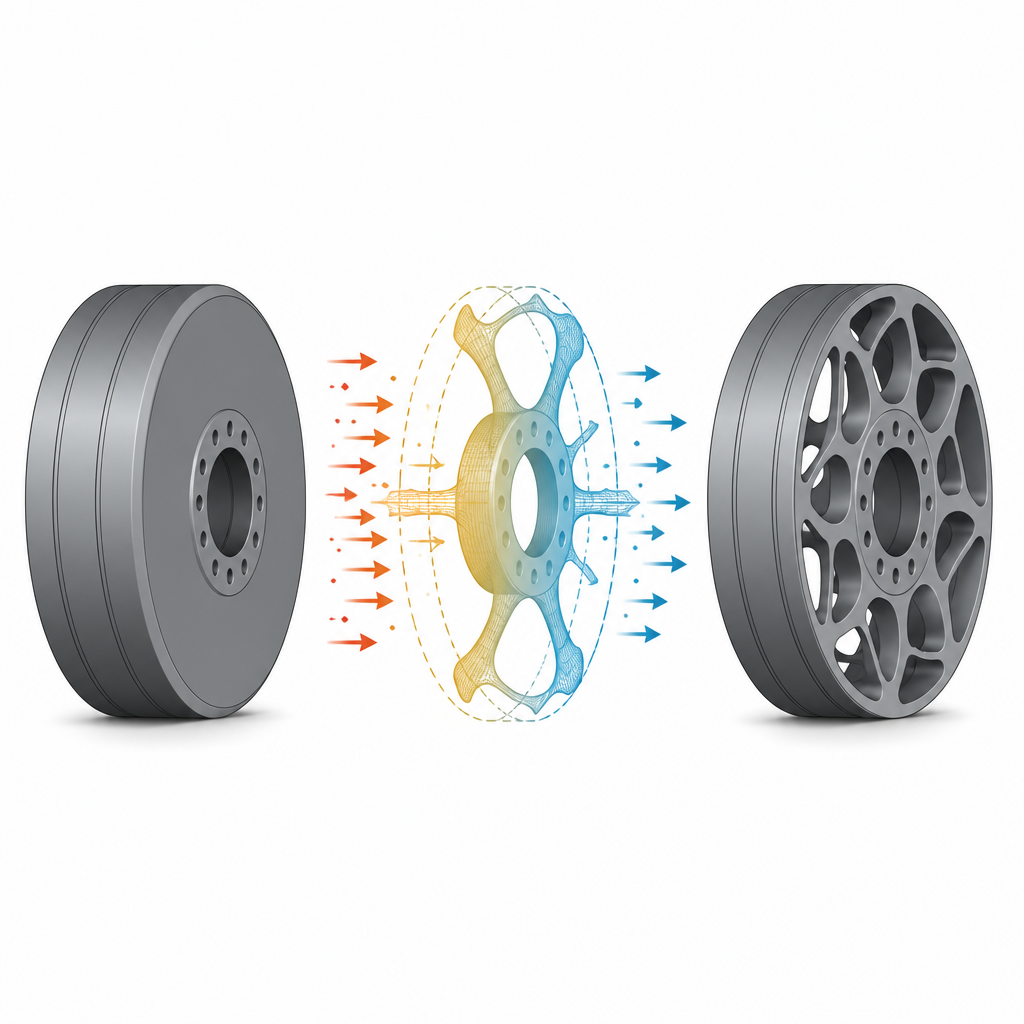
With these insights, the researchers turned to computer-guided design tools to remove unnecessary material while keeping strength where it is needed. First, they applied a method that treats the cross section of the wheel like a field where material density can vary from solid to empty. The algorithm gradually “thins” regions that do little to carry loads and keeps thick paths along which forces flow most efficiently. This step suggested adding internal cavities and shifting bolt locations to create a more balanced and efficient structure. A new three-dimensional wheel model was then generated by rotating the optimized cross section and adding realistic bolt holes.
Fine-tuning the details
Next, the team refined specific dimensions such as the thickness of the flanges and webs, the width of internal cavities, and the angle and placement of lightening holes. They used a two-stage search strategy: a broad genetic search that explores many possible combinations, followed by a more precise mathematical method that homes in on the best solution. During this process, they merged the two wheel halves in the model to speed up calculations and checked that this shortcut still gave accurate predictions of deflection. The goal was to minimize material volume while keeping wheel bending below strict limits set by the testing center.
What the new design achieves
Final computer simulations of the optimized wheel showed that stresses under both extreme loading cases remain safely below the yield strength of the aluminum alloy. Although local safety factors are lower than in the original “overbuilt” design, they still exceed values commonly accepted in engineering practice. The maximum deflection under the harshest loading remains within the testing center’s tolerance. Most strikingly, the total material volume of the wheel drops by 44.7 percent compared with the starting design. In everyday terms, the study shows how carefully shaping the paths that carry load allows engineers to cut almost half the metal from a critical test component without sacrificing safety or stiffness.
Citation: Li, J., Zhang, X., Zhang, Y. et al. Novel design of an airplane split wheel based on the hybrid topology and shape optimisation. Sci Rep 16, 15777 (2026). https://doi.org/10.1038/s41598-026-45544-8
Keywords: aircraft wheel, lightweight design, topology optimization, finite element analysis, structural strength