Clear Sky Science · en
Stable isotope analysis suggests nutrient connectivity between salmon and kelp within a commercial scale open coast integrated multi-trophic aquaculture system
Why fish farms and seaweed fields matter together
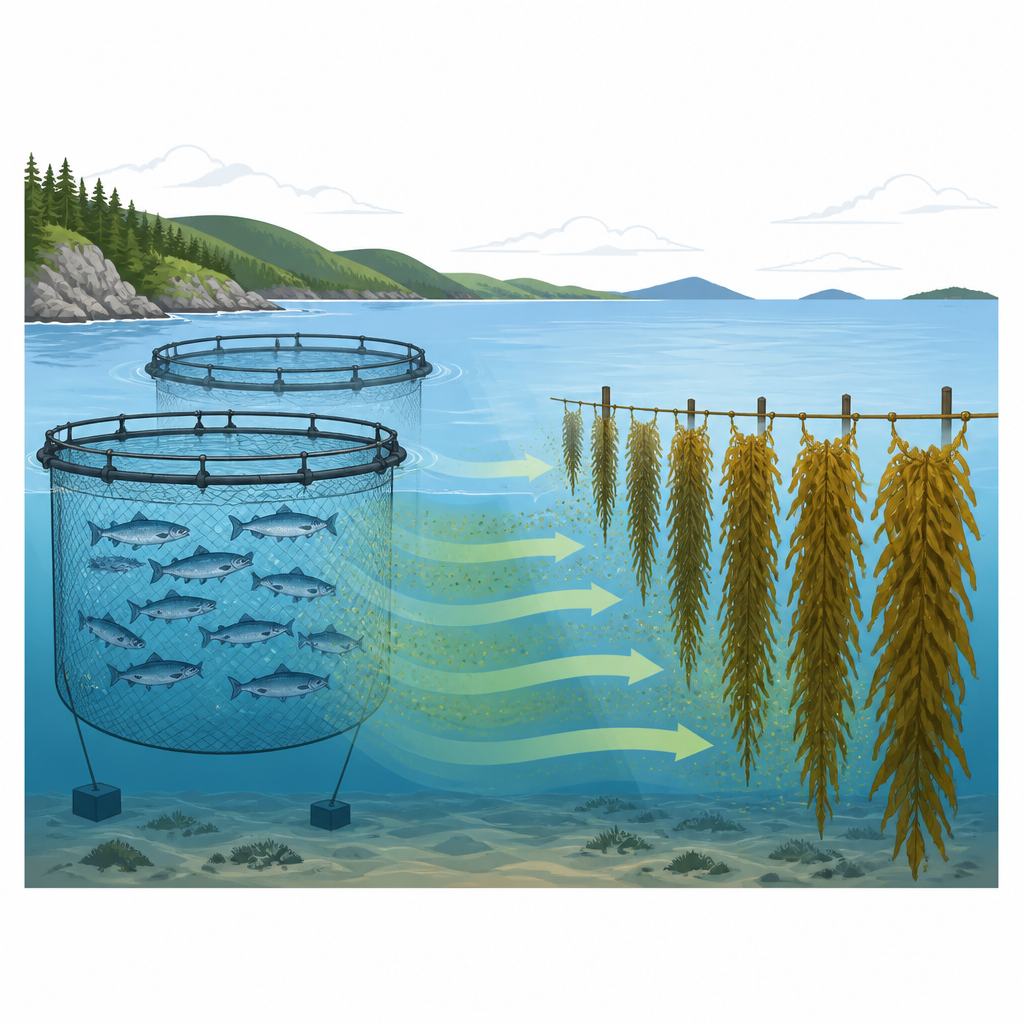
Along many coasts, floating pens of farmed salmon sit beside lines of swaying kelp. This pairing is more than a scenic backdrop; it hints at a way to grow seafood while easing pressure on the environment. In this study from Bantry Bay in Ireland, researchers asked a simple but important question: are the nutrients released by a commercial salmon farm actually reaching nearby sugar kelp, and does that help the seaweed grow better?
Farming fish and seaweed side by side
The work focuses on a concept called multi-species aquaculture, where high-value fish are raised next to low‑trophic organisms such as seaweed. The idea is that waste from the fish, rich in nitrogen, can feed the seaweed instead of simply dispersing into the ocean. Sugar kelp is an attractive partner because it grows quickly, thrives in rough water, and needs a lot of nitrogen. Yet until now, most evidence that fish waste boosts kelp has come from small trials or computer models, leaving uncertainty over how well this partnership works at a real commercial site on an open, wave‑exposed coast.
A natural before and after experiment
The study site offered a rare built‑in comparison. For four years, only the kelp farm operated. Then, in mid‑2023, a salmon farm beside it restarted production, with the kelp seeded on ropes in the same way in early 2023 and again in 2024. This created a before‑and‑after picture under nearly identical local conditions. During both years, scientists collected kelp, seawater, and samples that represented possible nitrogen sources: manufactured fish feed, salmon faeces, particles sinking through the water, and wild seaweeds growing on nearby shores. They also tracked light, temperature, and currents to ensure that any changes could not simply be blamed on a different season or weather pattern.
Following invisible fingerprints of nitrogen
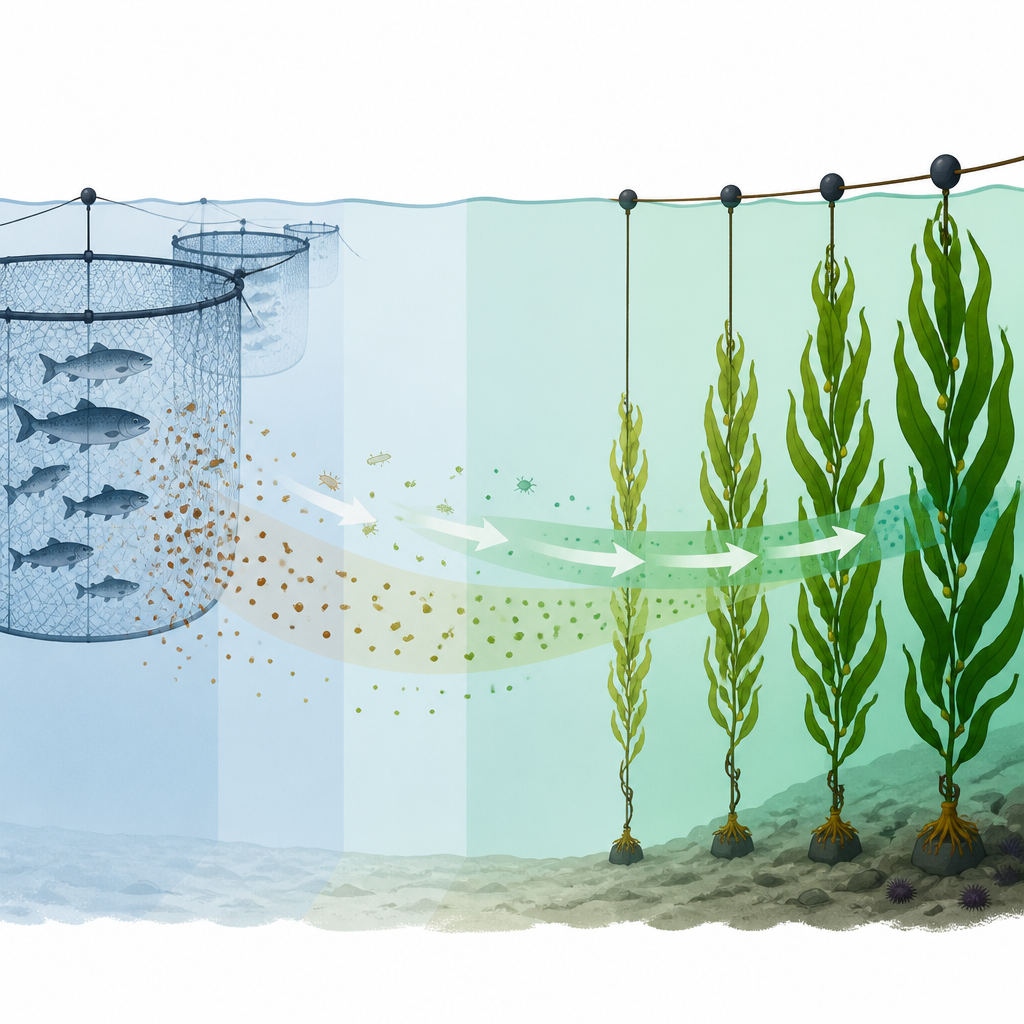
To find out where the kelp was getting its nitrogen, the team used stable isotope analysis, a technique that reads tiny natural variations in the weight of nitrogen atoms. Different nitrogen sources carry slightly different isotope “fingerprints.” By comparing the fingerprints in kelp tissue with those in feed, faeces, and wild algae, and running these data through a Bayesian mixing model, the researchers estimated which sources most likely supplied the kelp. They saw that the nitrogen signal in kelp changed over time and differed between years. In 2023, when no salmon were present, kelp matched the range expected from background marine sources such as wild algae and general particles in the water. In 2024, when salmon were being fed nearby, kelp showed lower values typical of nitrogen that had been cycled through fish feed and waste and then transformed in the water.
Seaweed growth and tissue changes
The chemistry results were backed up by how the kelp itself performed. In both years the seaweed grew, but in 2024 its blades became longer, wider, and heavier more quickly. The kelp also contained more nitrogen overall, and its balance of carbon to nitrogen indicated that it was not starved of this key nutrient. Nitrate levels in the bay’s surface water were higher at the start of the 2024 growing season, when the salmon were actively feeding, and then fell as the kelp grew rapidly and as fish were harvested and no longer fed. While natural variability in the water made it hard to pin down precise trends from water samples alone, the combination of faster growth, richer kelp tissue, and isotope fingerprints all pointed in the same direction.
What this means for cleaner coastal farming
Taken together, the findings suggest that nutrients from the salmon farm were indeed taken up by the adjacent sugar kelp at commercial scale in an open coastal setting. The study shows that stable isotope tools, used alongside simple growth and water measurements, can reveal how waste from fed fish may be turned into a resource for seaweed. It also highlights remaining gaps, such as the need to better understand how nitrogen is altered as it moves from feed through fish, microbes, and finally into kelp. As coastal communities look for ways to expand aquaculture without overloading local waters, this kind of fish‑and‑kelp pairing offers a path where one crop’s leftovers can help fuel another.
Citation: Krupandan, A., Falconer, L., Maguire, J. et al. Stable isotope analysis suggests nutrient connectivity between salmon and kelp within a commercial scale open coast integrated multi-trophic aquaculture system. Sci Rep 16, 15135 (2026). https://doi.org/10.1038/s41598-026-45539-5
Keywords: aquaculture, salmon farming, kelp, nutrient cycling, stable isotopes