Clear Sky Science · en
Validity, reliability and precision of a novel virtual reality rod and disk test to assess visual dependence
Why Our Sense of “Straight Up” Matters
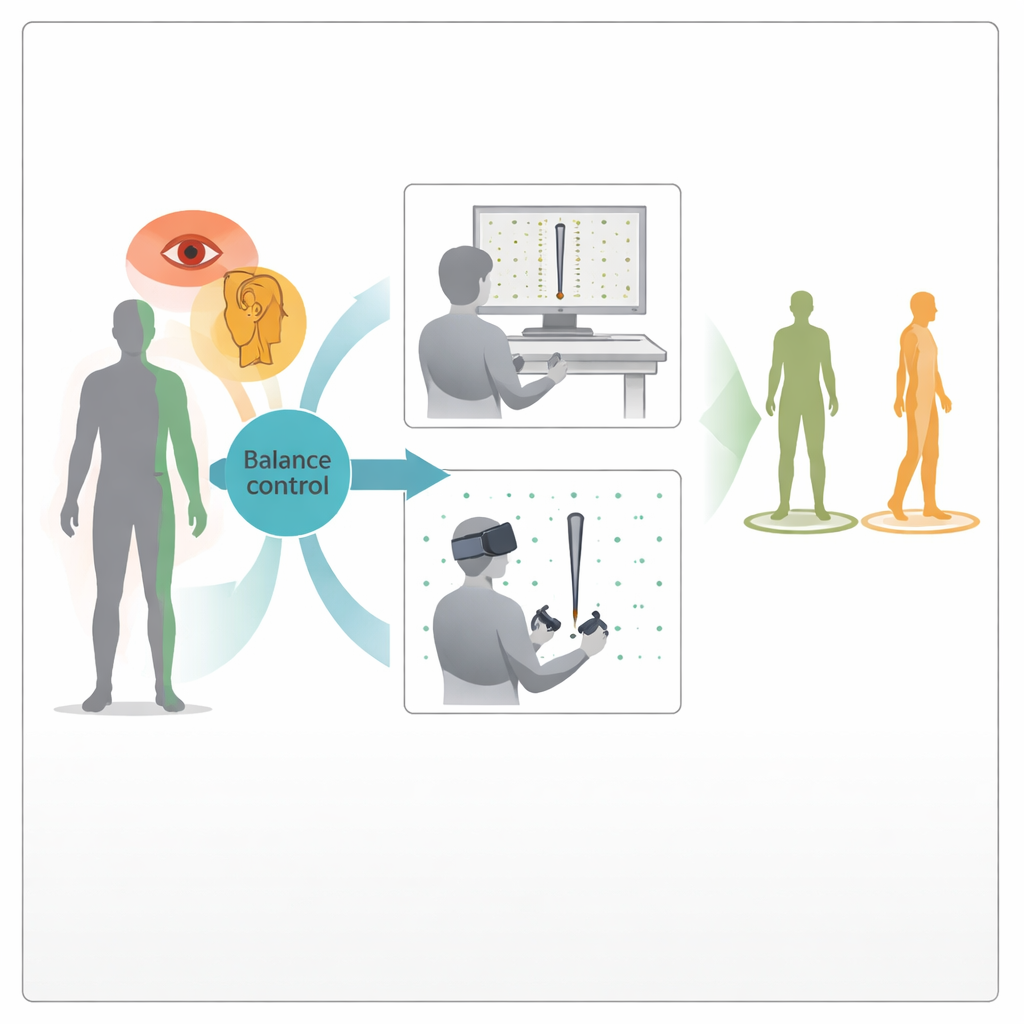
Standing upright without thinking about it is one of the brain’s quiet miracles. To stay balanced, we constantly blend what we see, what our inner ear feels, and what our muscles and joints report. When this system falters, everyday scenes like supermarket aisles or busy streets can trigger dizziness or unsteadiness. This study explores a new way—using virtual reality (VR)—to measure how much we rely on vision to feel upright, and asks whether this high-tech approach is accurate and consistent enough to help people with balance problems, including those with joint hypermobility.
A Simple Test for a Complex Sense
Researchers often study balance using a classic setup called the Rod and Disk Test. People look at a straight line (the “rod”) in front of a field of dots. Sometimes the dots sit still; other times they swirl around, tricking the eyes into feeling tilted. The task is simple: rotate the rod until it feels perfectly vertical. The more a person’s answer is pulled by the moving background, the more visually dependent they are—that is, the more they lean on sight rather than inner ear or body sense to feel upright. High visual dependence has been linked to dizziness, falls, and conditions that disturb balance.
Bringing the Lab into a Headset
Traditionally, the Rod and Disk Test is run on a desktop computer in a controlled lab room. That makes it hard to use at the bedside, in clinics with limited space, or at home. The team behind this study built a VR version of the same test, running on a lightweight standalone headset. Inside the headset, people again see a rod surrounded by dots that can either stay still or rotate. They adjust the rod using a hand controller until it feels vertical. VR offers a few appealing advantages: it can mimic the same viewing distance as the computer version, can be used in different head positions more easily, and could ultimately support remote assessments as part of digital health care.
Putting VR Head-to-Head with the Old Standard
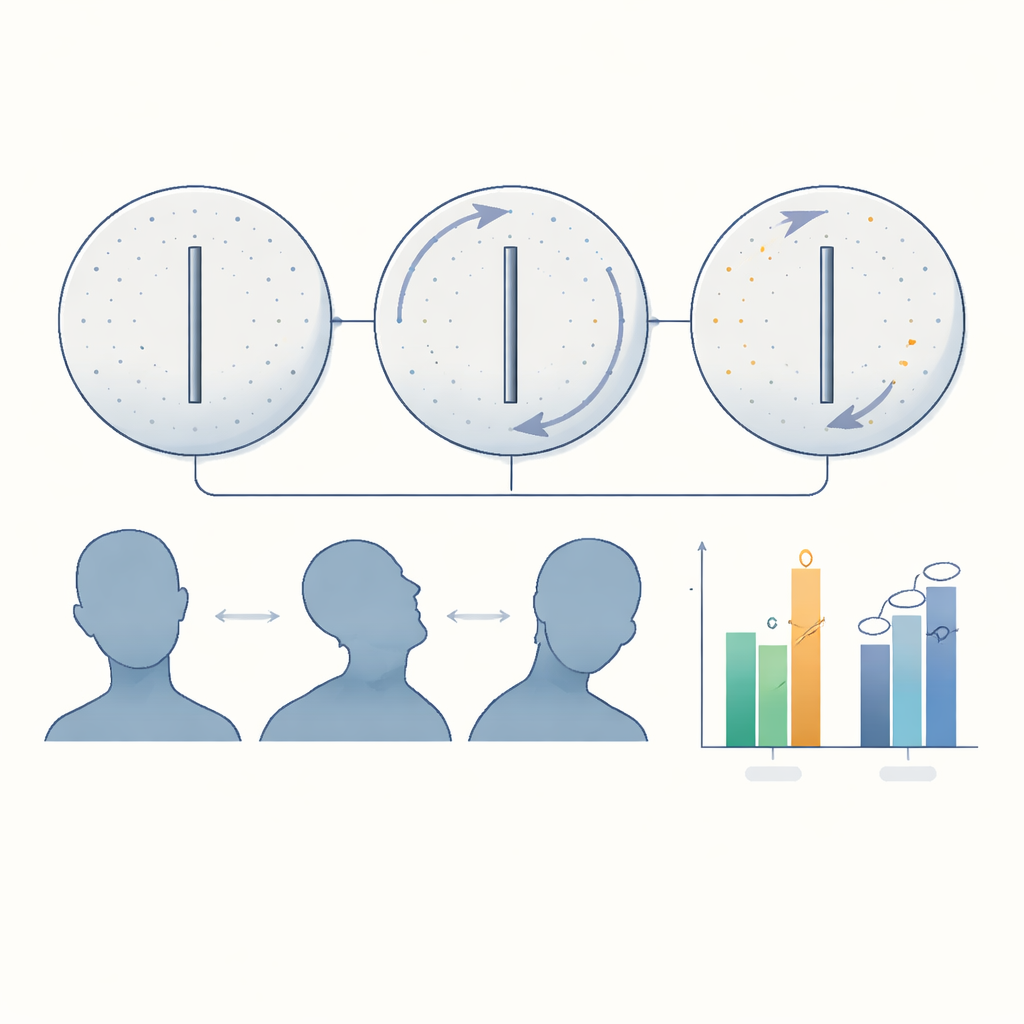
The researchers recruited 30 adults, half of whom had symptomatic joint hypermobility—a condition often linked with poor balance and frequent falls. Everyone completed both the traditional computer-based test and the new VR test in three head positions: facing forward, turned 45 degrees to the left, and 45 degrees to the right. The team then asked three questions. First, do the two methods give similar scores for visual dependence? Second, if a healthy person repeats the same test a week later, do they get roughly the same score (test–retest reliability)? Third, how small a change in score can we trust as a real shift, rather than simple measurement noise?
What the Numbers Really Say
Overall, the VR and computer tests were only weakly to moderately related. In other words, people who appeared more visually dependent on the computer did not always show the same degree on VR, except when their head was turned to the left, where the match was somewhat better. When healthy participants repeated the tests a week later, scores from the VR version varied quite a bit from one session to the next. Even the computer test—used widely as a reference—only showed poor to moderate repeatability. Yet both systems were quite precise in another sense: the random error in degrees was small. For the computer, a change of a little over 1 degree likely reflects a real shift; for VR, about 2 degrees. Participants, including those with hypermobility, generally tolerated VR well and reported low levels of motion sickness.
What This Means for Patients and Clinicians
The study shows that a VR-based rod and disk test is feasible and roughly tracks the same underlying sense of upright as the traditional computer version, but it is not yet a drop-in replacement. Both methods struggle to give perfectly consistent scores in people whose balance system is relatively normal, and the VR tool is currently a bit noisier. At the same time, the actual size of the errors is small—smaller than the differences typically seen between healthy people and those with serious balance disorders. For now, clinicians and researchers should treat small score changes with caution and focus on whether shifts are large enough to be meaningful. With further refinement, especially in groups with more pronounced balance difficulties, VR testing could become a practical way to bring sophisticated balance assessments out of the lab and closer to everyday care.
Citation: Wang, Y., Alexander, C.M. & Strutton, P.H. Validity, reliability and precision of a novel virtual reality rod and disk test to assess visual dependence. Sci Rep 16, 14627 (2026). https://doi.org/10.1038/s41598-026-45536-8
Keywords: visual dependence, virtual reality, balance disorders, subjective visual vertical, joint hypermobility