Clear Sky Science · en
Study of sand particle motion characteristics and distribution patterns in a helical-blade multiphase pump
Why sand in pumps matters
When oil is pulled up from deep, harsh reservoirs, it often comes mixed with water, gas, and sand. That sand may seem harmless, but inside high-speed pumps it can scratch metal surfaces, clog passages, and shorten equipment life. This study examines how sand grains move and spread inside a special type of oilfield pump with helical blades, aiming to show how particle size, amount of sand, and operating settings change wear risk and transport efficiency.
How the pump and sand were studied
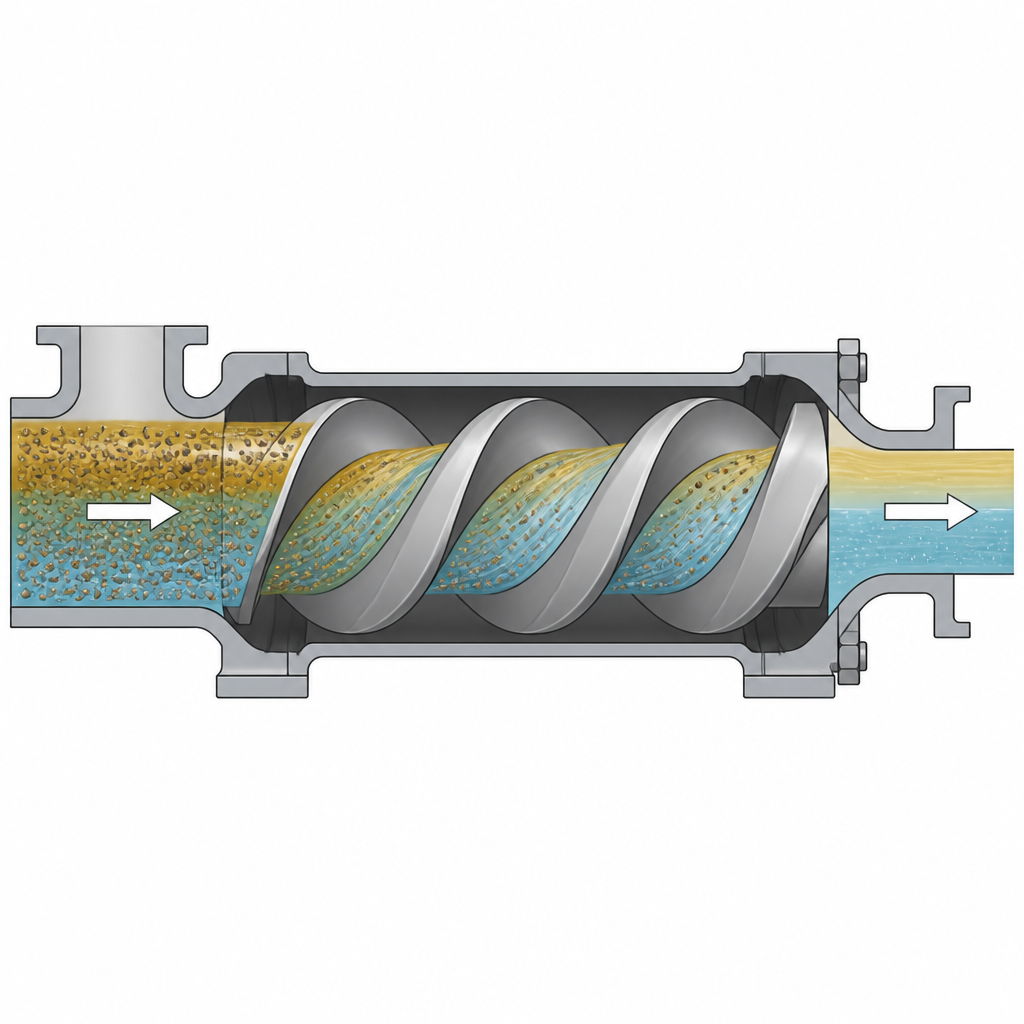
The researchers focused on a helical-blade multiphase pump already working in a real oilfield. Instead of testing every condition experimentally, which would be costly and difficult, they built a detailed computer model of a single pump stage. The model followed both the liquid mixture and thousands of individual sand parcels as they traveled through the impeller and diffuser regions. To ensure the virtual pump was realistic, they carefully refined the mesh, applied turbulence and particle-motion models, and checked that the simulated pressures, power use, and efficiency closely matched measurements from the field.
What happens when sand size and amount change
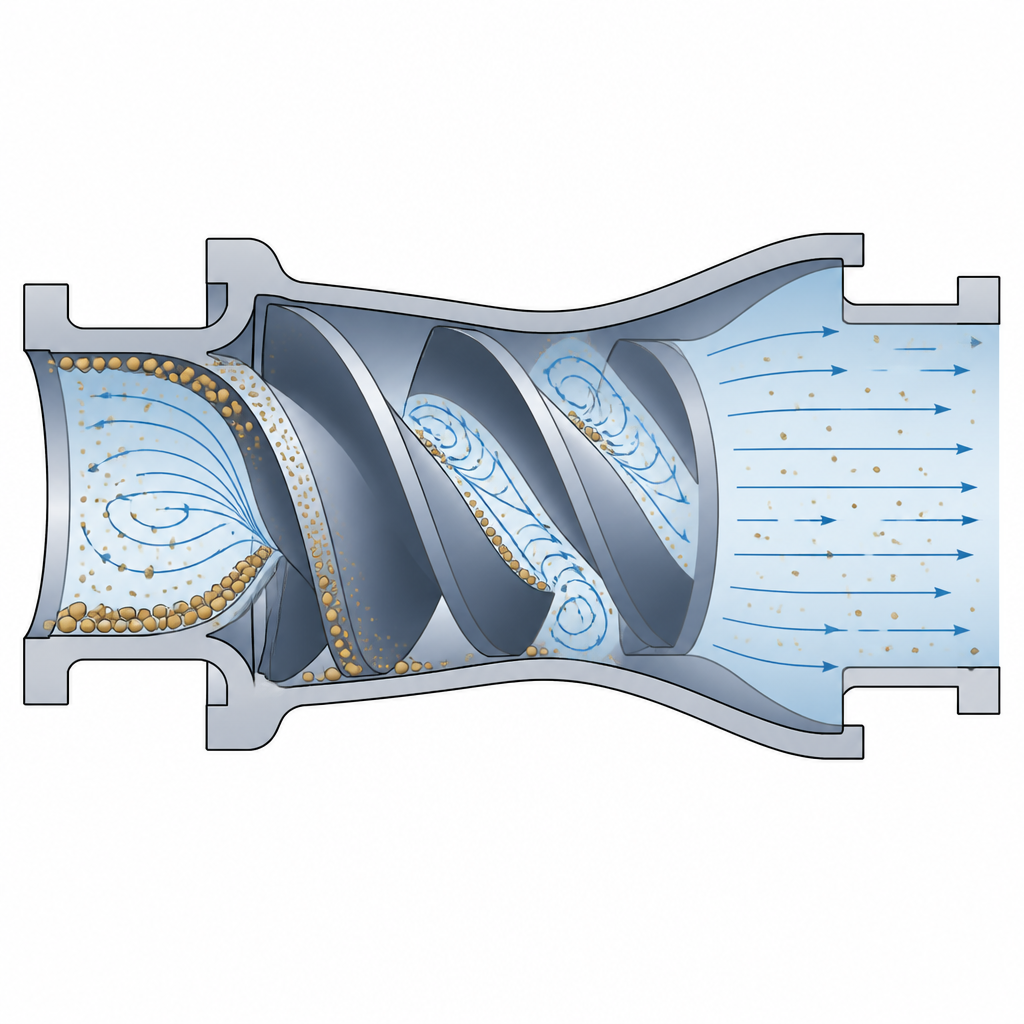
One key message is that sand grain size matters far more than grain shape or overall concentration for how particles move. Very small grains tend to follow the liquid streamlines and mostly end up toward the pump outlet. Large grains, up to 5 millimeters, are more stubborn: their heavier inertia makes them peel away from the flow, collect near the impeller inlet and blade surfaces, and dive into slow-moving corners. Mid-sized grains around 2.5 millimeters carry the strongest sideways push, or radial momentum, giving them the greatest tendency to move between the inner hub and outer tip. Higher sand concentration mainly raises the overall loading wherever sand is already present, especially in the diffuser, increasing the amount of material that can erode metal without strongly changing the paths that particles take.
How operating the pump changes sand motion
The way the pump is run also reshapes where sand goes. Raising the flow rate and rotational speed boosts the liquid’s kinetic energy, which sharpens fluctuations in how particles move sideways inside the impeller. High flow generally helps sweep sand through, lowering the average sand content trapped inside. In contrast, running at low speed lets more sand linger and build up at the impeller inlet, diffuser inlet, and diffuser outlet, conditions that raise the risk of clogging and wear. Another important factor is oil content. More oil in the mixture makes it thicker and more “sticky,” which strengthens the drag on sand grains. As the oil fraction rises, vortices weaken, and sand paths align more closely with the liquid, making it easier for particles to be carried out of the pump instead of settling in recirculation zones.
Patterns of force and buildup inside the pump
By tracking how particle speed and direction differ from the surrounding fluid, the study reveals when sand is gaining energy from the flow and when it is giving energy back. Inside the impeller, both radial and axial pushes on the grains fluctuate strongly, while in the downstream diffuser they almost fade away, leaving the particles mainly to coast toward the outlet. The analysis shows that small grains tend to accumulate at the outlet, large grains at the inlet, and higher inlet sand content strengthens buildup particularly in the diffuser region. Spherical grains travel more smoothly and produce lower mass concentration in the passages than rougher, non-spherical ones. Flow conditions that increase oil content or keep the pump close to its design flow reduce internal deposits, while high speeds call for careful anti-wear materials on blades and casings.
What this means for real oilfields
For engineers and operators, the work offers a practical map of where sand is likely to concentrate and under which conditions. It shows that choosing operating points near the design flow, avoiding very low speeds, and making use of higher oil content can all help pumps move sand-laden mixtures more safely. At the same time, designers can reinforce the most vulnerable spots, such as the impeller inlet, blade tips, and diffuser passages, with better shapes or protective coatings. In simple terms, by understanding how grains of sand dance through a helical-blade pump, the study points the way toward longer-lasting equipment and more reliable transport of gritty crude oil.
Citation: Zhao, X., Shi, G., Cui, Z. et al. Study of sand particle motion characteristics and distribution patterns in a helical-blade multiphase pump. Sci Rep 16, 15856 (2026). https://doi.org/10.1038/s41598-026-45521-1
Keywords: multiphase pump, sand transport, helical impeller, oilfield flow, particle erosion