Clear Sky Science · en
High gain and slant dual-polarized antenna for private 5G railway base stations
Smarter signals for busy train lines
Modern trains are becoming rolling data centers, streaming video, monitoring equipment, and talking constantly to the trackside network. To keep all this digital traffic flowing safely and smoothly, tomorrow’s railways need wireless links that stay strong whether a train is in open countryside, a tunnel, or a crowded station. This study presents a new type of antenna for private 5G railway base stations that is designed specifically to keep those links fast, stable, and less prone to interference.
Why railway 5G needs special antennas
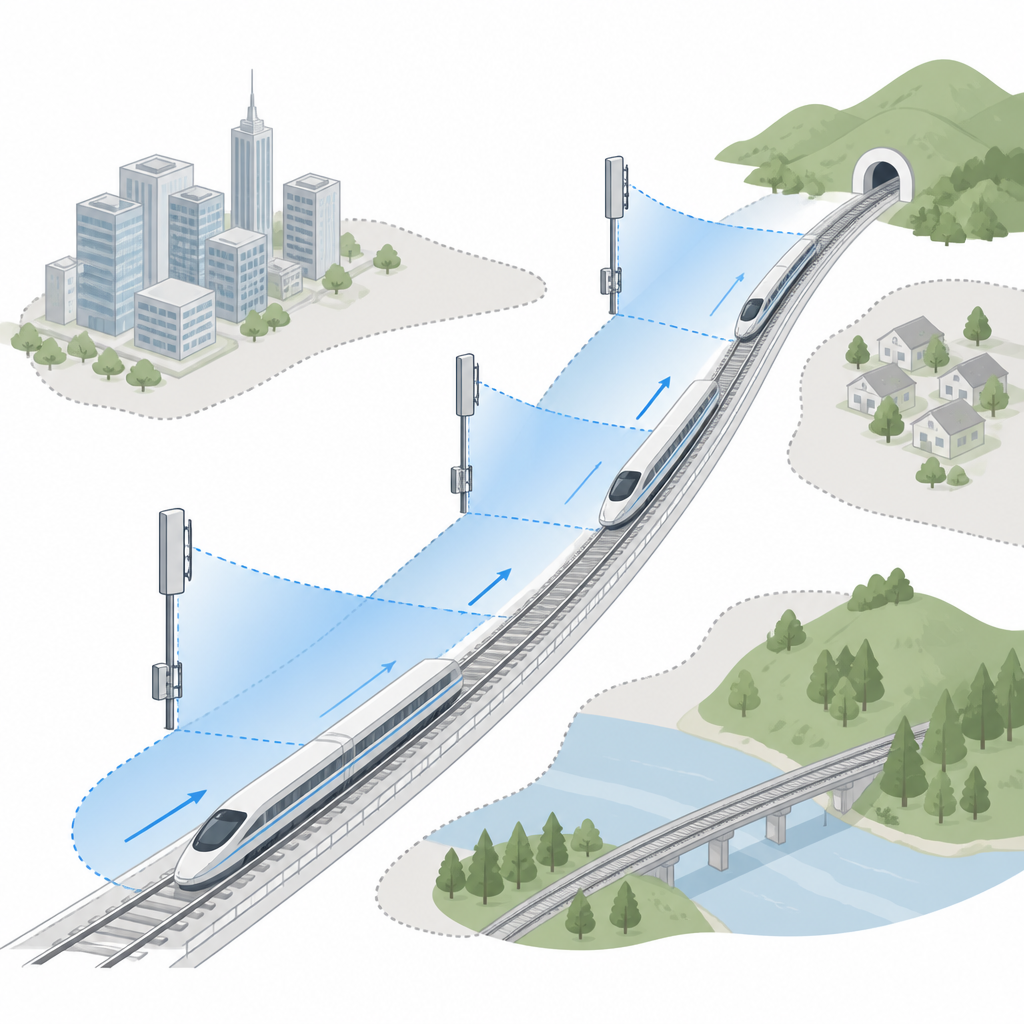
Unlike ordinary mobile phone networks, railway systems must serve trains that move very fast through many kinds of surroundings. Along most tracks the radio path between train and base station is clear, but in cities, stations, and hilly regions buildings and other obstacles bend and bounce the signals. This twisting changes the orientation of the radio waves, known as polarization, which can cause signal loss if the antenna is only sensitive in one direction. At the same time, using higher 5G frequencies brings more data but also stronger signal loss through the air, so each base station must focus its power more effectively along the track while avoiding interference with nearby public 5G services.
Shaping the beam along the tracks
Conventional railway antennas often use very narrow “pencil” beams that work well when the train is exactly where the designer expected, but their performance drops sharply if the path is blocked or the train is slightly off to the side. The authors instead aim for a “fan” shaped beam that is narrow along the track but tall in the vertical direction. This shape keeps power concentrated where the trains are, reduces radiation toward unwanted areas, and still tolerates some bouncing and shifting of the signal in complex station or urban layouts. The new design targets a beam only about six degrees wide horizontally but around forty degrees tall vertically, a combination that provides both reach and robustness.
How the compact antenna panel works
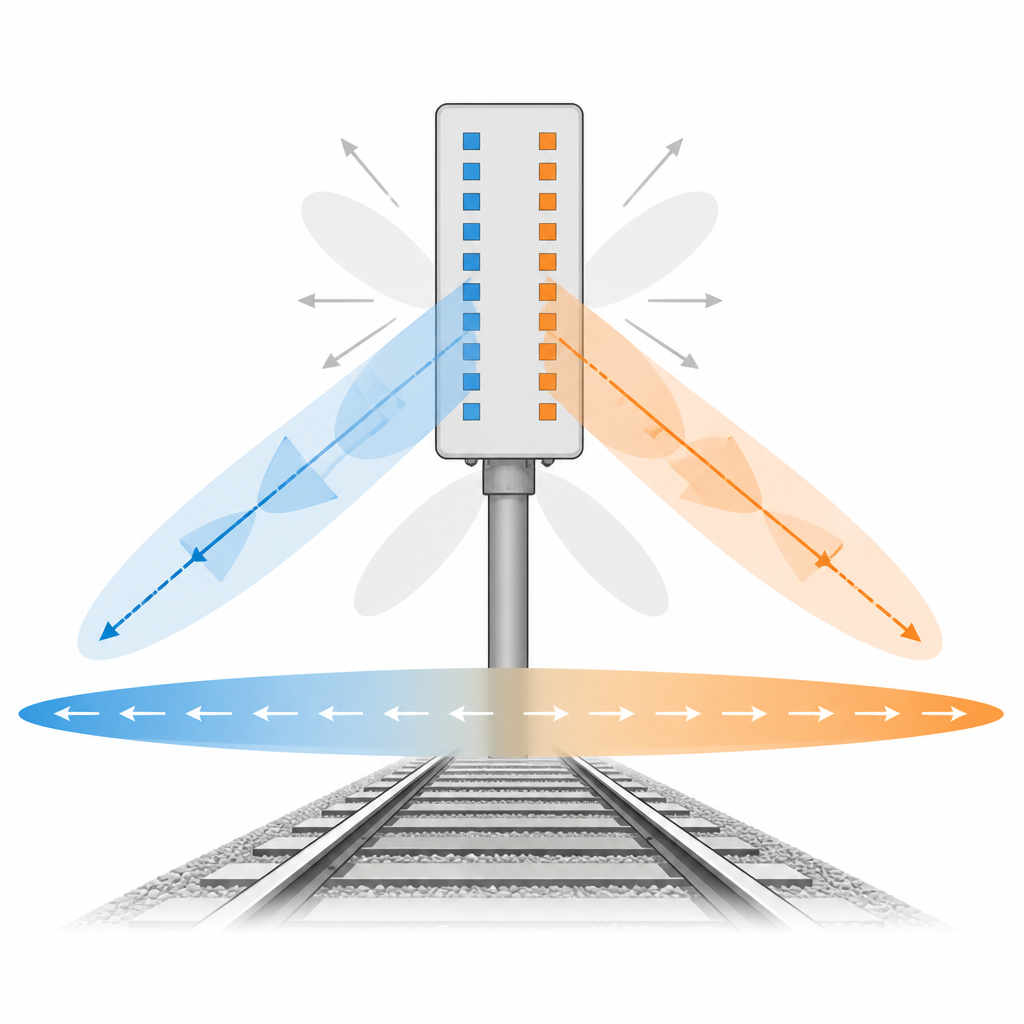
To achieve this beam shape, the researchers start from a flat metal patch antenna and carefully rework its internal patterns. By operating it in a higher resonant mode and carving central and side slots into the patch, they create several closely spaced “virtual” radiating regions that add together to produce higher gain while holding down unwanted side lobes. They then arrange two such structures at right angles and rotate the whole pattern by 45 degrees so the panel is sensitive to two slant polarizations. This slant dual polarization helps the base station keep listening even when obstacles have twisted the signal’s orientation. Despite these internal refinements, the single element remains relatively thin and compact while delivering about 12.8 dBi of gain, which is high for its size.
Building a track-following antenna array
The team next lines up six of these elements in a row to form a long, slim array panel. Because each element already produces a focused beam, they can space the elements farther apart than in typical arrays without suffering from confusing extra beams in unwanted directions. This wide spacing keeps the overall panel only about half a meter long while still sharpening the horizontal beam down to around six degrees. A specially designed six-way power splitter ensures that each element receives nearly identical signal strength and phase on both polarizations, so the combined beam remains clean and stable across the private 5G band around 4.7 GHz. Measurements in an anechoic chamber closely match computer simulations, confirming the real-world behavior of the design.
Balanced performance for real tracks
The authors compare their antenna with earlier dual-polarized designs using a simple score that combines gain, bandwidth, and physical size. Their panel achieves the best balance, offering strong signal focus, enough frequency range to cover the private 5G railway band, and a compact footprint suited to trackside installations. For passengers and operators, this translates into more reliable high speed data links, better coverage in tricky spots, and less chance of interference with nearby networks. In short, the work shows that carefully shaping both the beam and the polarization can give next generation railway 5G systems a sturdier and more efficient wireless backbone.
Citation: Lee, JG., Han, Y. & Ahn, B.K. High gain and slant dual-polarized antenna for private 5G railway base stations. Sci Rep 16, 15102 (2026). https://doi.org/10.1038/s41598-026-45487-0
Keywords: 5G railway, dual polarized antenna, fan beam array, base station design, wireless coverage