Clear Sky Science · en
An interpretable Convex Stacking with Guarded Calibration ensemble approach for predicting rock fragmentation in mine blasting
Why breaking rocks the right way matters
When mines blast solid rock to free up ore, they don’t just care that the rock breaks—they care how it breaks. If the fragments are too big, crushing and hauling become slow and expensive. If they’re too fine, energy is wasted and processing can suffer. This article presents a new data-driven method to predict the typical fragment size after blasting, aiming to help mines tune their explosions so that broken rock is "just right," saving energy, time, and money.
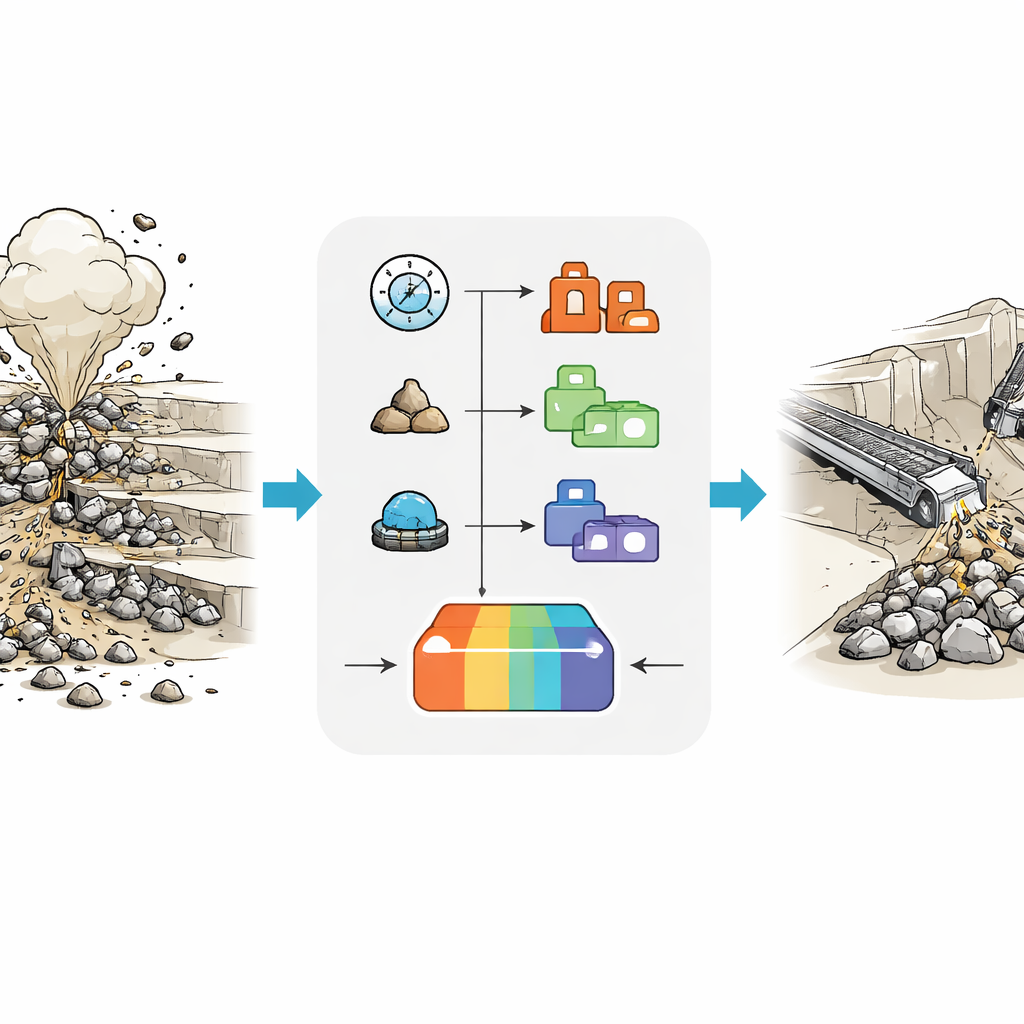
The challenge of guessing blast outcomes
Predicting how rock will shatter is difficult because many factors interact at once. The natural properties of the rock, the way blast holes are laid out, how high the bench is, how much explosive is packed, and how the holes are plugged all influence the final fragment size. Traditional formulas, developed decades ago, capture only part of this complexity and often need to be re‑tuned for each mine. Modern machine‑learning models can handle more variables and subtle patterns, but they can be "black boxes" and may struggle when only a small amount of data is available, which is common in real mining operations.
A blended model that plays it safe
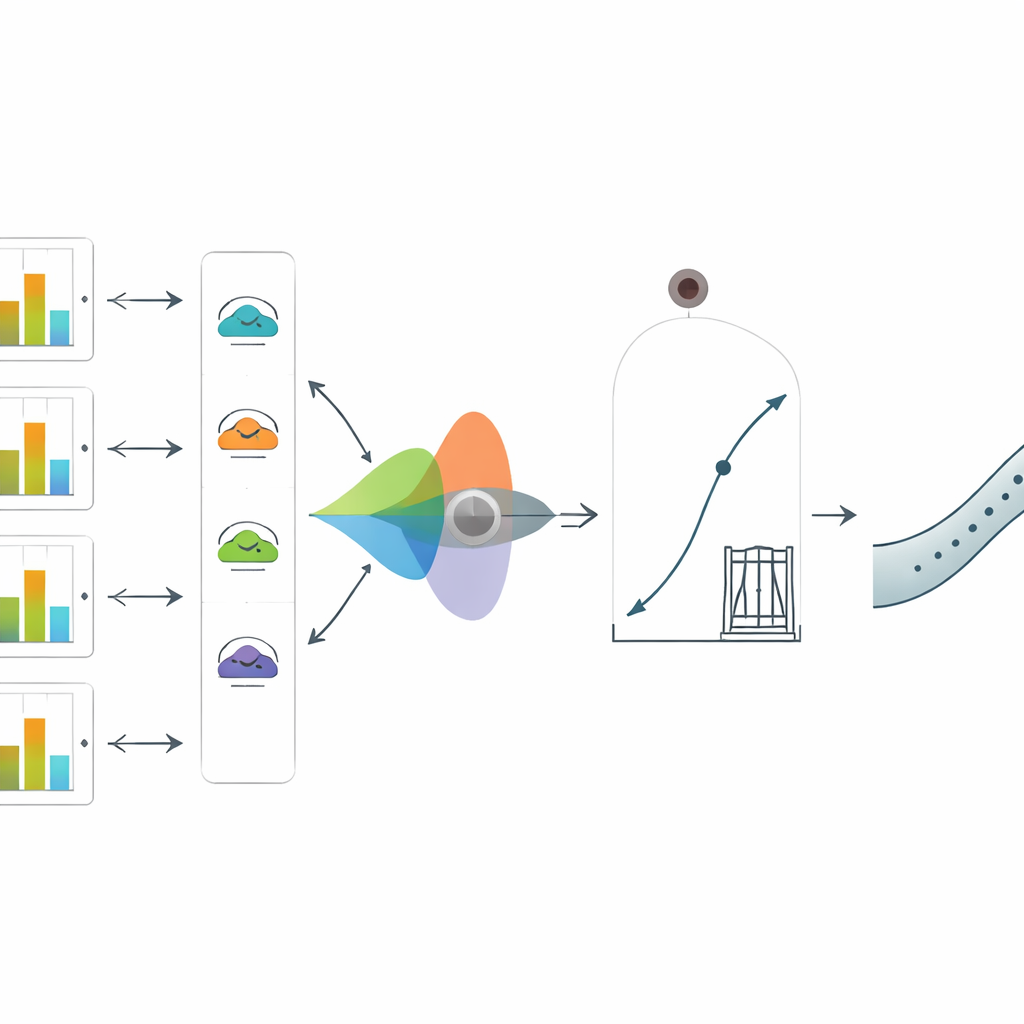
The authors introduce a new ensemble approach called Convex Stacking with Guarded Calibration (CSGC). Instead of relying on a single predictive model, CSGC combines six different machine‑learning methods, each with its own strengths in handling patterns and noise. These models are first trained and tested in carefully rotated subsets of the data so that their performance is judged fairly. The best performers are then given non‑negative weights that must add up to one, ensuring that the final prediction is a balanced blend rather than being dominated by any unstable outlier. A further step gently pulls the blended result toward the single strongest model, reducing the risk of overfitting to quirks in the training data.
Guard rails for better and more honest predictions
CSGC does more than simply average model outputs. After blending, the method checks for systematic offsets between predicted and observed fragment sizes and applies a simple correction. It then tries a special smoothing step that forces predictions to change in a more orderly way across the range of values. Crucially, this extra calibration is only kept if it improves performance when tested on data held back during training; if it does not help, it is switched off. This "guarded" design is meant to avoid the common pitfall in advanced models where added complexity appears to help on past data but fails on new blasts.
What the data say about blasting controls
The study uses 91 blast records from eight open‑pit mines in several countries, covering rock types from soft to quite stiff. Seven design and rock properties are fed into the model, and the average fragment size measured from images is the output. With this relatively small but varied dataset, CSGC achieves higher accuracy and lower error than any single model tested, including a strong gradient boosting method. To make the results understandable to engineers, the authors apply two explanation tools that show how each input factor nudges the prediction up or down. Across the sampled conditions, rock stiffness, the ratio of stemming length to burden, and the ratio of bench height to burden emerge as the main levers controlling fragment size, while some layout ratios contribute little within the current ranges.
How rock stiffness and design work together
The interpretability tools also reveal that rock stiffness does not have a simple, one‑directional effect. In softer rock, the model often finds that details of the blast design—especially how the top of the hole is plugged—can outweigh the natural tendency of the rock to break finely. In medium‑stiff rock, stiffness tends to push predicted fragment sizes downward, while in very stiff rock it again drives them upward, favoring coarser fragments unless countered by careful geometric choices. These shifting patterns suggest that there is no single "best" design rule; instead, effective blasting depends on matching hole layout and charge details to the mechanical character of the rock mass.
What this means for everyday mining
For a general reader, the key message is that smarter prediction can turn blasting from an art into a more precise science. By blending multiple models and building in safeguards against overconfidence, CSGC offers a way to forecast average rock fragment size more reliably from limited field data, while still showing engineers which parameters matter most and how they interact. Although the current study is based on a modest number of blasts and does not yet guarantee success at completely new mines, it demonstrates a promising path toward data‑assisted blast design that could cut energy use, reduce wear on equipment, and make mining operations more efficient and predictable.
Citation: Lin, C., Sun, X., Mai, J. et al. An interpretable Convex Stacking with Guarded Calibration ensemble approach for predicting rock fragmentation in mine blasting. Sci Rep 16, 10656 (2026). https://doi.org/10.1038/s41598-026-45479-0
Keywords: rock blasting, fragment size prediction, ensemble machine learning, mine optimization, model interpretability