Clear Sky Science · en
Leveraging butterfly meta material structures in a symmetric stub-loaded microstrip MIMO antenna for advanced biomedical and security applications
Smarter scans for health and safety
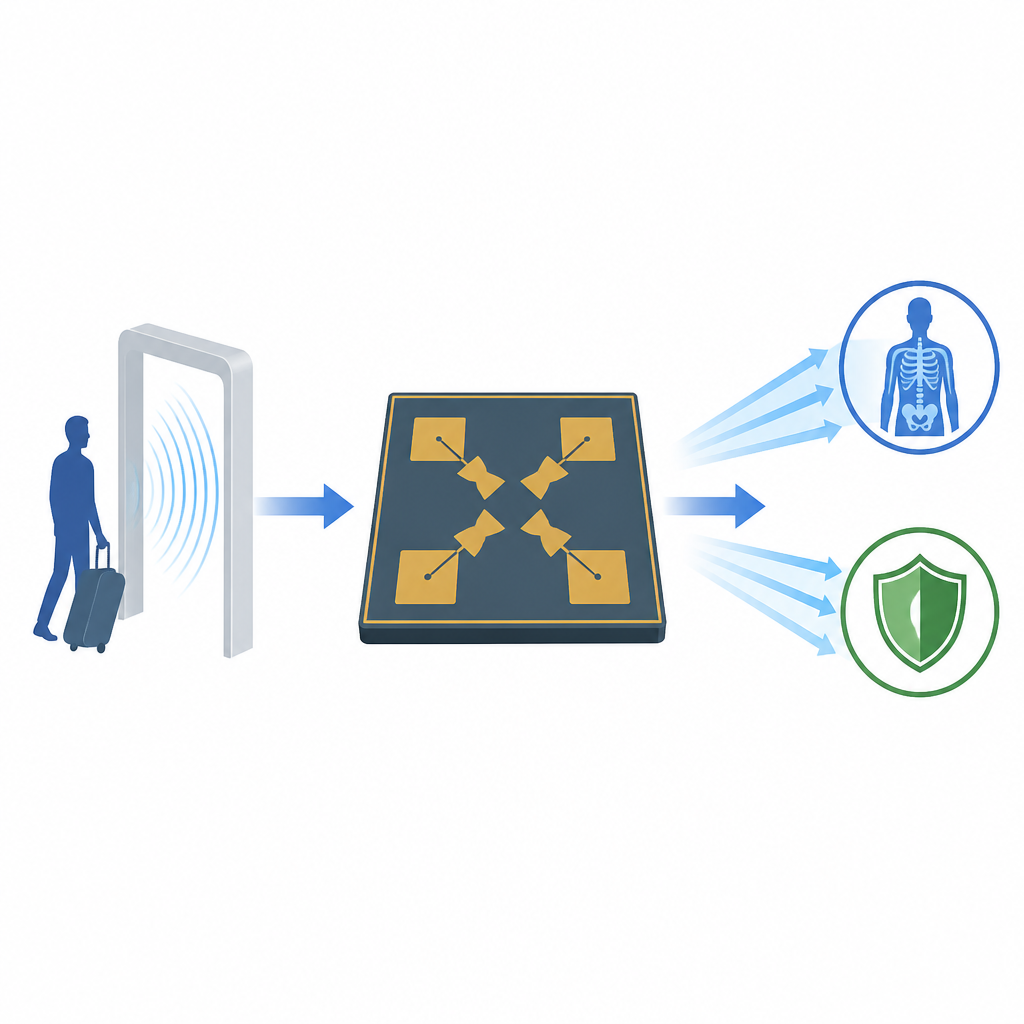
Hospitals and airports increasingly look to terahertz waves for seeing beneath clothing or skin without using X rays. Yet building tiny antennas that can send and receive these ultra high frequency signals clearly, safely, and over more than one channel is a major challenge. This study introduces a compact, chip scale antenna that uses a butterfly shaped internal structure to sharpen terahertz signals, making it attractive for future medical imaging and security screening devices.
Why terahertz waves matter
Terahertz radiation sits between microwaves and infrared light. It can penetrate fabrics and some biological tissues while avoiding the ionizing effects associated with X rays. That combination makes it appealing for detecting hidden objects or subtle changes in skin and tissue. However, the parts that control terahertz waves are still expensive and limited. Many existing antenna designs are bulky, hard to integrate with electronics, and offer only moderate signal strength and separation between channels. The authors aim to overcome these drawbacks with a design that is both compact and better suited to on chip integration.
Building a tiny dual band antenna
The team develops a multiple input, multiple output (MIMO) antenna that works at two terahertz frequencies, around 3.8 and 6.4 terahertz. They stack a thin layer of silicon, which has favorable electrical and thermal properties, with a conducting layer of silver shaped into small rectangular patches. These patches act like miniature transmitting and receiving plates. By carefully choosing the thickness and width of each layer, the researchers miniaturize the device to tens of micrometers while still allowing it to operate efficiently at both target frequencies. Computer simulations guide the exact dimensions so that unwanted reflections are minimized and most of the power is radiated outward.
Butterfly structures that tame interference
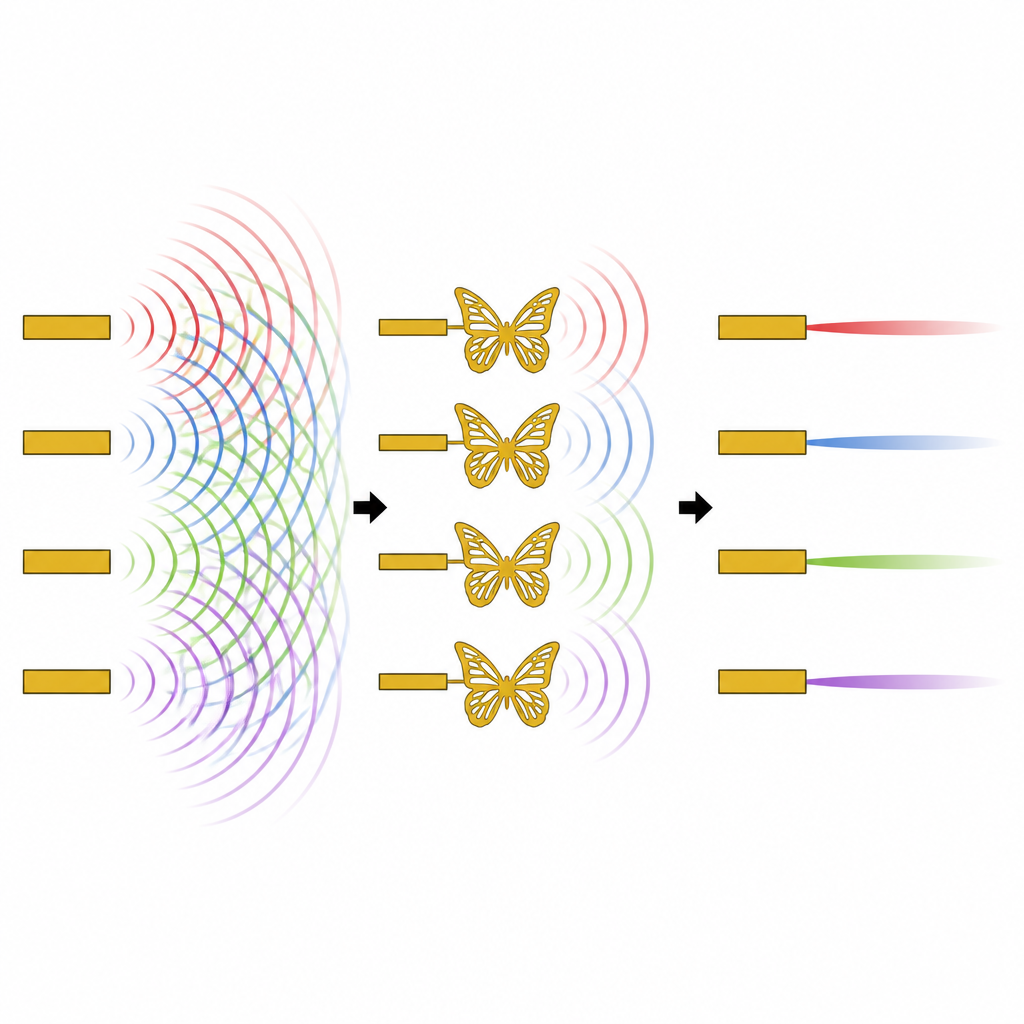
A key innovation lies in adding a special internal pattern between the antenna elements, described as a butterfly shaped metamaterial. Metamaterials are engineered arrangements of tiny structures that can bend and filter electromagnetic waves in unusual ways not found in ordinary materials. In this design, the butterfly pattern creates a kind of stop band that blocks unwanted coupling between neighboring antenna elements. As the structure is refined through several design steps, the simulated response shows deeper, cleaner resonances at the two working frequencies, stronger gain, and much better isolation between channels. This means each antenna element can carry information with less cross talk, which is crucial for reliable MIMO operation.
Testing performance on many fronts
The authors evaluate their antenna using several measures that relate directly to real world communications. The device reaches gains close to 9 decibels at both operating bands, with radiation efficiencies around or above 80 percent, indicating that little power is wasted as heat. Isolation between channels reaches roughly 40 decibels, showing that signals on one path have very little influence on another. Other metrics used in wireless engineering, such as envelope correlation, mean effective gain, and channel capacity loss, all fall in favorable ranges. Together these results suggest that the antenna can support high data rates and stable links while keeping interference and reflected power low.
What this means for future devices
From a layperson’s perspective, this work shows how a carefully sculpted, butterfly like pattern on a silicon chip can help produce cleaner terahertz signals in a very small space. The combination of dual band operation, high gain, and low interference makes the antenna a strong candidate for future wearable medical monitors, non contact imaging tools, and compact security scanners. While further testing on the body and in practical systems is still needed, the study points toward terahertz scanners and health sensors that are smaller, more efficient, and easier to integrate into everyday technology.
Citation: Vineetha, K.V., Madhav, B.T., Siva Kumar, M. et al. Leveraging butterfly meta material structures in a symmetric stub-loaded microstrip MIMO antenna for advanced biomedical and security applications. Sci Rep 16, 14977 (2026). https://doi.org/10.1038/s41598-026-45446-9
Keywords: terahertz antenna, metamaterial, MIMO, biomedical imaging, security screening