Clear Sky Science · en
Physically-based modelling for retrospective detection of archaeological proxies (cropmarks)
Hidden stories in everyday fields
Across much of the world, ordinary crop fields quietly cover traces of ancient tombs, walls, and settlements. These buried structures can subtly change how plants grow above them, creating faint patterns called cropmarks that become visible from the air or from satellites. This study shows how physics-based models and modern machine learning can work together to detect those patterns, even in old archived images, opening new ways to explore past landscapes without disturbing the ground.
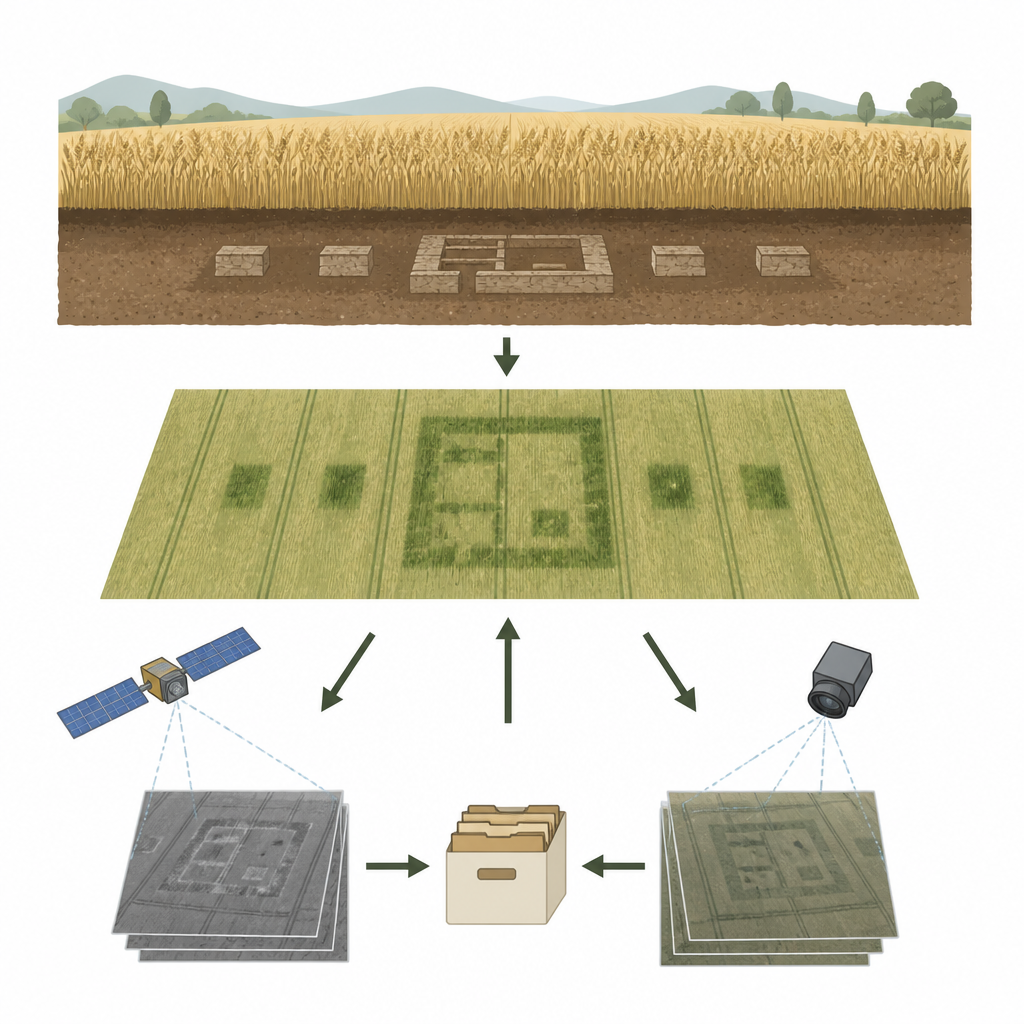
How buried remains change growing plants
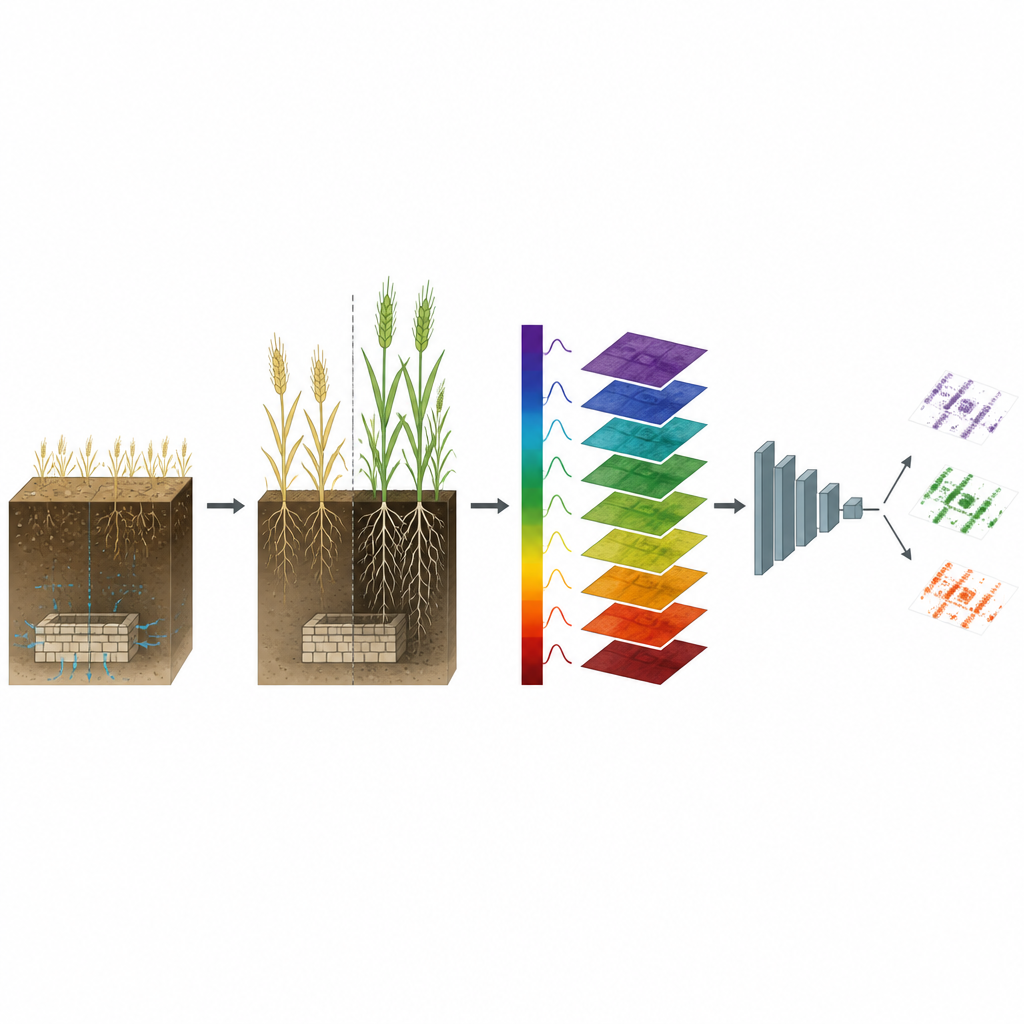
When stone structures lie just below the surface, they alter how water and nutrients move through the soil. In some places, crops become stunted and stressed; in others, they grow more vigorously, forming negative or positive cropmarks. These differences are often too subtle for the naked eye, but they change how leaves reflect sunlight in visible and near-infrared wavelengths. By measuring that reflected light, researchers can spot spectral “fingerprints” of stress that hint at what lies beneath the soil.
A test field built to mimic an ancient site
To study these signals under controlled conditions, the team used a small barley field near the village of Alampra in Cyprus. Beneath this five-by-five‑meter plot, they built structures designed to resemble ancient tombs at a shallow depth, carefully keeping the natural soil layering intact. Over two growing seasons separated by thirteen years, they collected detailed measurements of light reflected from crops above the buried features, from healthy crops nearby, and from bare soil. The newer campaign focused on the crucial winter months when crops are at peak greenness and later as they age and dry out.
Simulating plant light to create virtual data
The heart of the approach is a computer model called PROSAIL, which uses the physics of light passing through leaves and plant canopies to relate what a sensor sees to plant traits such as leaf pigments, water content, and density. The researchers first “inverted” the model: they fed it the measured spectra and asked which combinations of plant properties could explain them, while gently steering the solution toward realistic values from crop science. From these estimated properties, they built statistical descriptions of how each trait varied and how traits were linked to one another for both cropmarks and healthy plants on each observation date.
Building synthetic fields for machine learning
Using these statistical patterns, the team generated large synthetic sets of plant properties and ran PROSAIL forward to produce thousands of realistic “virtual” spectra for each crop condition and date. Each synthetic spectrum carried a known label: over buried feature or healthy area. They then trained an ensemble of different machine learning classifiers on these synthetic data, sometimes adding small amounts of noise to better mimic real sensors. The key test was retrospective: models built from the 2025 campaign were asked to identify cropmark signatures in the 2012 measurements, effectively simulating how such tools might mine old aerial or satellite records.
What the models revealed about timing and reliability
The retrospective tests showed that the method can correctly classify more than 90 percent of past signatures under favorable conditions. The models worked best when crops were in their peak greenness phase, when the canopy is dense and leaf properties are relatively uniform. During this period, even simple, nearly linear classifiers performed well, and adding noise made the models slightly more robust. As the season moved into senescence and plants became more uneven in color and structure, predictions grew less stable and more sensitive to how much synthetic data were used for training. Nonetheless, the synthetic spectra stayed close to the real ones, and machine learning models could still find useful patterns, especially when carefully tuned.
Why this matters for exploring the past
This research demonstrates a reproducible pipeline that starts from physical models of how plants interact with light, uses those models to construct synthetic training data, and then applies machine learning to detect subtle traces of past human activity. For a non-specialist, the key idea is that we can now use our understanding of plant physics to “teach” computers what buried remains should look like in spectral terms, and then send those trained detectors back in time to search through archived images. While the current work is based on a single test plot and needs expansion to different crops, soils, and climates, it offers a path toward systematically scanning aerial and satellite archives for long-faded cropmarks, helping archaeologists rediscover hidden sites that today’s landscape may no longer reveal.
Citation: Gravanis, E., Agapiou, A. Physically-based modelling for retrospective detection of archaeological proxies (cropmarks). Sci Rep 16, 15089 (2026). https://doi.org/10.1038/s41598-026-45441-0
Keywords: cropmarks, archaeological prospection, remote sensing, synthetic data, machine learning