Clear Sky Science · en
Telomere shortening in workers occupationally exposed to a wide range of mostly low benzene levels: a multicenter study
Why this research matters for everyday life
Most of us will never work in a chemical plant, yet we all encounter benzene, a common industrial solvent and air pollutant. This study explores whether even low levels of benzene at work can speed up biological aging by shortening telomeres, the protective caps on our chromosomes. Understanding this link helps us gauge how safe our workplaces and cities really are, and whether current exposure limits truly protect long term health.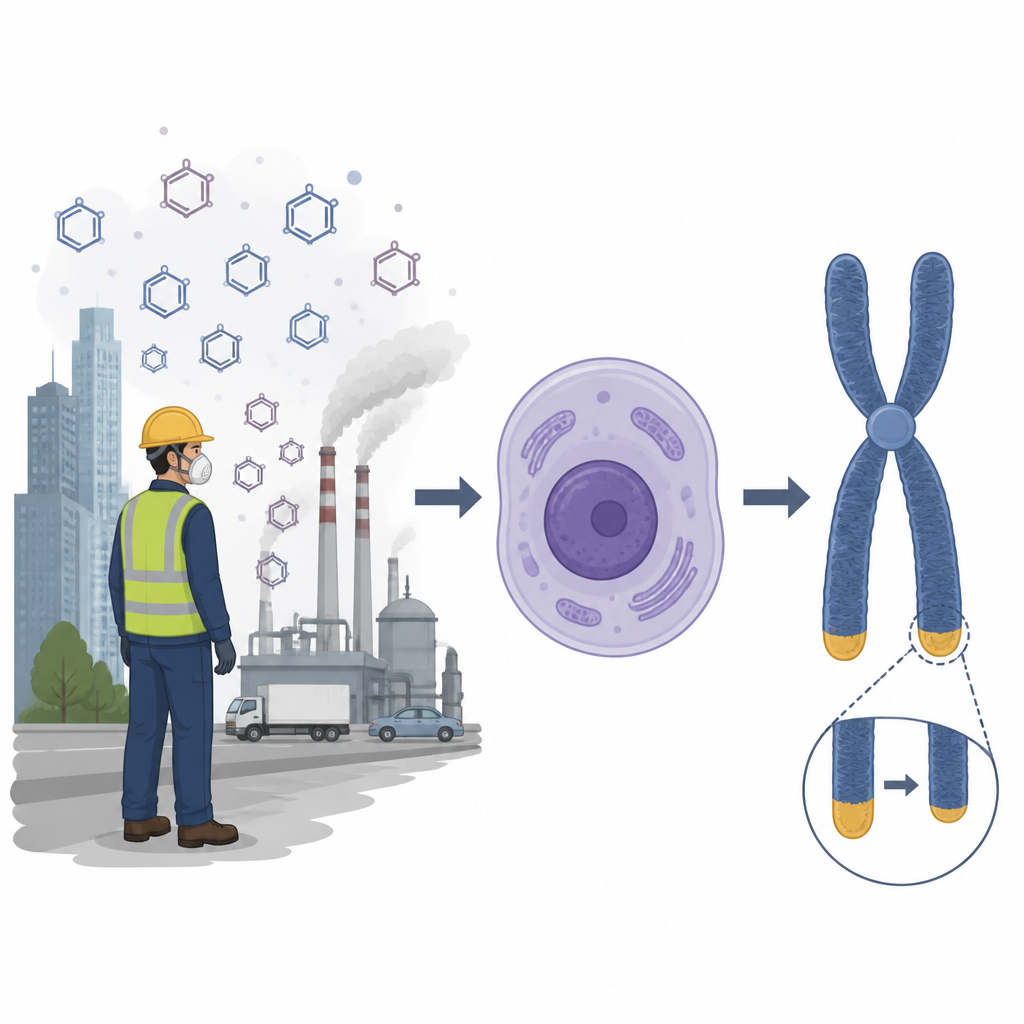
Protective caps at the ends of our DNA
Telomeres are like tiny plastic tips on shoelaces, but on our chromosomes. Each time a cell divides, telomeres get a little shorter, and over a lifetime this slow erosion is tied to aging, heart disease, and cancer. When telomeres become critically short, cells stop dividing properly or die, which can lead to tissue damage and genetic instability. Because of this, telomere length is often used as a marker of biological age, which may differ from the age on our birth certificate.
A closer look at workers and their exposure
The researchers combined data from 613 adults in three Italian cities and one Bulgarian city, including 423 workers who routinely encountered benzene on the job and 190 comparison participants with no such tasks. Jobs ranged from bus drivers and traffic police officers to gas station attendants and petrochemical workers. Everyone answered the same lifestyle questionnaire and wore sampling devices near their breathing zone for most of a work shift. These devices measured personal benzene exposure in the air, and in a subgroup, the team also measured benzene in urine as a biological marker of how much entered the body.
Measuring the body’s wear and tear
Blood samples taken at the start of the work shift were used to measure telomere length in white blood cells. The team applied a sensitive DNA test that compares the amount of telomere DNA with a single reference gene, giving a relative telomere length value for each person. They then used statistical models that accounted for age, sex, smoking, number of cigarettes per day, alcohol use, and differences among cities. This careful adjustment helped isolate the role of benzene from other factors known to affect telomeres, such as aging and tobacco.
What the data revealed about benzene and aging
Across the full range of exposures, from very low to moderate, higher benzene levels were linked to shorter telomeres. For every tenfold rise in benzene in the air, telomere length dropped by about 7 percent, and the pattern was even stronger among people who never smoked. When the researchers focused on the subgroup with urine measurements, they again saw that higher internal benzene levels went hand in hand with shorter telomeres. These consistent findings held up even after allowing for toluene, another solvent measured in part of the group, suggesting that benzene itself plays an important role.
Limits, open questions, and what comes next
The study has some caveats. It captured benzene exposure on only one workday and did not include details on diet, exercise, or other pollutants such as polycyclic aromatic hydrocarbons, ethylbenzene, and xylene, all of which could also influence telomeres. In one city with relatively few participants, patterns were less clear, and in Milan traffic police showed shorter telomeres than gas station workers despite lower benzene readings, hinting that traffic air pollution and job stress may add to the burden. Finally, because this was a cross sectional snapshot, it cannot show how fast telomeres changed over time.
What this means for workers’ health
Taken together, the results suggest that even mostly low workplace benzene levels can be associated with telomere shortening, a sign of accelerated biological aging. For a lay reader, the key message is that “low” does not necessarily mean harmless when exposure is repeated day after day. The findings support tighter monitoring and control of benzene in occupational settings, and they highlight telomere length as a useful early warning signal that the body’s cells may be feeling the wear of our environment long before disease appears.
Citation: Antonangeli, L.M., Ferrari, L., Pesatori, A.C. et al. Telomere shortening in workers occupationally exposed to a wide range of mostly low benzene levels: a multicenter study. Sci Rep 16, 14870 (2026). https://doi.org/10.1038/s41598-026-45427-y
Keywords: benzene exposure, telomere length, occupational health, biological aging, air pollution