Clear Sky Science · en
Performance evaluation of superplasticizers in one part geopolymer mortar
Cleaner buildings for a warming planet
Concrete is the backbone of modern cities, but the cement that binds it together comes with a heavy climate cost. This study explores a new kind of low‑carbon “just‑add‑water” powder that could replace ordinary cement in many uses. By tweaking the recipe with special flow‑enhancing powders, the researchers show it is possible to make a greener binder that is easier to handle on site, strong enough for structural work, and cheaper than today’s standard cement.
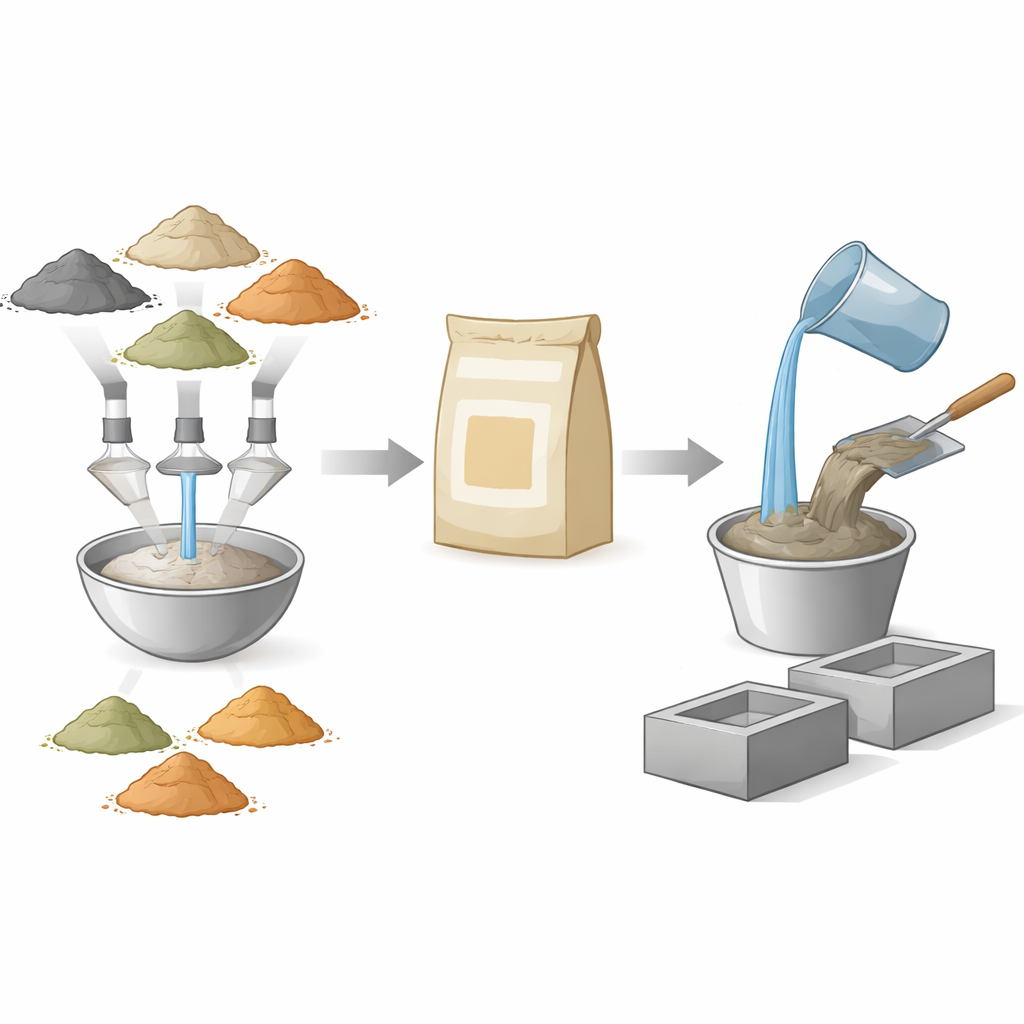
From factory waste to building blocks
Instead of relying on freshly burned limestone, the team builds its binder from industrial leftovers: ground granulated blast furnace slag from steelmaking, along with naturally occurring diatomite and feldspar. These powders are activated with solid sodium salts so that, when water is added, they form a hard stone‑like network known as a geopolymer. Crucially, all ingredients are dry mixed at the factory. On site, workers only need to add water, much like mixing a bag of conventional dry mortar. This “one‑part” approach avoids handling harsh liquid chemicals, simplifies logistics, and better suits large or remote projects.
Making a stiff mix flow like fresh batter
One major obstacle for geopolymers is that they are often thick and hard to place. To tackle this, the researchers tested two powdered superplasticizers—chemical helpers widely used to make concrete more fluid without adding extra water. One, based on sulfonated naphthalene formaldehyde (SNF), and the other, a more modern polycarboxylate ether (PCE), were blended into the dry binder at doses between 0.5% and 2.5% of the powder. They then measured how easily the fresh mortar spread on a flow table and how long it took to stiffen. With just 1% SNF, the mix spread almost three times farther than the version without additives, reaching flow similar to ordinary Portland cement mortar, while only slightly delaying setting time.
Strength and toughness that rival ordinary cement
The team cast small blocks and beams to test compressive, bending, and splitting strengths over 7 and 28 days, and used non‑destructive tools such as ultrasound pulses and rebound hammers to probe internal quality. The stand‑out performer was again the mix with 1% SNF: its 28‑day compressive strength reached about 54 megapascals, roughly 15% higher than the same geopolymer without additives and clearly above the 43‑megapascal benchmark for a common structural cement grade. Flexural and tensile strengths also rose slightly, and ultrasound measurements showed a denser, more uniform interior. At higher SNF contents, strength began to drop, suggesting that beyond an optimum dosage, over‑dispersion creates extra pores and microcracks. In stark contrast, all mixes containing PCE lost strength—up to nearly half at the highest dose—and showed lower ultrasound speeds and rebound numbers, pointing to a weaker, more porous matrix.
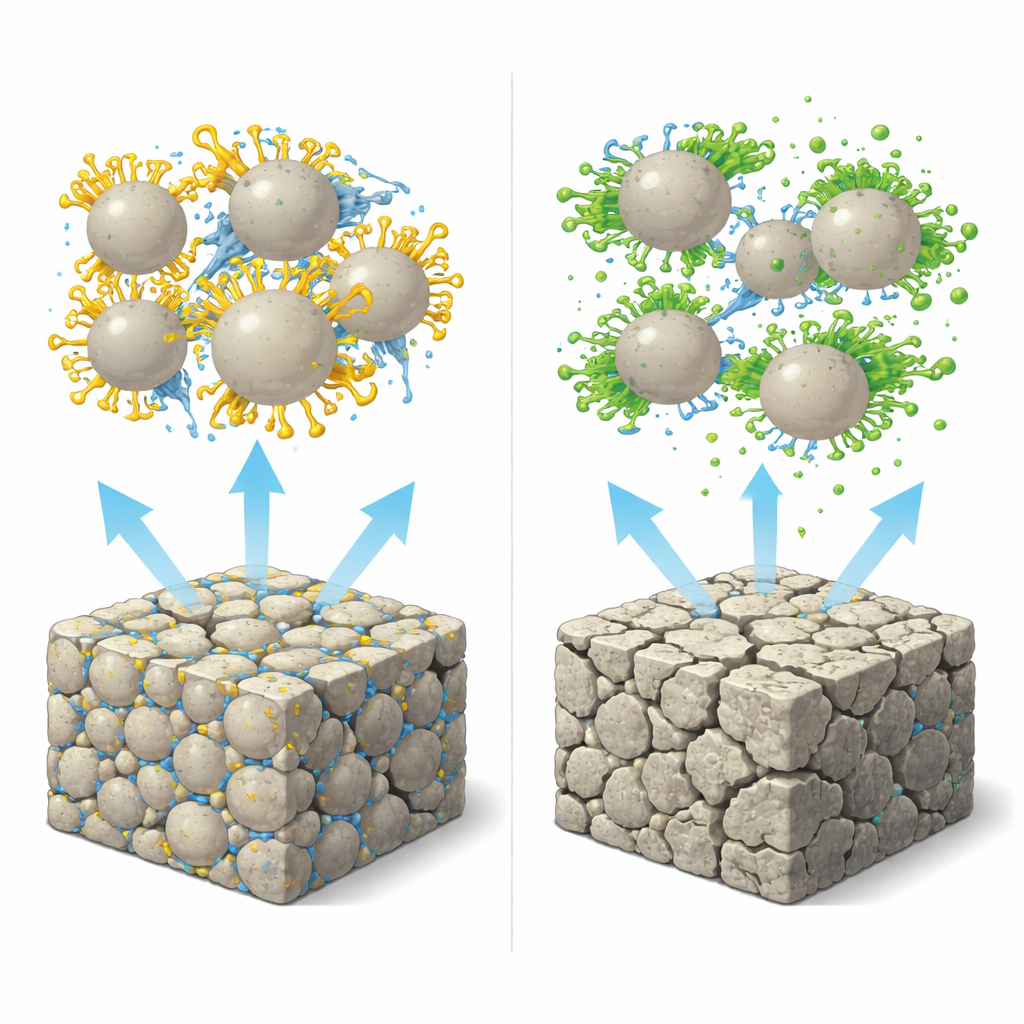
Zooming in on why one helper works and the other fails
To understand the chemistry behind these performance gaps, the researchers examined how the additives behaved in the highly alkaline geopolymer environment. Measurements of surface charge (zeta potential) and carbon content in solution showed that SNF attached strongly to the reactive particles, promoting good dispersion. Infrared spectroscopy confirmed that SNF’s key functional groups stayed intact in the caustic mix. In contrast, PCE carried a stronger negative charge that kept it from sticking to the already negative particles, and its molecular structure partly broke down in the alkaline solution. X‑ray diffraction and electron microscopy backed this up: the SNF‑modified mortars formed a continuous, gel‑rich network with relatively few voids, while PCE mixes displayed fragmented gels, unreacted grains, and many pores.
Lower costs and a path toward greener construction
Because it relies heavily on inexpensive by‑products and modest amounts of chemical activators and SNF, the optimized one‑part geopolymer binder was estimated to cost 16–25% less per kilogram than standard Portland cement, while matching or exceeding its strength. At the same time it avoids the energy‑intensive clinker kilns that drive cement’s carbon footprint. The study shows that, with the right powdered additive and careful dosing, dry‑mix geopolymers can become strong, workable, and practical enough for real‑world building sites—offering a cleaner, more affordable way to make the concrete our infrastructure depends on.
Citation: Poojalakshmi, E.S., Nagarajan, P., Sudhakumar, J. et al. Performance evaluation of superplasticizers in one part geopolymer mortar. Sci Rep 16, 10892 (2026). https://doi.org/10.1038/s41598-026-45408-1
Keywords: geopolymer cement, low carbon concrete, superplasticizer, construction materials, industrial by-products